

Two recently completed NASA-funded studies examine how solar and galactic phenomena may have shaped Earth’s climate throughout the planet’s history, revealing previously underappreciated connections between the Sun’s behavior and terrestrial conditions.
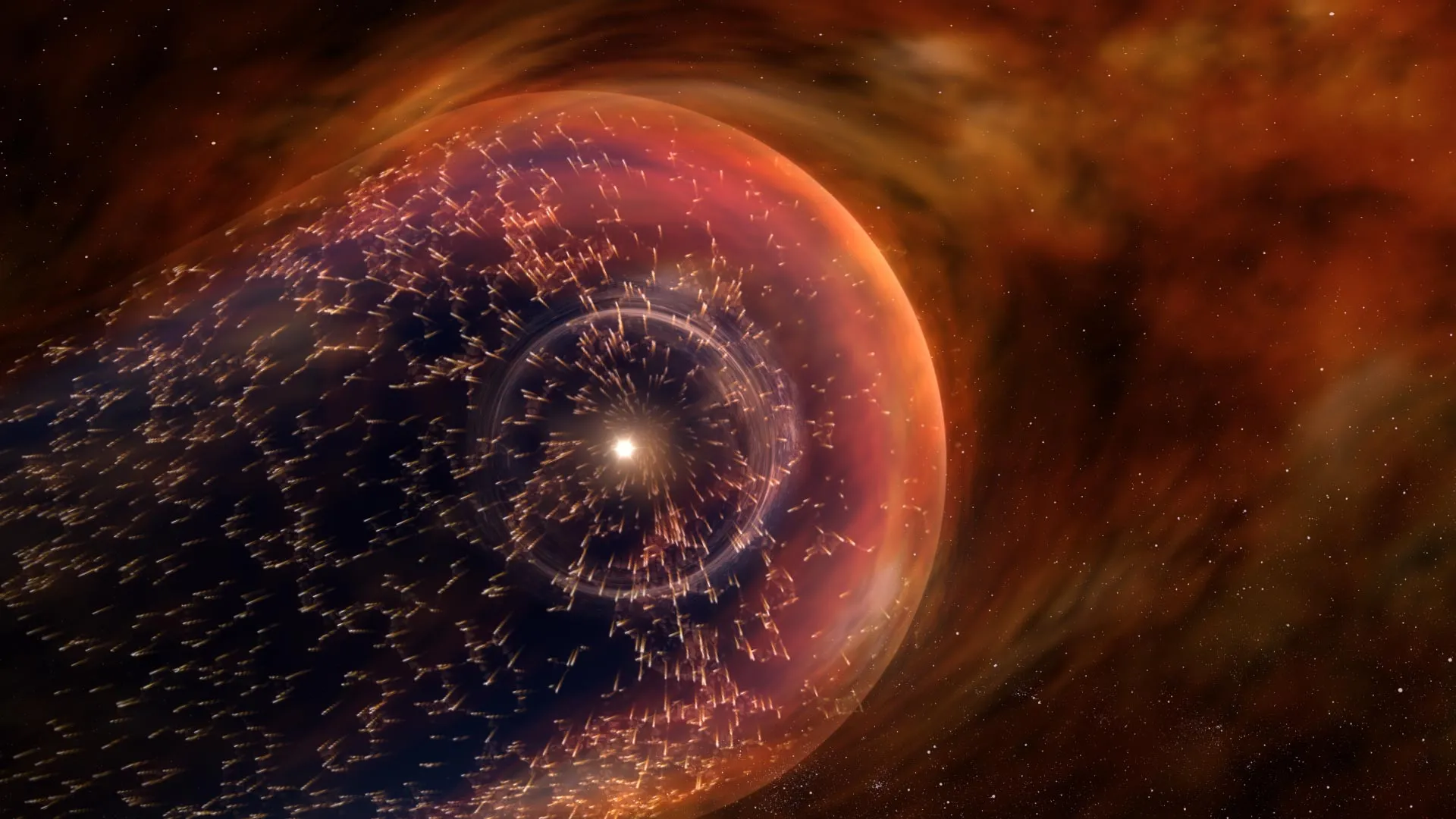
The first study, conducted by NASA’s SHIELD center at Boston University, reconstructed the heliosphere’s path through the galaxy over billions of years. The heliosphere is the region of charged particles surrounding the solar system that shields it from interstellar radiation. Using computer simulations, researchers led by Merav Opher traced the solar system’s journey and identified three major encounters with extremely dense, cold clouds of interstellar gas and dust. These encounters are estimated to have occurred 2 to 3 million years ago, 6 to 7 million years ago, and 13 to 14 million years ago. During such encounters, the simulations indicate the heliosphere may have compressed dramatically, potentially shrinking smaller than Earth’s orbital distance and temporarily exposing the planet’s atmosphere directly to the interstellar environment.
The researchers found geological evidence supporting these findings, including traces of interstellar dust detected in deep-sea sediment cores, Antarctic snow, and lunar samples corresponding to these time periods. According to the simulations, when Earth’s atmosphere was exposed to dense clouds of galactic hydrogen, atmospheric water vapor increased and upper-atmosphere conditions changed, eventually influencing surface climate. This mechanism may have contributed to some of Earth’s long-term climate patterns, including possible ice ages.
A separate investigation led by Vladimir Airapetian of NASA’s Goddard Space Flight Center addressed a long-standing astronomical mystery: how early Earth remained warm enough for liquid water when the young Sun was only 70 percent as bright as today. By examining young star systems in the Milky Way, Airapetian’s team found that young Sun-like stars produce enormous superflares daily. The researchers propose that similar activity from the young Sun could have triggered atmospheric chemical reactions that generated greenhouse gases, solving what scientists call the Faint Young Sun paradox. Laboratory experiments recreating early Earth’s atmospheric conditions are underway to test this hypothesis.
Article Attribution | Read More at Article Source
Article summary produced by Claude AI