

While most people conceive of a day as precisely 24 hours, Earth’s rotation exhibits subtle variations measured in milliseconds. Scientists have long been able to detect these fluctuations, which occur as a result of complex interactions between different layers of the planet.
For approximately three decades, researchers have documented that Earth’s liquid core does not maintain a constant rotation rate. The core can gradually accelerate over several decades before subsequently decelerating during subsequent decades. During this process, the mantle—the thick rocky layer beneath the crust spanning roughly 3,000 kilometers—responds in a compensatory manner. When the core speeds up, the mantle slows slightly, and vice versa. This exchange occurs because Earth’s total angular momentum must remain constant, even as the distribution of rotational energy shifts between layers.
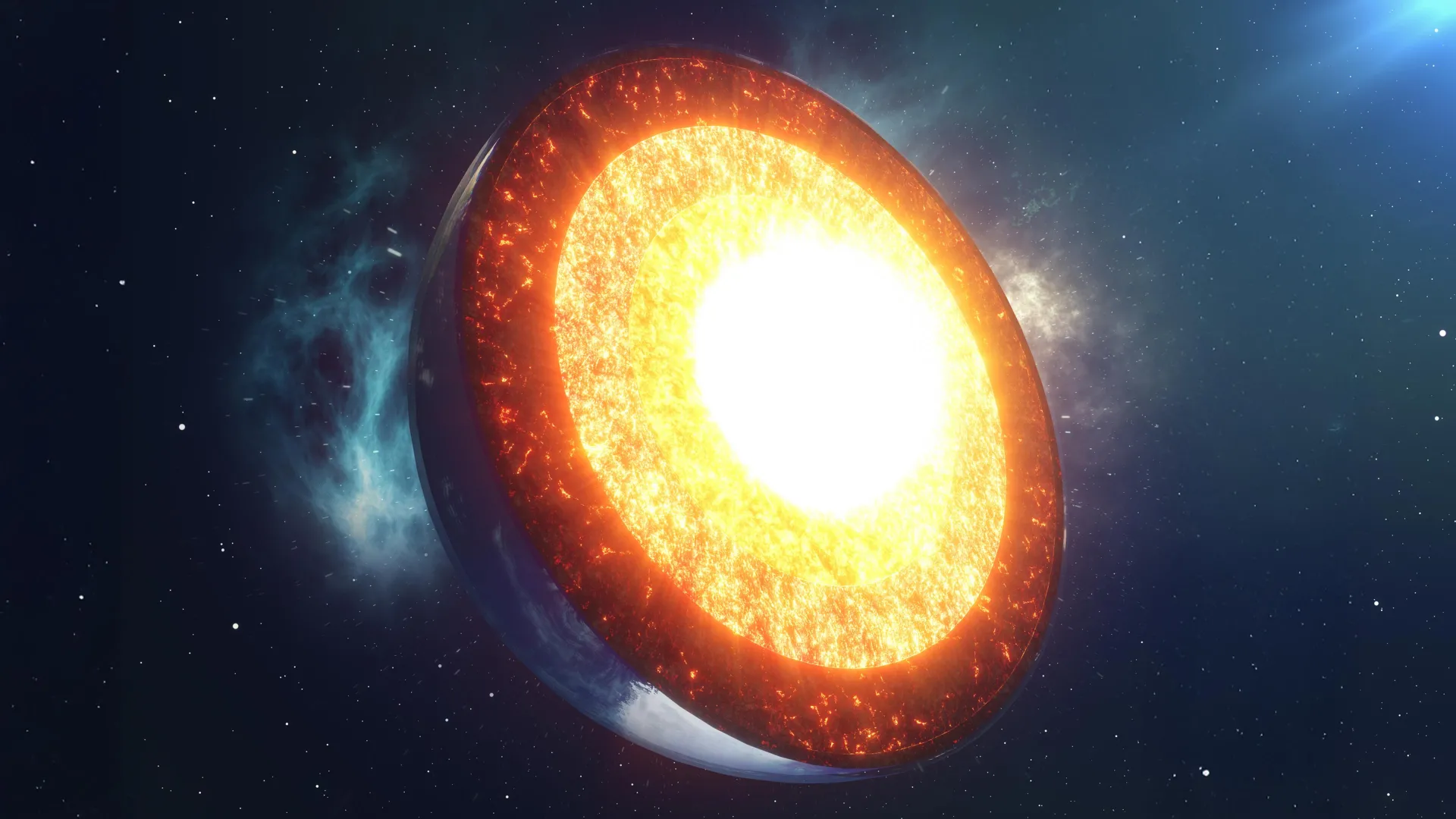
A study released Sept. 23 in Nature by University of Alberta physics PhD student Huifeng Zhang and professor Mathieu Dumberry proposes a mechanism for how this momentum transfer occurs. The researchers determined that variations in the rotational speed of Earth’s inner core—the solid region at the planet’s center—generate gravitational effects. Because the inner core lacks a perfectly spherical shape, changes in its motion can gravitationally interact with irregularly distributed mass in the mantle, subtly influencing the mantle’s rotation rate and consequently altering day length.
The gravitational interaction is balanced by competing forces at the boundary between core and mantle. Known as core mantle boundary torque, this phenomenon produces friction and electromagnetic resistance that counteracts the gravitational pull and constrains how significantly day length can fluctuate. The researchers conclude that observed variations in day length result from shifts in the equilibrium between these two competing forces.
Beyond clarifying the mechanism behind Earth’s changing day length, the findings suggest that the inner core behaves more dynamically than previously understood. Zhang and Dumberry indicate the inner core undergoes viscous deformation on approximately a 10-year cycle, implying that Earth’s deepest interior may shift shape and respond to internal forces considerably more actively than its solid composition would ordinarily suggest.
Article Attribution | Read More at Article Source
Article summary produced by Claude AI