

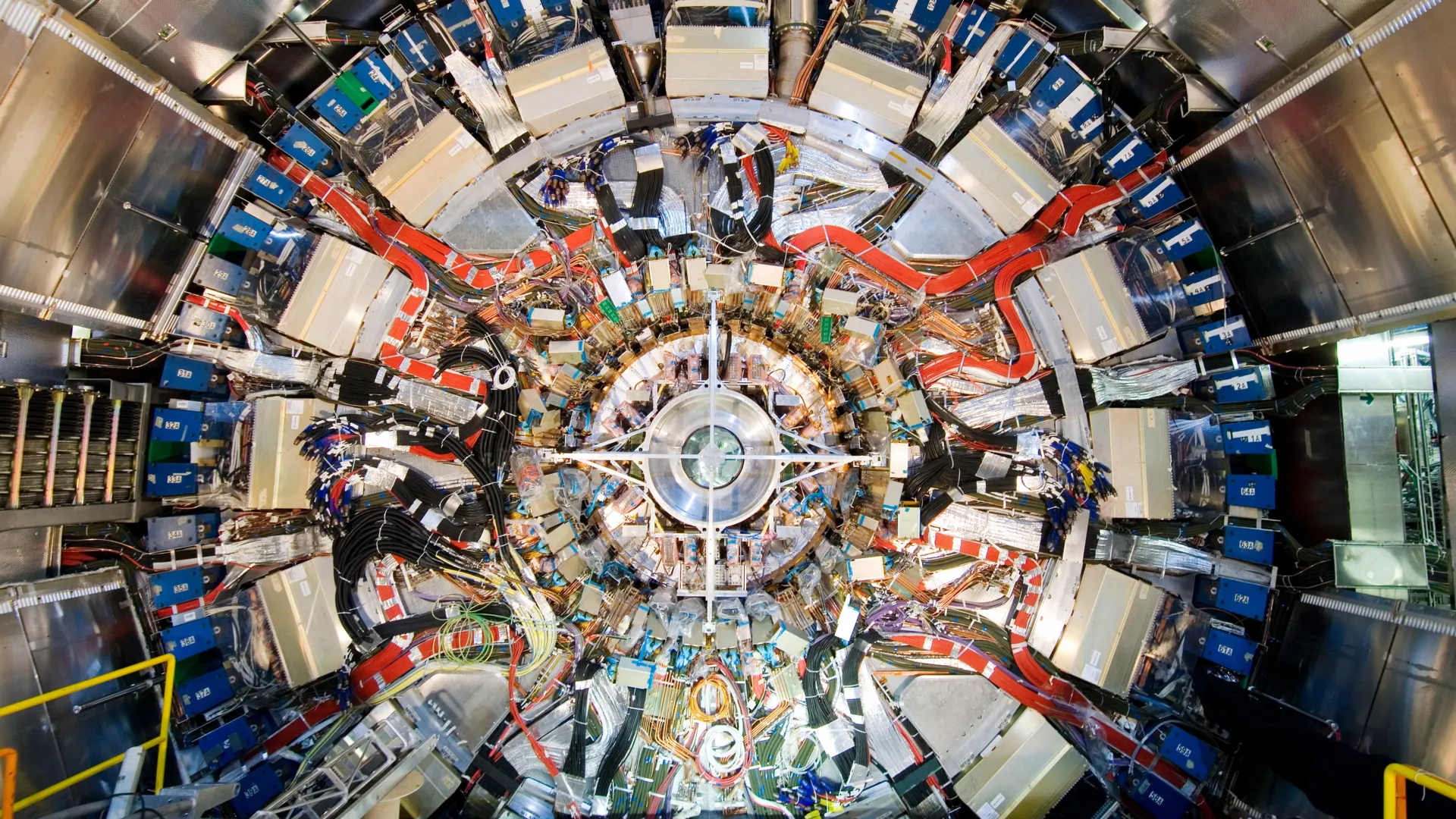
An international research team led by scientists at the University of Oxford has published findings in Physical Review Letters demonstrating that quantum entanglement can persist among some of the most massive and short-lived particles ever created. The work was conducted using CERN’s Large Hadron Collider near Geneva, Switzerland, through the ATLAS experiment.
Quantum entanglement is a phenomenon in which two particles become correlated such that measuring properties of one particle provides information about the other, regardless of separation. Albert Einstein famously characterized this phenomenon as “spooky action at a distance.” While researchers have previously observed entanglement in systems involving photons, electrons, and trapped ions, the question remained whether the effect could survive under the extreme conditions generated by high-energy particle collisions.
To investigate this question, the research team studied pairs of Z bosons, massive particles that decay almost immediately after formation. These Z bosons were produced through the decay of Higgs bosons created in proton collisions at energies reaching thirteen trillion electron volts. Although the Z bosons exist for only fractions of a second before decaying into electrons or muons, the ATLAS detector measured the trajectories and angles of these decay products with sufficient precision to reconstruct information about the original particles’ spins and determine whether they exhibited quantum entanglement.
The analysis revealed strong evidence that the Z boson pairs displayed the correlations expected from quantum entanglement, representing one of the highest energy confirmations of this quantum effect achieved to date. The findings contribute to a broader effort to apply concepts from quantum information science to high-energy particle physics, potentially enabling more sensitive detection methods for subtle physical phenomena. Oxford University scientists are contributing to ongoing upgrades of the ATLAS detector, which are expected to provide larger data sets and enable more sophisticated investigations of quantum behavior at extreme energies.
Article Attribution | Read More at Article Source
Article summary produced by Claude AI