

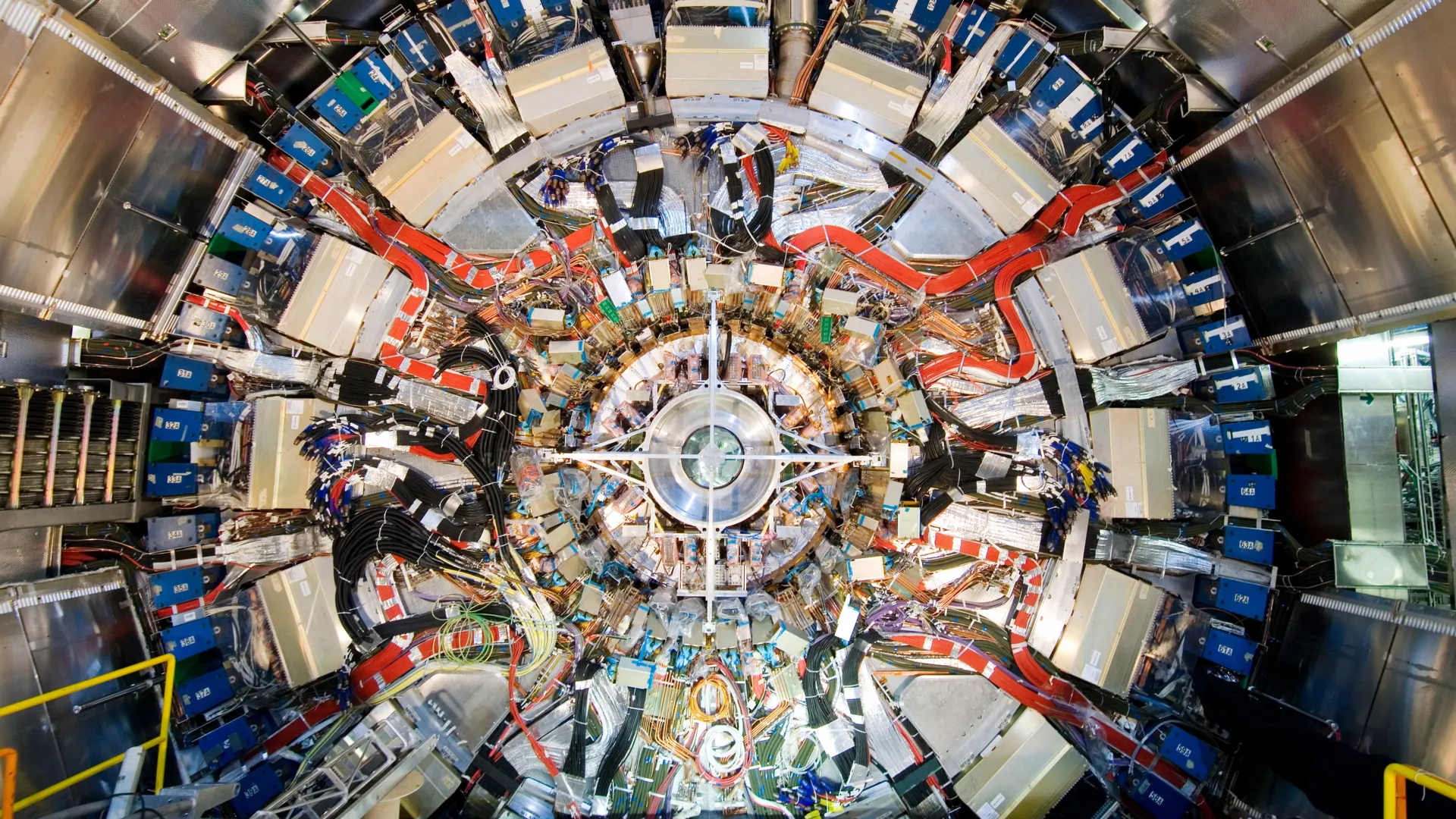
Researchers at the University of Oxford collaborated with scientists at CERN to investigate whether quantum entanglement, a foundational phenomenon in quantum mechanics where two particles maintain correlated properties across distances, could persist under extreme high-energy conditions. The study examined entanglement between pairs of Z bosons, massive particles that decay within fractions of a second, using the ATLAS experiment at the Large Hadron Collider near Geneva, Switzerland.
The Z bosons were produced through the decay of Higgs bosons generated when protons traveling at 99.99% the speed of light collide at energies of thirteen trillion electron volts. Although Z bosons exist for only brief moments before decaying into electrons or muons, the ATLAS detector measured the angles at which these resulting particles emerged, allowing researchers to reconstruct the spins of the original Z bosons and determine whether they displayed quantum entanglement correlations. The analysis provided strong evidence for entanglement, representing one of the highest energy confirmations of the phenomenon to date.
The findings extend previous observations of entanglement in photons, electrons, and trapped ions into a new domain involving some of nature’s heaviest particles under extraordinarily violent conditions. Professor Alan Barr from Oxford’s Department of Physics, who pioneered the idea of using particle colliders to study entanglement at extreme energies, noted that the results demonstrate the robustness and fundamental nature of quantum effects, challenging conventional understanding that treats entanglement as a delicate laboratory phenomenon.
The work reflects a broader effort to merge quantum information science concepts with high-energy particle physics research. By applying techniques from quantum computing to the massive datasets generated by particle colliders, researchers aim to develop more sensitive detection methods for subtle patterns that could reveal physics beyond current theoretical frameworks. Oxford University is contributing to detector upgrades for the High-Luminosity Large Hadron Collider, expected to provide larger datasets and enable more sophisticated quantum investigations at extreme energies in the coming years.
Article Attribution | Read More at Article Source
Article summary produced by Claude AI