

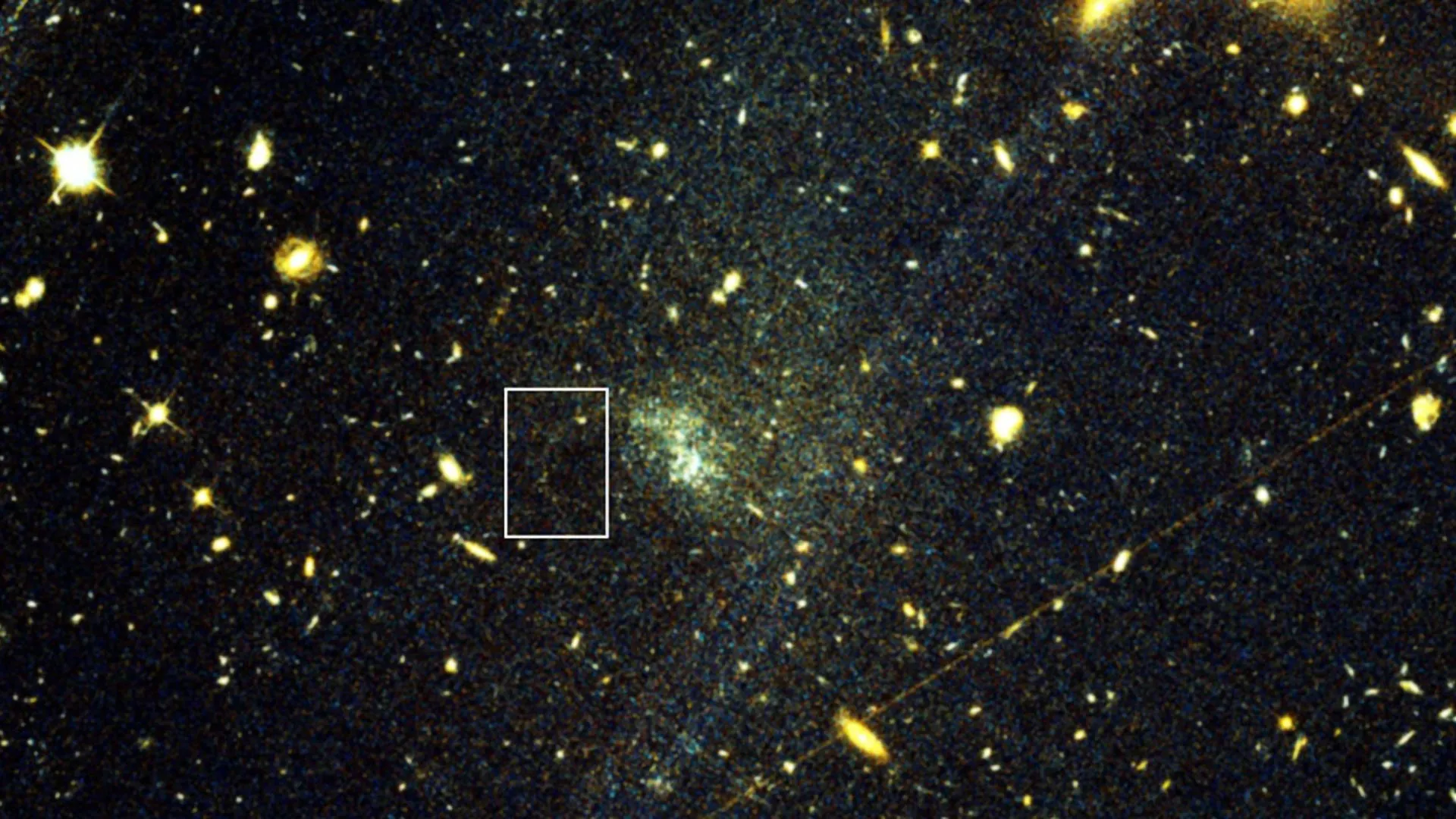
An international research team has announced the discovery of a globular cluster stellar stream in another galaxy, marking the first time such a structure has been identified beyond the Milky Way. The finding was published in Nature and represents a significant advancement in astronomical observation and dark matter research.
Globular cluster stellar streams are long, narrow trails of stars that originate from dense stellar collections held together by gravity. These streams form when the gravitational pull of a host galaxy gradually strips stars away from globular clusters through a process known as tidal stripping. Because gravity controls the shape and motion of these streams, they can serve as tracers for understanding how mass is distributed throughout galaxies, particularly the invisible dark matter that comprises approximately 80-85 percent of all matter in the universe.
The discovery was made in an ultra-diffuse galaxy called UGC9050-Dw1, a type of galaxy that emits very little light, making detection of the stellar stream exceptionally challenging. The research team, led by PhD student Julie Kiel Holm of the Niels Bohr Institute and Associate Professor Sarah Pearson of DTU Space, not only identified the stream but also demonstrated that it could be used to measure dark matter content in galaxies outside the Milky Way. Their analysis produced new estimates of the galaxy’s total mass and mass distribution, with results consistent with previous dark matter studies of the same galaxy.
The significance of this work extends beyond the single detection. By establishing that globular cluster stellar streams can be studied in other galaxies, researchers have created a new tool for investigating dark matter distribution across many different galaxy types. This capability addresses a long-standing challenge in astronomy, as measuring dark matter in galaxies beyond the Milky Way has traditionally proven difficult. As new space telescopes provide improved observations of faint galaxies and stellar structures, astronomers expect the number of detectable globular cluster stellar streams to increase substantially, enabling broader investigation of dark matter behavior across the universe.
Article Attribution | Read More at Article Source
Article summary produced by Claude AI