

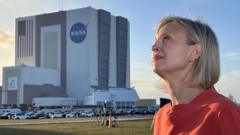
Four crew members—Reid Wiseman, Victor Glover, Christina Koch, and Jeremy Hansen—successfully completed the Artemis II mission, a historic spaceflight that took humans farther from Earth than any previous voyage. The mission launched from Kennedy Space Center in Florida and involved a quarter-million-mile journey to the Moon and back, lasting approximately ten days.
The crew operated in confined conditions aboard their spacecraft, which was roughly the size of a minibus. Living, working, eating, and sleeping in such tight quarters presented various challenges, including issues with the spacecraft’s waste management system. Despite these constraints, the astronauts documented their journey extensively, transmitting live video and capturing thousands of images of the lunar surface as they passed within 252,756 miles of Earth, surpassing the distance record previously set during the Apollo 13 mission.
The mission carried significant emotional and historical weight. Messages from Apollo-era astronauts were relayed to the crew during their flight. A particularly poignant moment occurred when the astronauts named a lunar crater after Reid Wiseman’s late wife, Carroll. The crew also conducted extensive observations and audio descriptions of the Moon’s surface features during their close approach.
As the spacecraft returned to Earth, the crew faced the mission’s most dangerous phase. Re-entry exposed the capsule to extreme temperatures approaching half the surface temperature of the Sun. Throughout the mission, NASA personnel and leadership, including administrator Jared Isaacman, emphasized the importance of human participation in space exploration. Isaacman outlined plans for future lunar activities, including a crewed landing scheduled for 2028, establishment of a lunar base, and eventual human missions to Mars. The successful completion of Artemis II represented a significant step in NASA’s broader exploration objectives.
Article Attribution | Read More at Article Source
Article summary produced by Claude AI