

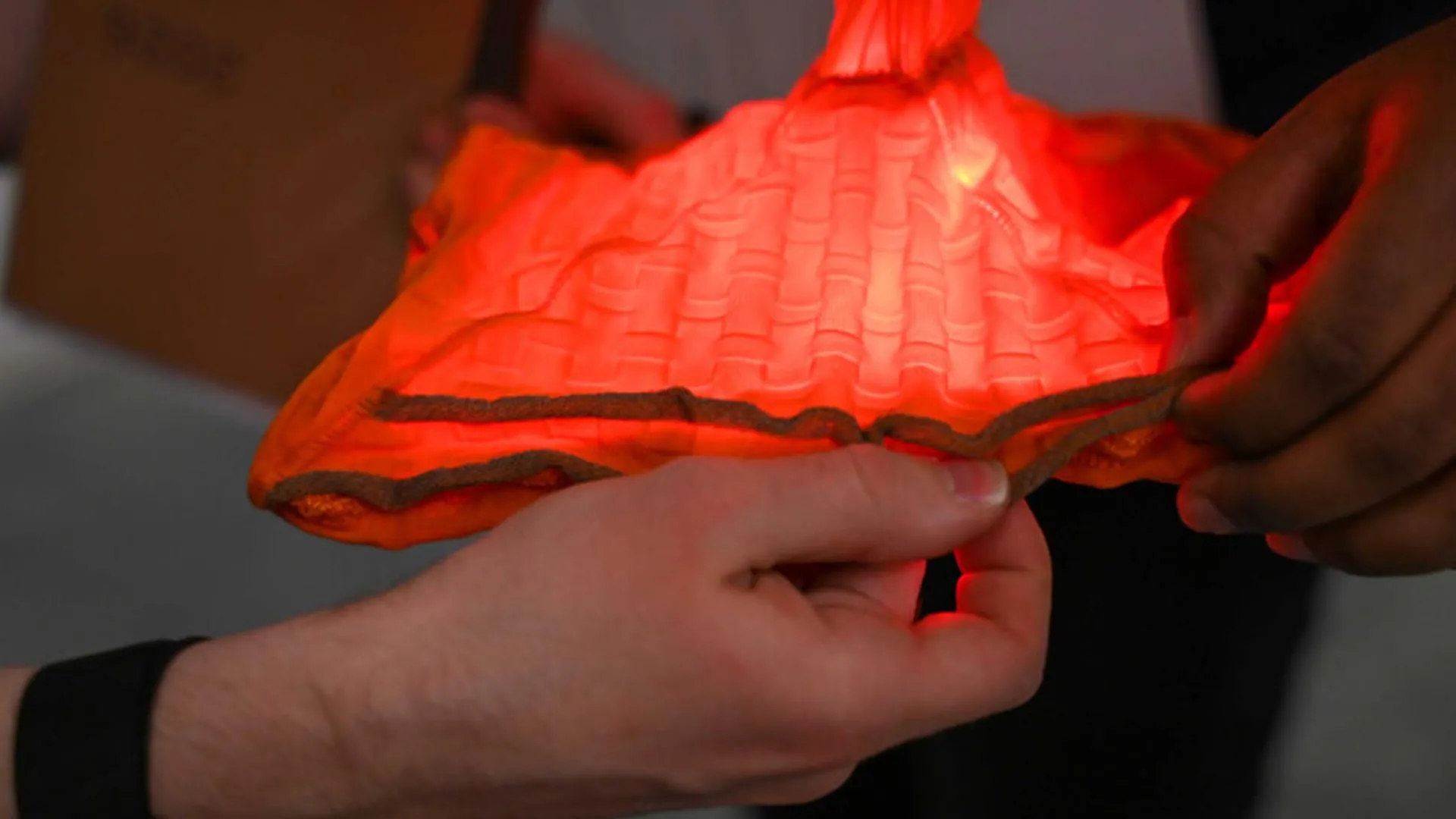
Scientists at Harvard’s John A. Paulson School of Engineering and Applied Sciences have demonstrated that standard industrial knitting methods can produce functional textiles with shape-shifting capabilities. The research, led by recent Ph.D. graduate Kausalya Mahadevan in the laboratory of Katia Bertoldi, was published in Advanced Functional Materials and represents a significant step toward programmable smart fabrics.
The team engineered machine-knitted fabrics that maintain multiple stable configurations, a property physicists call multistability. Rather than relying on traditional polymer molding techniques, the researchers utilized weft knitting—the same industrial process used to manufacture hats and gloves—combined with highly elastic yarns and a plating method that places different yarns on opposite sides of the textile. This approach created dense fabrics that naturally curl into three-dimensional forms. By arranging horizontal and vertical stripes in specific patterns, the researchers created textiles capable of snapping between different shapes while remaining stable in each configuration, similar to a light switch that stays in either the on or off position.
To demonstrate practical applications, the team incorporated thin conductive yarns into the knitted structures, transforming them into soft, stretchable electrical switches. Prototypes included a multistable knitted shell that toggles an LED on and off as the fabric transitions between states, and a wearable textile switch designed for placement over joints like knees or elbows that can count steps by detecting the snapping motion when joints bend. The researchers also created a reconfigurable lampshade containing three separate multistable switches, each controlling different colored lighting.
A significant advantage of this approach is its compatibility with existing industrial knitting equipment already present in garment factories, suggesting the technology could be scaled for widespread production relatively quickly. The work bridges textiles with nonlinear mechanical metamaterials, specialized engineered structures designed to bend and snap in controlled ways. Researchers envision future applications including fabrics that track body movement, provide tactile feedback, or alter physical shape on demand.
Article Attribution | Read More at Article Source
Article summary produced by Claude AI