

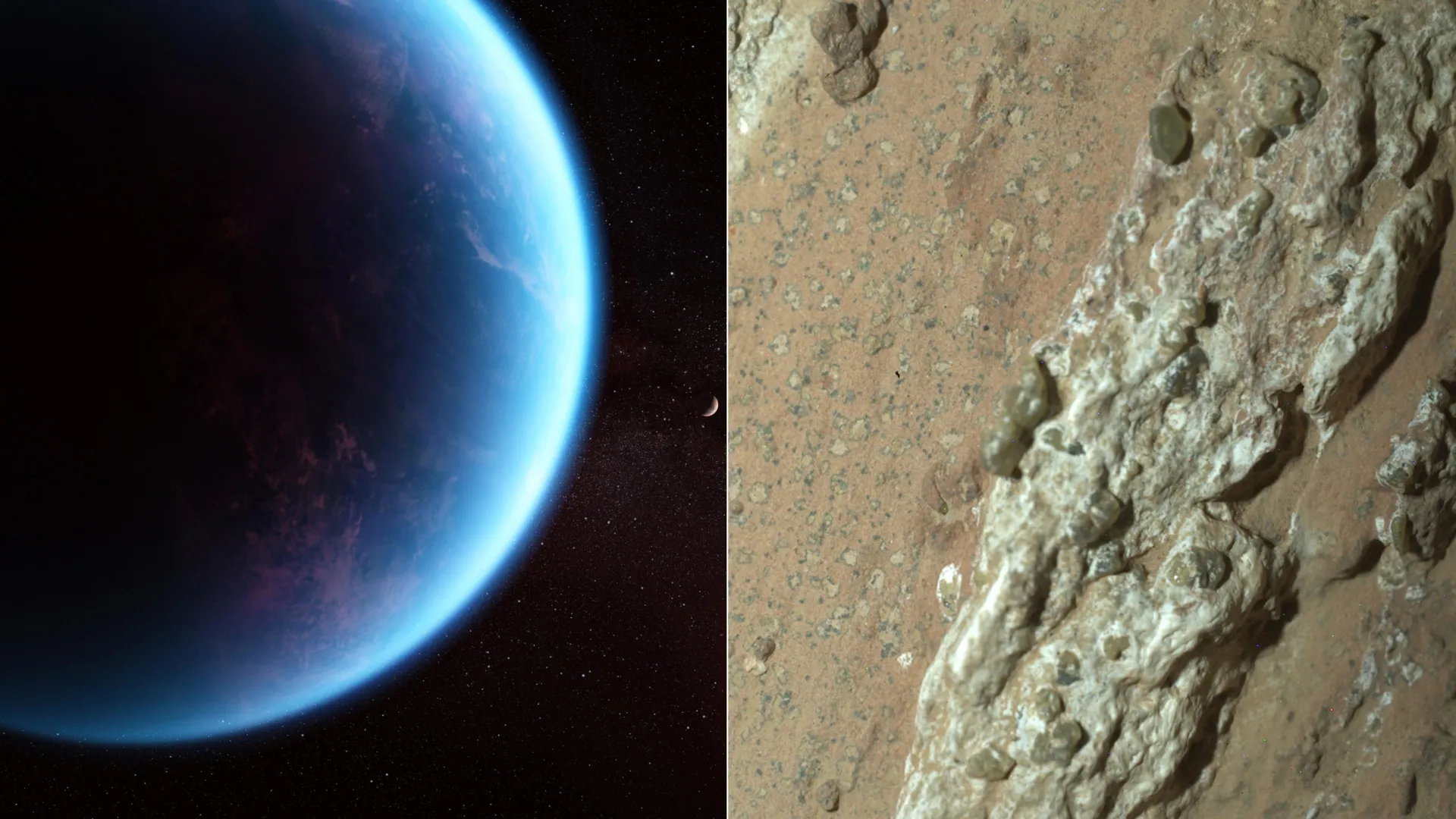
Following two major announcements in 2025 regarding potential extraterrestrial life—one involving atmospheric signatures detected on the exoplanet K2-18b and another concerning a Martian rock sample called Cheyava Falls—researchers conducted a survey to measure expert opinion within the astrobiology community. The study sought to determine whether the broader scientific community shared the optimistic framing present in media coverage and official statements.
The survey results indicated marked scientific caution regarding both discoveries. For the K2-18b case, researchers reported detecting dimethyl sulfide and dimethyl disulfide in the exoplanet’s atmosphere; only 6.6% of surveyed astrobiologists agreed that extraterrestrial life had probably been discovered, while nearly two-thirds disagreed and 28% remained neutral. The Mars case, involving mineral formations potentially created by microbial activity, received somewhat higher confidence levels but still reflected restraint: 15.1% agreed with the discovery claim, 44.6% disagreed, and 40.3% stayed neutral.
The distribution of scientific opinion revealed nuanced patterns beyond simple agreement or disagreement. The proportion of astrobiologists who strongly disagreed decreased substantially between the two cases, suggesting the community became more receptive to evidence without necessarily endorsing the conclusions. Experts noted that the two cases involved different types of evidence—distant atmospheric detection versus direct physical examination of material—which likely influenced assessment levels. Additionally, scientists acknowledged that biological and non-biological processes can produce similar-appearing signatures, complicating interpretation.
The research highlights a broader methodological concern in public discourse about science. Scientific opinion rarely presents as binary agreement or rejection, yet media coverage and policy discussions frequently treat expert consensus as clearly established or absent. C-SCOPE, a research center at Durham University, has undertaken efforts to systematically measure how scientific communities respond to emerging evidence and uncertainty. This approach aims to provide more accurate representations of expert opinion distribution across fields including climate science, pandemic response, artificial intelligence, and medical research, rather than relying on selective quotations from individual researchers.
Article Attribution | Read More at Article Source
Article summary produced by Claude AI