

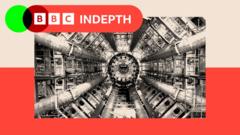
The United Kingdom is considering significant reductions in its contributions to major particle physics and astronomy research initiatives, including upgrades to the Large Hadron Collider at CERN. This development comes amid a broader debate about the balance between fundamental research and applied science funding in the country.
The proposed cuts have sparked controversy within the scientific community, with some researchers viewing them as a shift away from blue-sky research—investigation driven purely by scientific curiosity—toward applied research with more immediate economic benefits. The Science and Technology Facilities Council announced a potential 30% reduction in funding for particle physics and astronomy earlier this year. Officials attributed the cuts to previously initiated projects that lacked adequate funding, along with inflation and currency fluctuations. However, some senior scientists dispute this explanation, suggesting instead that funds have been deliberately redirected from fundamental research to government-prioritized areas such as artificial intelligence and quantum computing.
Theoretical physicist Dr. Simon Williams of Durham University emphasized that fundamental research and applied research are interdependent, noting that removing blue-sky research from the country risks driving away industry and innovation that depends on it. Approximately 30 young physicists have been unable to secure grants to continue working in the UK due to funding delays, potentially forcing them to pursue opportunities abroad. Williams told lawmakers that cutting foundational research is equivalent to “killing the tree by removing the roots.”
Internally, the STFC appears to have acknowledged a “major shift of funding from curiosity-driven research to priority areas,” according to minutes from the council’s governing meetings. However, leadership at UKRI has denied that any diversion of funds has occurred, maintaining that curiosity-driven research is being protected. The disagreement reflects broader tensions within science policy about how to allocate limited research resources in an era of economic constraints.
Article Attribution | Read More at Article Source
Article summary produced by Claude AI