

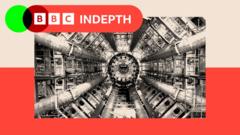
The UK is preparing to reduce its participation in major particle physics and astronomy research initiatives, including upgrades to the Large Hadron Collider, amid broader funding restructuring within Britain’s scientific research system.
The cuts represent a departure from the country’s legacy in blue-sky research—investigations aimed at understanding fundamental principles without immediate practical application. This approach has historically generated breakthroughs including the discovery of the electron, DNA structure, and early computer development, which subsequently spawned major industries. When Peter Higgs, a British theorist whose prediction of the Higgs boson was confirmed in 2012 and earned recognition in Stockholm in October 2013, received his Nobel Prize, he emphasized the importance of supporting such fundamental research.
The proposed reductions stem from a restructuring of how the UK allocates scientific funding. The UK Research and Innovation Agency implemented a new system dividing funds into three categories: foundational research, government priorities like artificial intelligence and quantum computing, and industry development. Simultaneously, the Science and Technology Facilities Council announced a projected 30% reduction in particle physics and astronomy funding. The Council’s leadership attributed this to previously initiated projects lacking adequate financial backing and cited inflation pressures. However, internal council documents and independent scientists dispute this explanation, suggesting funds have been deliberately redirected from curiosity-driven research toward applied priorities.
The consequences extend beyond academic impact. Early-career physicists report difficulty securing grants to continue research in Britain, with approximately 30 young scientists potentially forced to relocate their work internationally. Researchers warn that removing foundational science infrastructure may prompt associated industries to relocate as well, ultimately harming Britain’s economic competitiveness in emerging technology sectors.
Article Attribution | Read More at Article Source
Article summary produced by Claude AI