

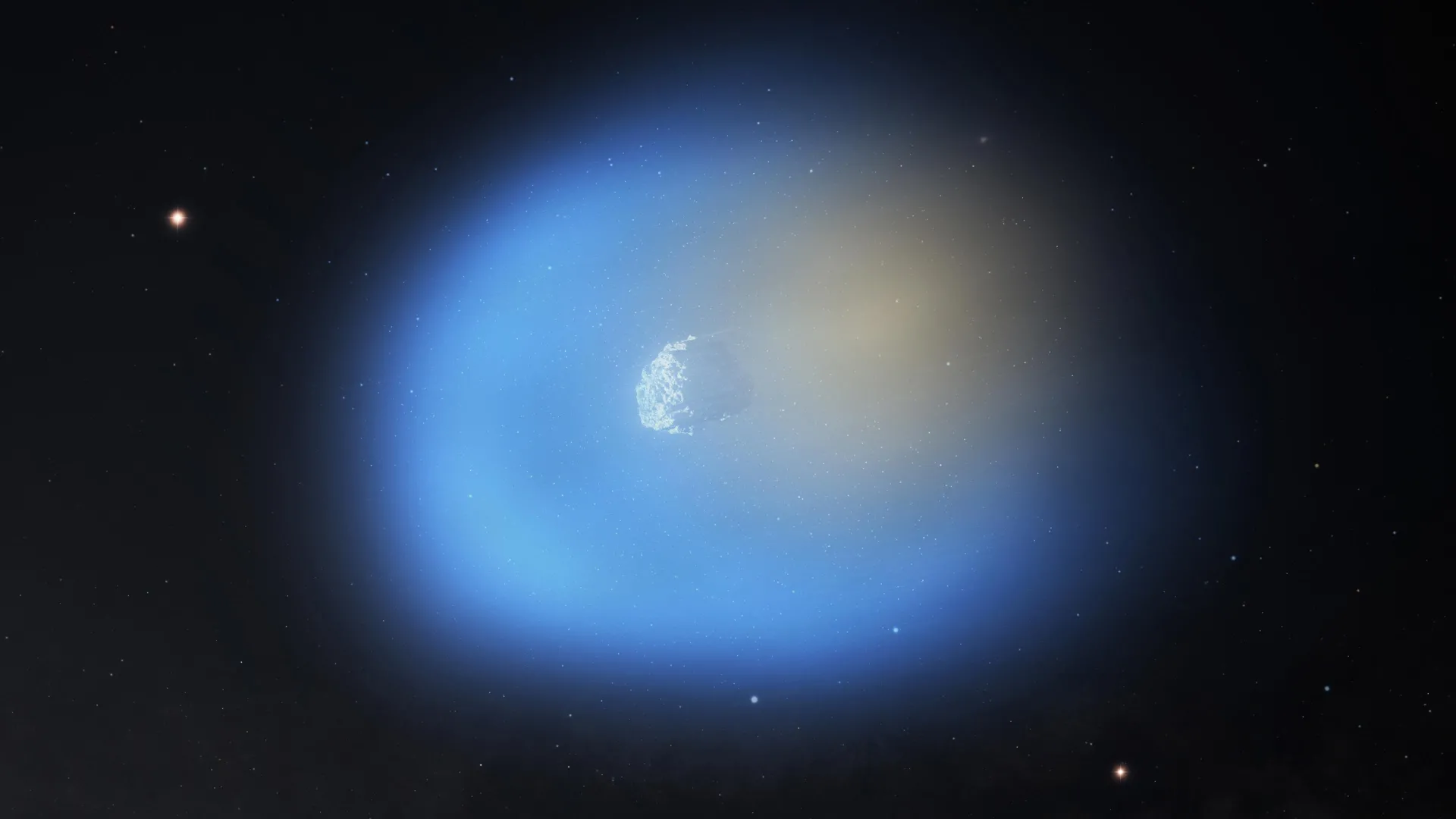
Astronomers studying the interstellar comet 3I/ATLAS have detected an exceptionally large concentration of methanol, a finding that distinguishes this visitor from other solar system comets. Research conducted using the Atacama Large Millimeter/submillimeter Array (ALMA) in late 2025 as the comet approached the Sun revealed methanol-to-hydrogen cyanide ratios of approximately 70 and 120, placing 3I/ATLAS among the most methanol-rich comets ever examined by scientists.
The research team observed the comet during its approach to the Sun, when solar heating caused gases and dust to escape from its icy surface, creating a luminous cloud of material surrounding its core. By analyzing the molecular signatures present in this cloud, researchers identified the chemical composition of material carried by the comet. Since 3I/ATLAS originated outside the solar system, these measurements provide a rare opportunity to study how icy bodies may form in other planetary systems without requiring interstellar travel.
The unusual methanol abundance suggests the ice inside 3I/ATLAS formed under or was exposed to conditions significantly different from those experienced by most solar system comets. Earlier observations using the James Webb Space Telescope had already identified carbon dioxide as a dominant component of the comet’s cloud, and the new methanol discovery adds to the growing list of distinctive chemical characteristics. ALMA’s high-resolution imaging capabilities enabled researchers to track how different molecules behave as they escape from the comet.
The observations revealed that hydrogen cyanide originates primarily from the comet’s central nucleus, consistent with typical cometary behavior. Methanol, however, appears to originate from both the nucleus and from ice particles suspended within the surrounding cloud. These small icy grains behave as miniature comets themselves, releasing additional methanol as temperatures increase during the comet’s approach to the Sun.
Comet 3I/ATLAS represents the third confirmed interstellar object entering the solar system, following 1I/’Oumuamua and 2I/Borisov. Each interstellar visitor offers scientists opportunities to compare the solar system with distant planetary systems and to advance understanding of how planets, comets, and other small bodies form around stars elsewhere in the galaxy.
Article Attribution | Read More at Article Source
Article summary produced by Claude AI