

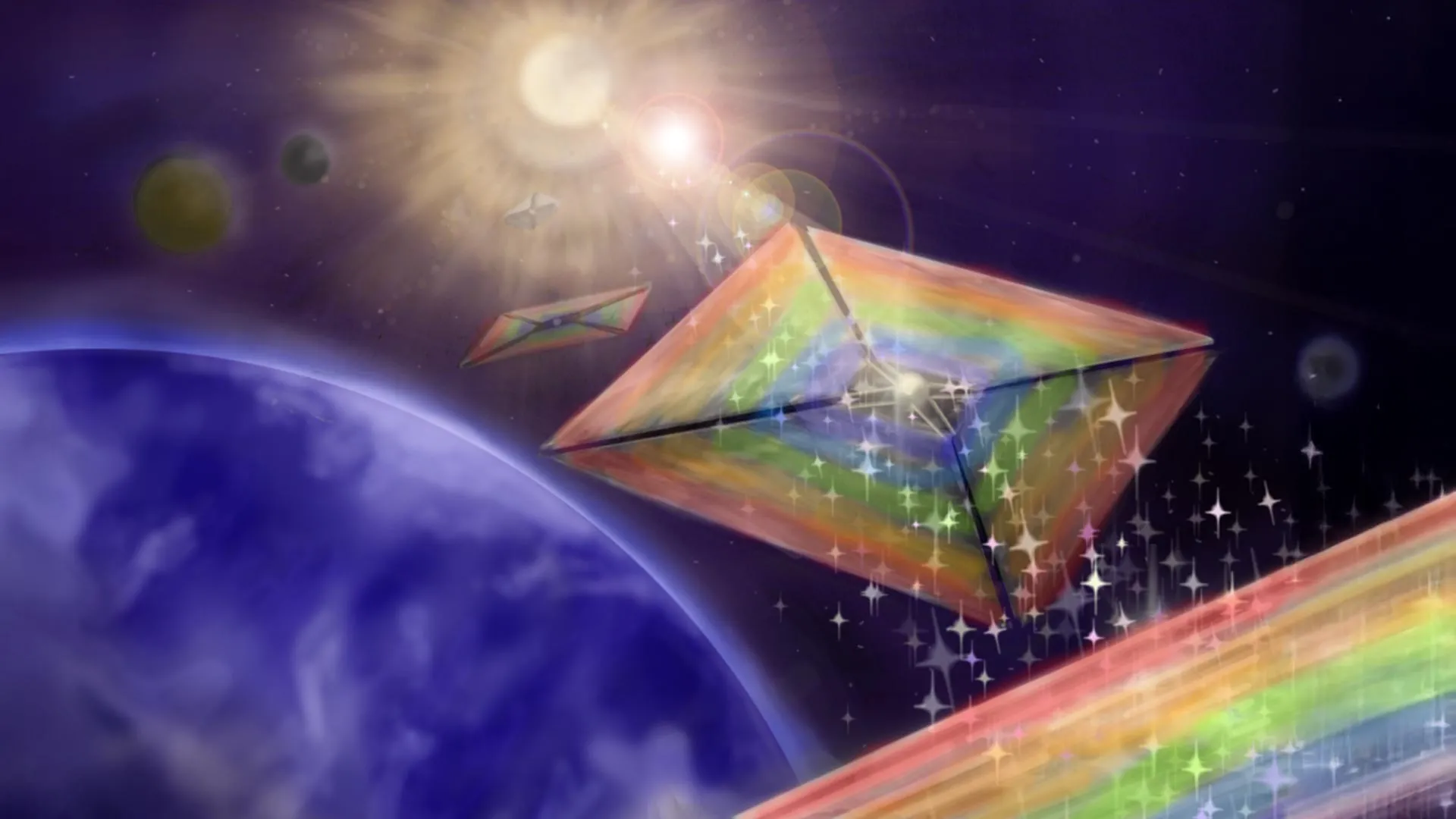
Scientists at the Harbin Institute of Technology have identified a counterintuitive challenge for solar sail propulsion at extreme velocities. Solar sails, which rely on momentum transfer from powerful lasers to achieve high speeds, have been proposed as a potential solution for reaching other stars within feasible timescales. However, a new analysis reveals that such systems encounter significant complications once they approach relativistic speeds.
The researchers analyzed the three primary ways photons interact with a solar sail: direct momentum transfer from incident light, momentum imparted through specular reflection, and momentum from diffusely scattered photons. At conventional speeds, all three mechanisms work together to accelerate the sail forward. As the spacecraft accelerates and moves away from its laser source, the Doppler effect begins to reduce the frequency of incoming light, which progressively diminishes thrust efficiency regardless of speed.
A more severe problem emerges around 75% of light speed. At these relativistic velocities, light aberration causes diffusely scattered photons to redirect forward, in the same direction the sail is traveling. Due to conservation of momentum, this forward-directed radiation generates a reaction force opposing the sail’s motion, creating an unexpected drag effect. While this drag does not completely overcome the forward thrust from other mechanisms, it substantially reduces overall propulsion efficiency.
The study examines purely radiative dynamics and does not account for additional real-world complications such as collisions with interstellar dust and gas, thermal stress on sail materials, or spacetime curvature. The researchers modeled the sail as an idealized mirror, whereas actual spacecraft would require sophisticated materials engineered for specific laser wavelengths. Advanced metamaterials and photonic crystals under investigation might potentially exploit the aberration effects to maintain trajectory stability.
Fully operational interstellar solar sails remain distant prospects, and engineers will need comprehensive understanding of relativistic effects to develop viable propulsion systems for reaching distant stars.
Article Attribution | Read More at Article Source
Article summary produced by Claude AI