

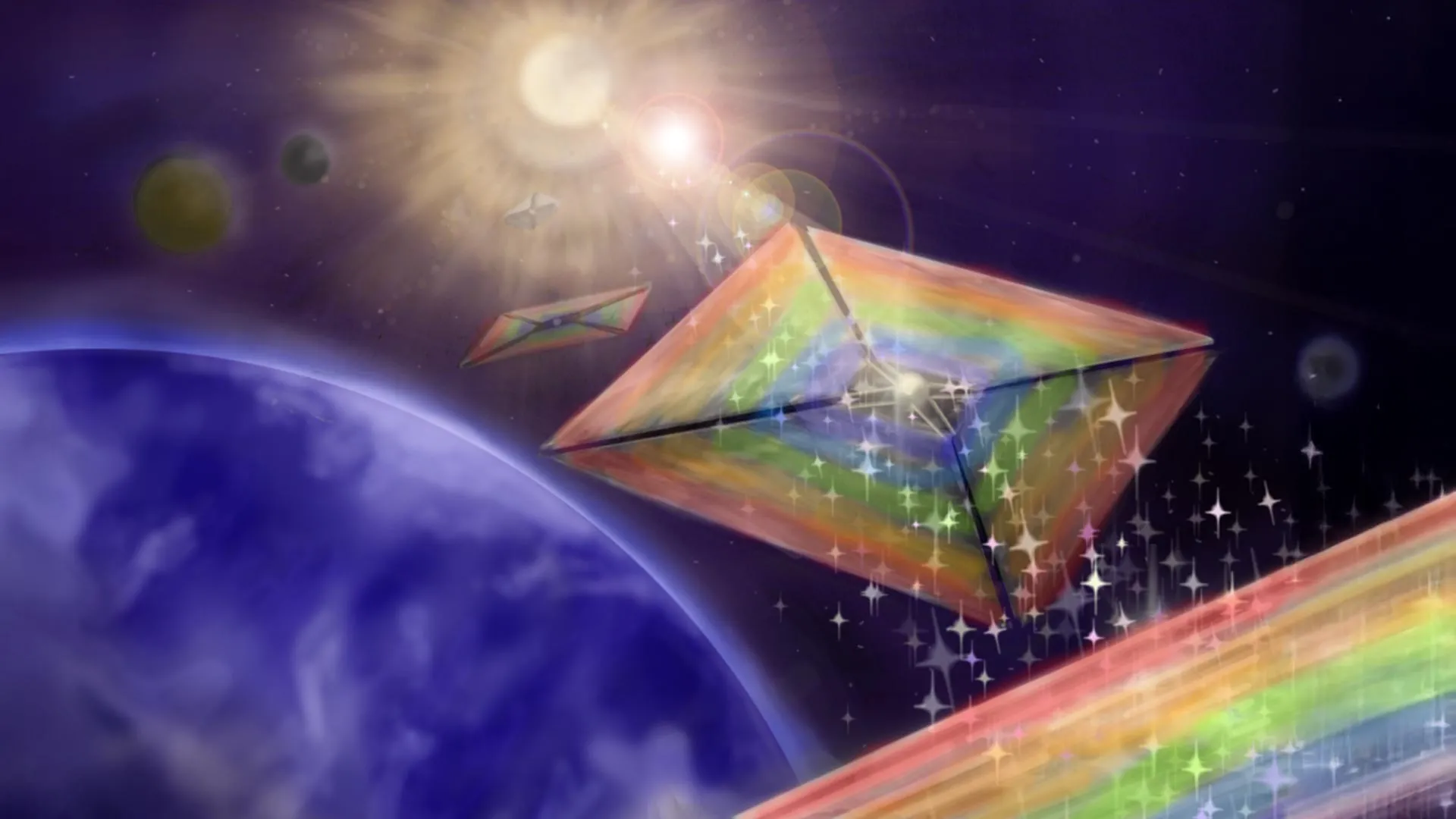
Researchers at the Harbin Institute of Technology have identified a previously overlooked challenge for interstellar solar sail propulsion. According to their analysis, while solar sails—large reflective structures pushed by powerful lasers—represent a promising approach for achieving the extreme velocities needed for interstellar travel, a significant efficiency problem emerges at relativistic speeds.
The propulsion mechanism relies on three distinct forces generated when photons strike the sail. Incident light provides the primary thrust through raw photon momentum, followed by specular reflection as photons bounce perfectly off the surface, and diffuse scattering from photons that are absorbed and randomly re-emitted. At conventional speeds, all three forces work together to accelerate the sail forward. However, the Doppler effect begins to complicate this dynamic as the sail accelerates away from its laser source, with decreasing light frequency reducing the thrust produced across all three components.
The situation becomes significantly more problematic once the lightsail approaches approximately 75% of the speed of light. At these relativistic velocities, light aberration causes diffusely scattered photons to be directed forward along the sail’s trajectory. Since every action produces an equal and opposite reaction, this forward-directed radiation creates a drag force that opposes the sail’s motion. While the laser continues providing net forward thrust, the propulsion system’s overall efficiency drops substantially at these extreme speeds.
The research focuses specifically on radiative dynamics and does not account for additional real-world complications such as collisions with interstellar dust and gas, or the thermal limitations of actual materials. Real solar sails would face overheating risks from exposure to extremely powerful lasers, and engineers would need to employ sophisticated materials rather than idealized mirrors. Some researchers are exploring advanced metamaterials and photonic crystals designed for specific laser wavelengths that might potentially exploit the aberration effects to improve sail stability and orientation.
While operational interstellar solar sails remain theoretical, understanding these high-speed dynamics represents an essential step toward eventually enabling crewed or robotic missions to other star systems. The analysis deliberately simplifies several factors including spacetime curvature, meaning additional complications likely await future research.
Article Attribution | Read More at Article Source
Article summary produced by Claude AI