

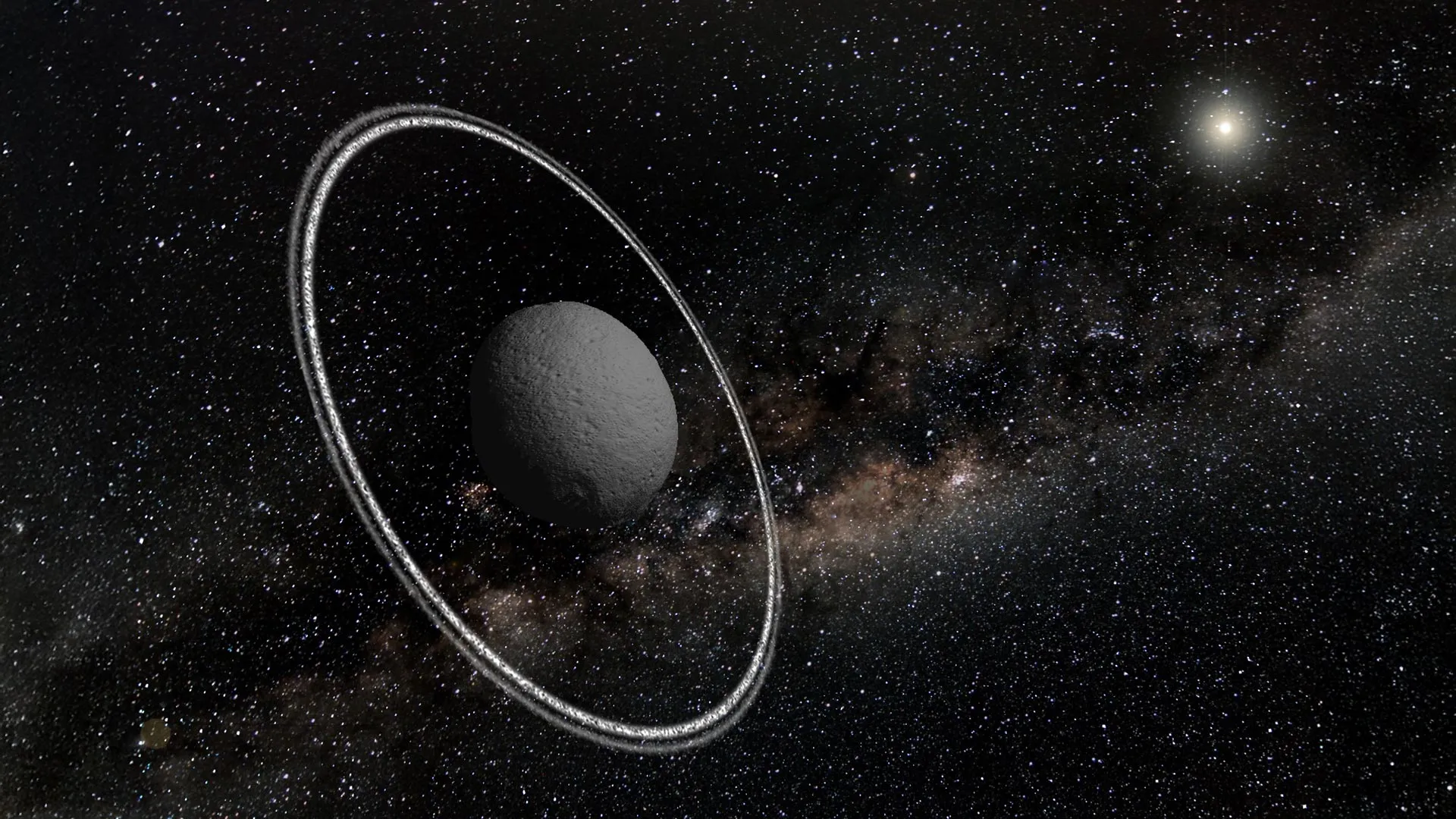
The James Webb Space Telescope has detected unexpected changes in the ring system surrounding Chariklo, a small celestial body approximately 250 kilometers across that orbits in the region between Saturn and Uranus. The discovery challenges long-held assumptions about the stability of ring systems around small objects in the Solar System. While rings were historically associated only with giant planets, astronomers identified two dense rings around Chariklo in 2013. A new study published in Science Advances, conducted by researchers at the Institute of Astrophysics of Andalusia, provides the first direct evidence that these rings have evolved over a relatively short period spanning only a few years.
The research team made its key observations on October 18, 2022, when they used JWST to monitor Chariklo as it passed in front of a distant star in an event known as a stellar occultation. This technique allowed scientists to study an object too small and distant for direct imaging by measuring how the rings blocked starlight as they crossed in front of the background star. When comparing the JWST data with stellar occultation observations gathered throughout the previous decade, researchers discovered divergent changes in Chariklo’s two rings. The inner ring now blocks considerably more light than it did previously, indicating increased opacity, while the outer ring blocks less light, showing decreased opacity. This unexpected divergence suggests that Chariklo’s rings represent dynamic, evolving structures shaped by physical processes more intricate than scientists had previously understood.
The JWST observation marked a significant technological achievement as the first stellar occultation specifically predicted and scheduled for the space telescope that was subsequently executed successfully. The precision required was substantial, demanding exact knowledge of Chariklo’s orbital path, the position of the background star as mapped by the European Space Agency’s Gaia mission, and JWST’s own trajectory around the L2 Lagrange point. The relatively slow relative motion of only 2.5 kilometers per second between Chariklo and JWST during the occultation provided researchers with exceptionally detailed spatial information about the ring structure.
The findings compel scientists to reconsider assumptions about ring systems orbiting small bodies in the Solar System. The observable changes occurring over such a brief timeframe indicate that these ring systems can transform on unexpectedly short timescales. While researchers remain uncertain whether the changes represent genuine evolution within the rings, instrumental differences from observations conducted with different filters, or a combination of factors, the capability to detect these variations opens new avenues for investigating how ring systems form, develop, and maintain stability around distant worlds. The research involved collaboration among scientists from Spain, Brazil, France, Hungary, and the United States.
Article Attribution | Read More at Article Source
Article summary produced by Claude AI