

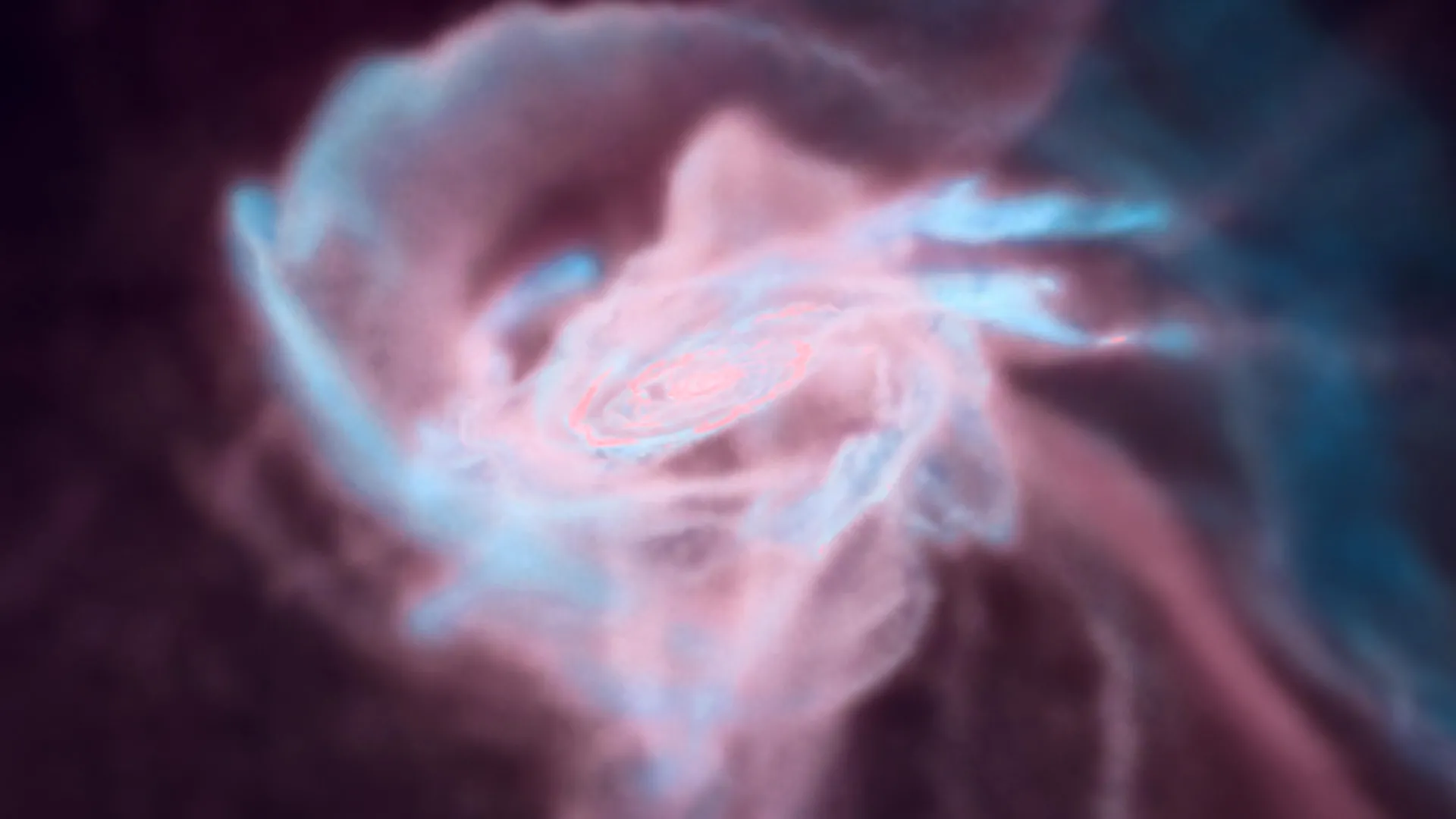
Researchers using Japan’s ATERUI III supercomputer have conducted detailed cosmological simulations of the early Universe to investigate the nature of Little Red Dots, enigmatic red objects discovered by the James Webb Space Telescope. The study, led by Sunmyon Chon of the Max Planck Institute for Astrophysics, employed high-resolution computing to model conditions from individual galaxies down to specific gas clouds during the young cosmos.
The simulations reveal a mechanism by which black holes could have grown at extraordinary rates in the early Universe. Intense far-ultraviolet radiation from nearby galaxies can inhibit normal star formation within certain gas clouds, causing the gas to collapse into a single supermassive star rather than fragmenting into many smaller objects. This supermassive star can then collapse to form a black hole seed. Once formed, these black holes become surrounded by thick, dense gas disks that trap radiation and enable far more efficient consumption of material than occurs in the modern Universe, allowing growth rates dozens of times faster than what is possible today.
The research addresses a longstanding astronomical puzzle concerning supermassive black holes. Objects containing millions or even billions of times the Sun’s mass have been observed to exist less than 600 million years after the Big Bang, a timeframe that has challenged conventional explanations for their formation and rapid development. The James Webb Space Telescope was expected to help resolve this mystery by detecting fainter and more distant galaxies than previous instruments.
Instead of immediately solving the problem, JWST identified a large population of Little Red Dots, whose properties closely match those of the simulated black holes in the new models. The research suggests these objects represent an early stage of extremely rapid black hole growth and may constitute a common phenomenon in the young Universe rather than requiring unusual physics or extraordinarily rare events. Ongoing observations from JWST and future telescopes may provide additional data to validate this framework for understanding the formation and evolution of the cosmos’s earliest black holes.
Article Attribution | Read More at Article Source
Article summary produced by Claude AI