

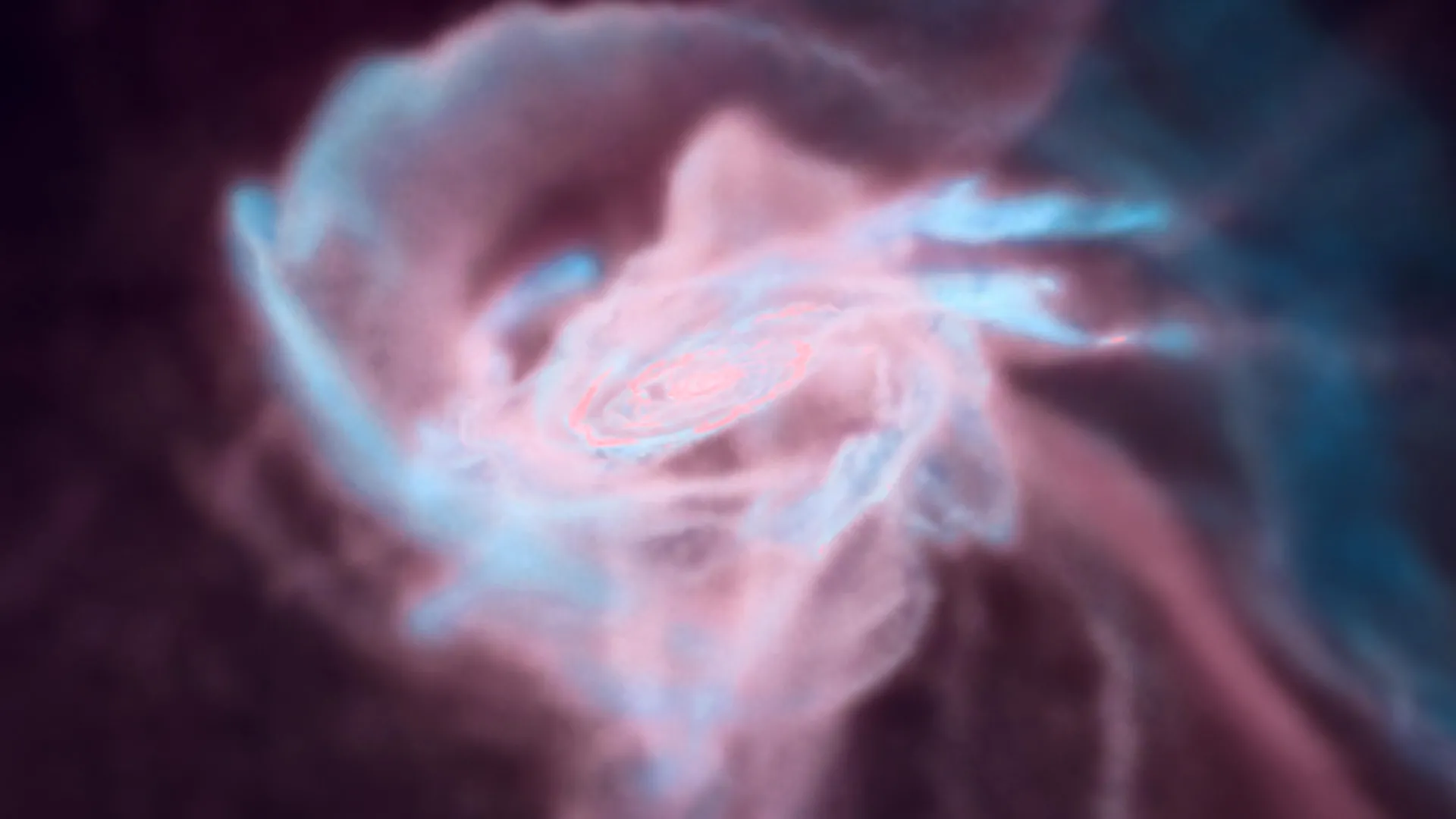
Researchers have proposed a new explanation for one of the James Webb Space Telescope’s most intriguing discoveries: a population of small, intensely red objects termed Little Red Dots. Using Japan’s ATERUI III supercomputer, scientists led by Sunmyon Chon of the Max Planck Institute for Astrophysics conducted detailed cosmological simulations of the early Universe to investigate the nature of these objects.
The simulation process involved starting at the scale of young galaxies and progressively zooming into smaller regions, eventually focusing on individual gas clouds. This high-resolution approach required the computational capabilities of ATERUI III. According to the findings, intense far-ultraviolet radiation from nearby galaxies could have suppressed ordinary star formation in certain gas clouds during the early cosmos. Rather than fragmenting into multiple smaller stars, the gas would instead collapse into a single supermassive star, which could subsequently collapse to form a black hole seed.
Once formed, these black hole seeds would become enshrouded in thick, dense gas disks that would trap radiation and enable the black holes to consume material far more efficiently than is possible in the current Universe. Under these conditions, black holes could grow at rates dozens of times faster than observed in modern times. The properties of these simulated black holes closely match those of the Little Red Dots observed by JWST, suggesting these objects may represent an early phase of exceptionally rapid black hole growth.
The research addresses a long-standing astronomical puzzle regarding how supermassive black holes, containing millions or billions of times the Sun’s mass, existed so early in cosmic history—less than 600 million years after the Big Bang. JWST was designed to help resolve this question by detecting fainter and more distant galaxies than previous telescopes. The new simulation model indicates that the Little Red Dots could be the missing key to understanding this phenomenon, as the conditions enabling their formation and rapid growth arose naturally in the early Universe without requiring unusual physics or improbable events.
As JWST continues to identify additional Little Red Dots and future observatories examine even more distant objects, this model may provide astronomers with a framework for comprehending how the Universe’s earliest black holes formed, evolved, and influenced cosmic development.
Article Attribution | Read More at Article Source
Article summary produced by Claude AI