

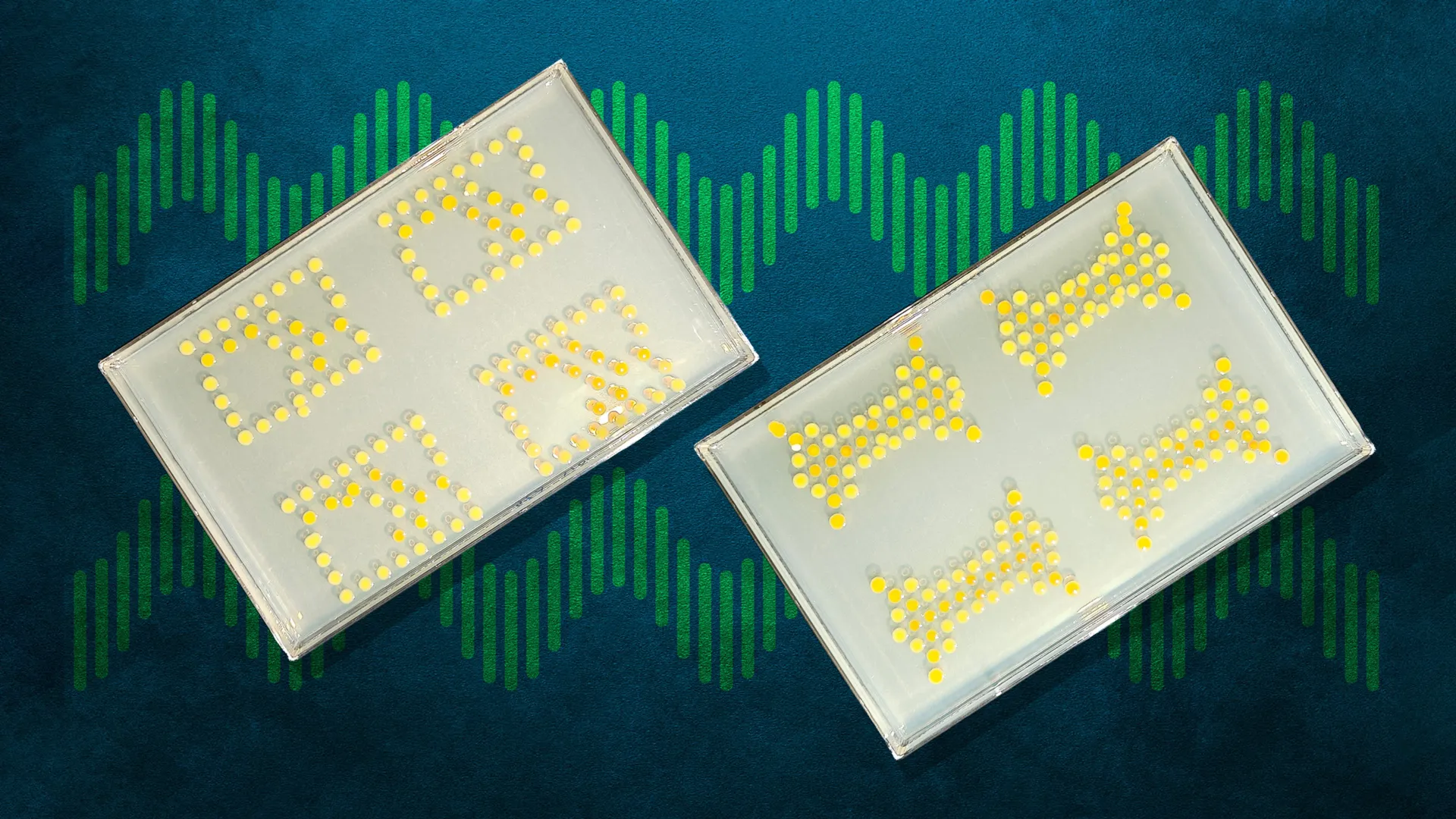
Researchers at MIT have successfully engineered bacterial cells to operate as transistors, the fundamental switching components found in electronic circuits. In this biological approach, bacterial cells regulate the movement of signaling molecules rather than controlling electrical current, allowing information to pass between different circuit components in a manner analogous to traditional electronics.
The research team developed two distinct types of bacterial transistors and created three additional bacterial strains that function as relays, effectively wiring the components together. These five strains form a modular toolkit capable of constructing a wide variety of circuit configurations. The researchers demonstrated the system’s versatility by building circuits that could perform addition functions and direct signals to specific destinations based on input conditions.
To assemble these living circuits, researchers printed bacterial colonies onto agar plates with precise spacing of approximately 5 millimeters between neighbors. This arrangement ensures that chemical signals travel only to adjacent colonies, enabling information to flow through the circuit in a controlled, sequential manner. The system employs the bacterium Pantoea agglomerans, a species commonly found on plant surfaces, which was engineered to respond to specific signaling molecules and produce outputs that activate subsequent components.
While the biological circuits operate significantly slower than electronic computers, requiring approximately eight hours per calculation, researchers suggest this speed remains practical for agricultural applications. Potential uses include deploying the bacterial circuits on plant roots or leaves, where they could continuously monitor environmental conditions and trigger protective responses to stresses such as drought or pest infestations. This approach represents a shift from traditional synthetic biology by distributing computational functions across multiple cells rather than concentrating all operations within a single cell, thereby circumventing capacity limitations in protein production machinery. The work was supported in part by the U.S. Defense Advanced Research Projects Agency and the U.S. Intelligence Advanced Research Projects Activity.
Article Attribution | Read More at Article Source
Article summary produced by Claude AI