

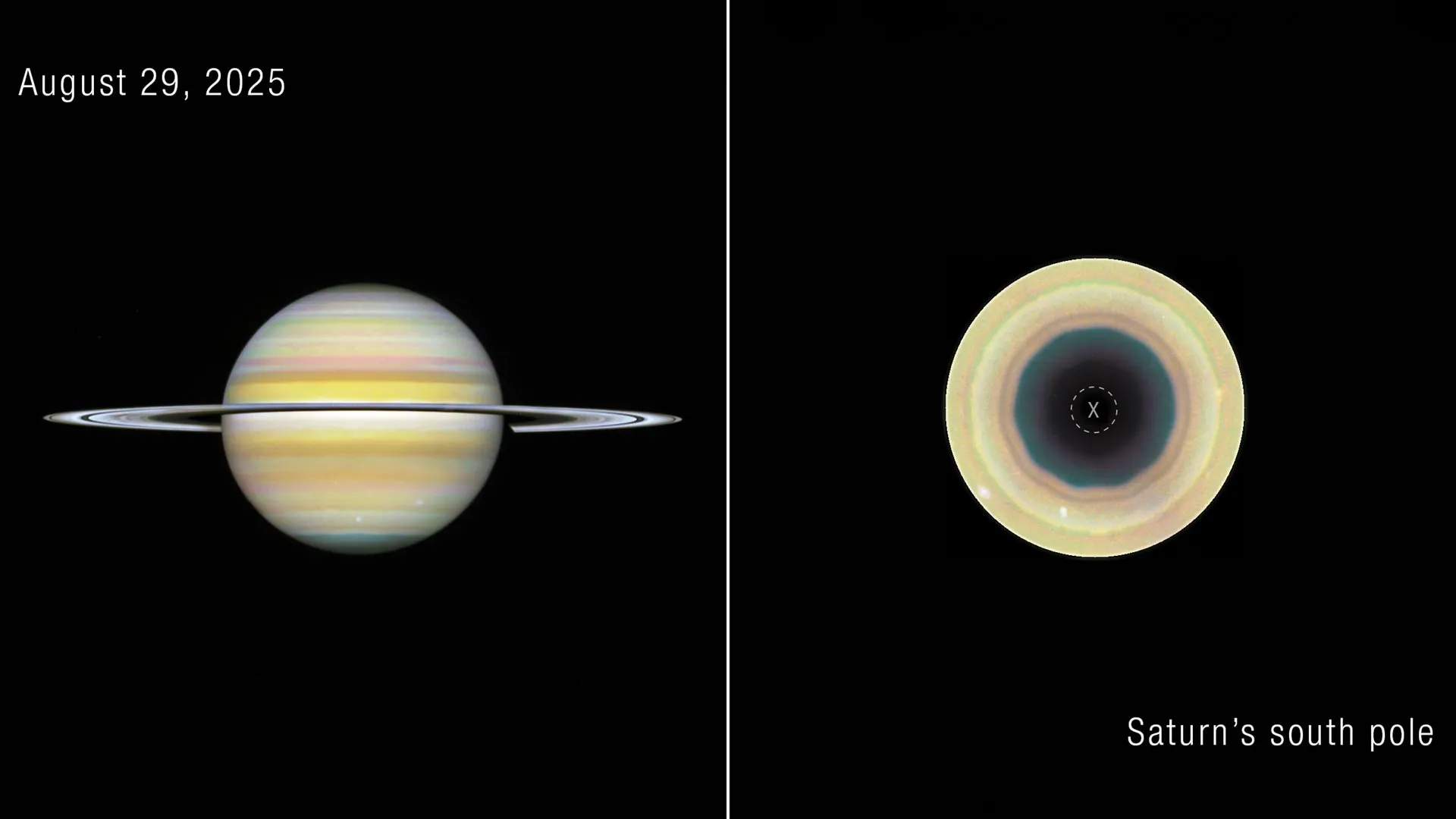
Scientists using NASA’s Hubble Space Telescope have identified a substantial 10-sided atmospheric feature positioned near Saturn’s south pole, representing a significant discovery in planetary science. The structure was first detected through ground-based observatory images, with amateur astronomers and researchers at Spain’s University of the Basque Country recognizing the unusual wave-like formation. Subsequent Hubble observations confirmed the feature’s presence in data extending back to 2023, allowing researchers to track its gradual development over several years.
The decagon differs from Saturn’s well-documented northern hexagon, which has remained visible for over 40 years. Unlike the stable northern formation, this southern structure appears to be actively strengthening and developing, offering researchers a rare opportunity to observe the formation of a large-scale atmospheric pattern. The feature exists within one of Saturn’s jet streams and extends through multiple atmospheric layers, indicating it represents a vertically structured phenomenon rather than merely a surface-level cloud pattern.
The discovery emerged partly due to Saturn’s seasonal positioning, which gradually brought its south pole into better view from Earth-based telescopes. Researchers working through NASA’s Outer Planet Atmospheres Legacy program, which has documented outer planet imagery for more than a decade, leveraged both ground-based observations and space telescope data to analyze the formation. The wavelength-dependent visibility of the structure suggests it has a complex vertical organization, with its apparent position shifting depending on the observational wavelength used.
Scientists acknowledge that the causes behind the decagon’s formation remain unclear, and whether it will remain stable long-term is uncertain. Additional investigations using Hubble and NASA’s James Webb Space Telescope, combined with computational modeling, will be necessary to determine the mechanisms driving the wave, its potential longevity, and its relationship to Saturn’s northern hexagon. Ongoing monitoring of the feature may provide insights into atmospheric dynamics on giant planets and potentially broader understanding of atmospheric behavior applicable to other planetary bodies.
Article Attribution | Read More at Article Source
Article summary produced by Claude AI