

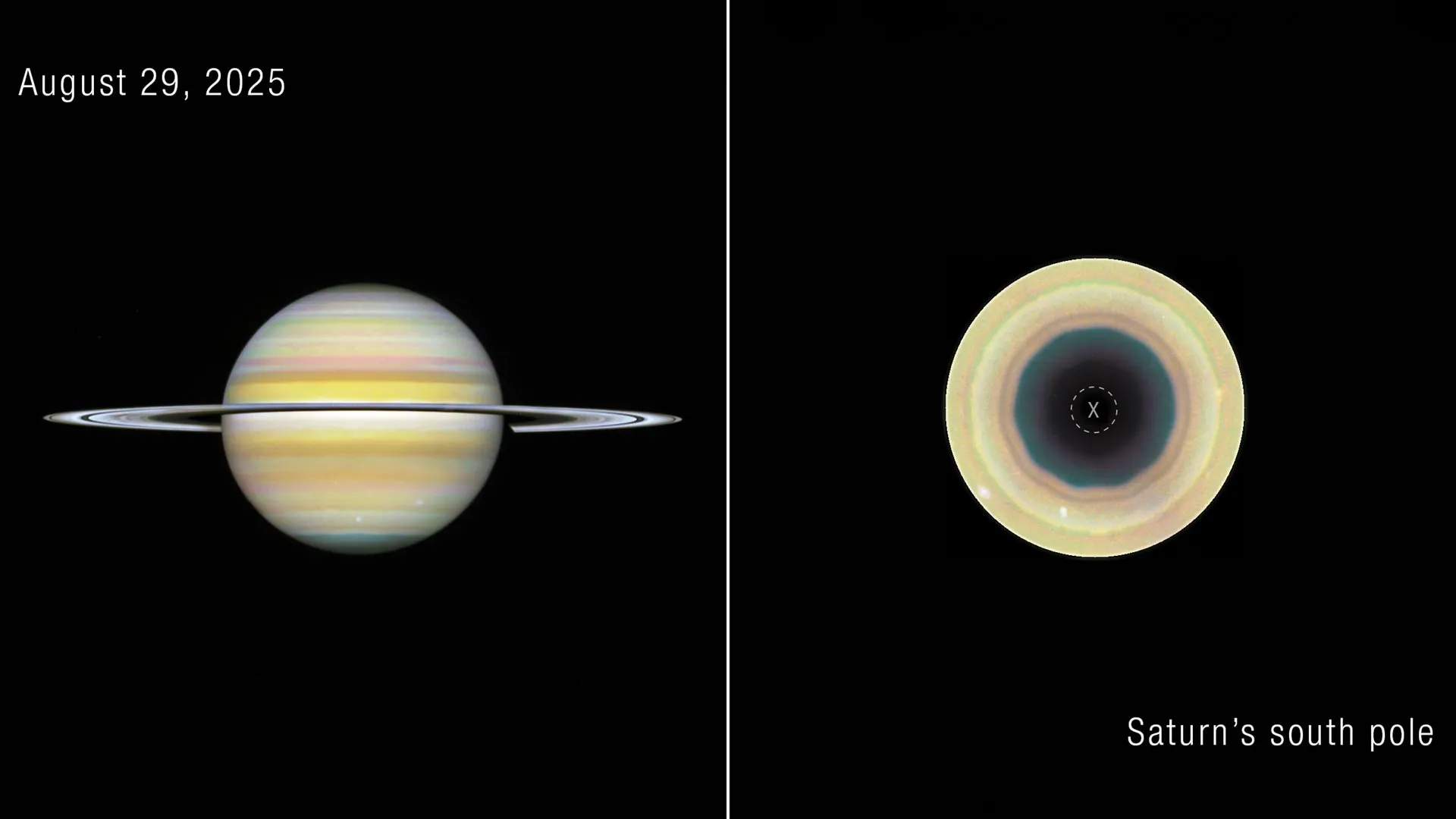
Scientists using NASA’s Hubble Space Telescope have identified a striking 10-sided atmospheric feature at Saturn’s south pole, representing the first discovery of a large, regularly shaped jet pattern in that region of the planet. The structure, which resembles some characteristics of Saturn’s well-known northern hexagon but exhibits important distinctions, has been tracked through multiple years of observations dating back to 2023. Findings from the research were published in the journal Science Advances.
The detection of this feature involved collaboration between professional astronomers and amateur observers. Researchers at the University of the Basque Country in Spain, working through the Planetary Virtual Observatory Laboratory, first identified faint traces of the structure in ground-based images from 2024 with assistance from amateur astronomers. Subsequent observations from the ground in 2025 provided clearer evidence of the decagon’s development. When professional astronomers examined archived Hubble data, they confirmed the structure’s presence in images extending back to 2023, demonstrating gradual strengthening over time.
Unlike Saturn’s northern hexagon, which has remained visible for more than 40 years, this southern feature appears to be a newly formed or recently activated atmospheric pattern. The decagon exists within one of Saturn’s jet streams and extends through multiple layers of the atmosphere rather than appearing only at cloud-top level. Researchers note that its appearance shifts slightly depending on the wavelength of light used for observation, reflecting its vertical structure within different atmospheric altitudes.
The precise cause of the decagon’s formation remains unknown, as does its long-term stability. Scientists indicated that additional data from Hubble and NASA’s James Webb Space Telescope, combined with computer modeling, will be necessary to determine how the structure originated, whether it will persist like its northern counterpart, and what atmospheric principles govern its behavior. The discovery underscores the value of sustained observational programs in revealing planetary changes that develop gradually over years.
Article Attribution | Read More at Article Source
Article summary produced by Claude AI