

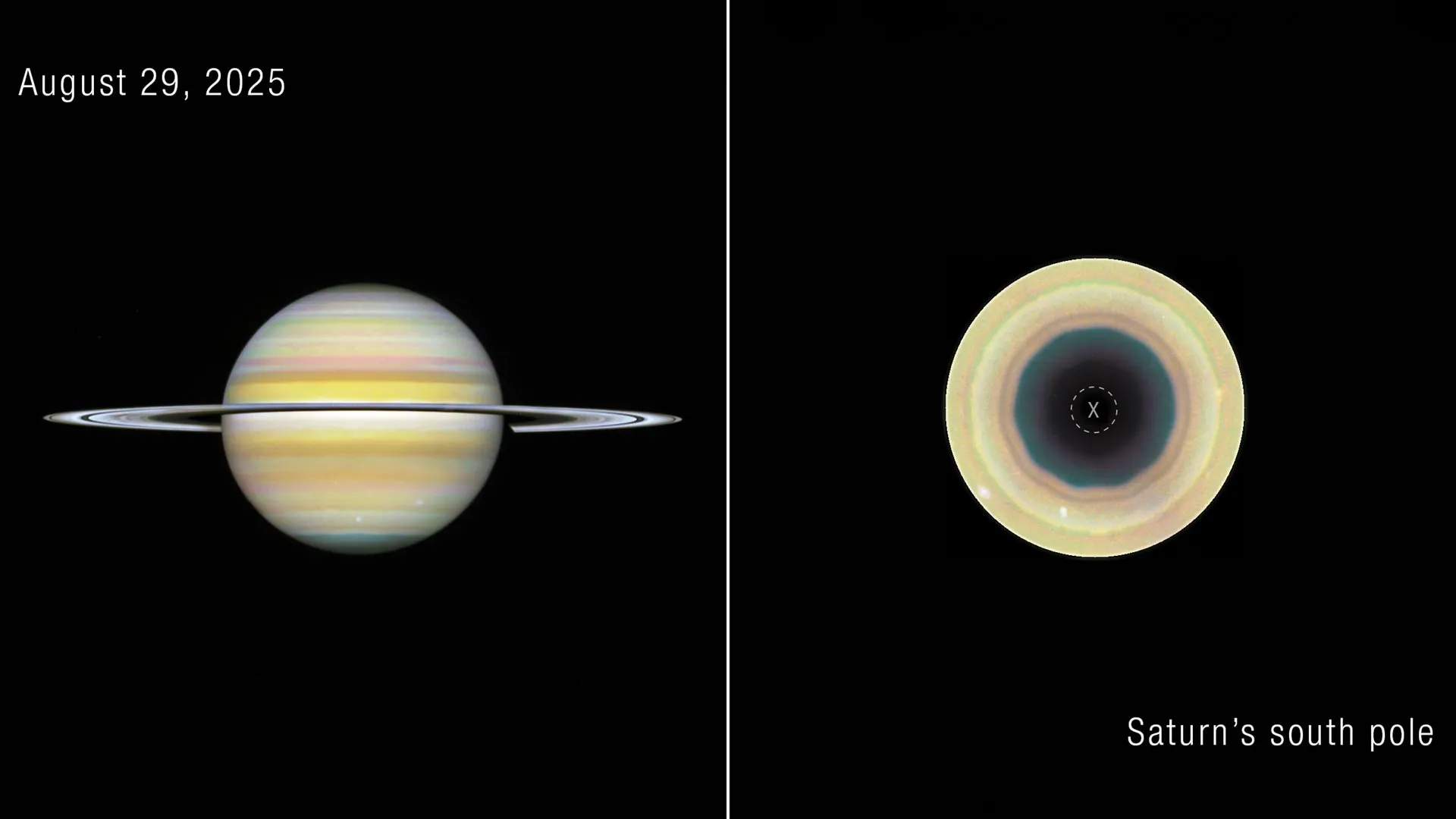
Researchers using NASA’s Hubble Space Telescope have identified a significant atmospheric feature on Saturn: a large, 10-sided wave pattern located near the planet’s south pole. This marks the first time scientists have documented a major, regularly formed jet structure in Saturn’s southern hemisphere, distinguishing it from the well-known hexagonal pattern at the northern pole.
The discovery builds on observations collected through the Hubble Outer Planet Atmospheres Legacy program, which has been capturing annual images of distant planets for over a decade. Scientists traced the feature’s development using data going back to 2023, when early faint indications of the structure were visible. Ground-based astronomers, including amateur observers Trevor Barry and Jean-Paul Oger working with researcher Agustín Sánchez-Lavega at Spain’s University of the Basque Country, initially noticed the unusual wave pattern in observations from 2024 and 2025. The detection benefited from Saturn’s seasonal positioning, which gradually made the south pole observable from Earth.
Detailed Hubble observations confirmed the structure extends through multiple atmospheric layers rather than appearing only at the cloud tops, indicating it represents a vertically extended phenomenon. The decagon’s apparent position shifts slightly depending on the observation wavelength, allowing astronomers to examine different altitudes within Saturn’s atmosphere. Amy Simon, the Outer Planet Atmospheres Legacy program principal investigator, emphasized the rarity of witnessing such an atmospheric pattern develop, noting that Saturn’s northern hexagon has remained stable for over 40 years while this southern feature appears to be actively strengthening.
Researchers remain uncertain what triggered the decagon’s formation or whether it will persist long-term. Further investigation using Hubble and NASA’s James Webb Space Telescope, combined with computer modeling, will be necessary to understand the formation mechanism and compare this structure to the stable northern hexagon. Scientists hope these findings will illuminate atmospheric dynamics on giant planets and potentially offer insights applicable to Earth’s own atmospheric behavior.
Article Attribution | Read More at Article Source
Article summary produced by Claude AI