

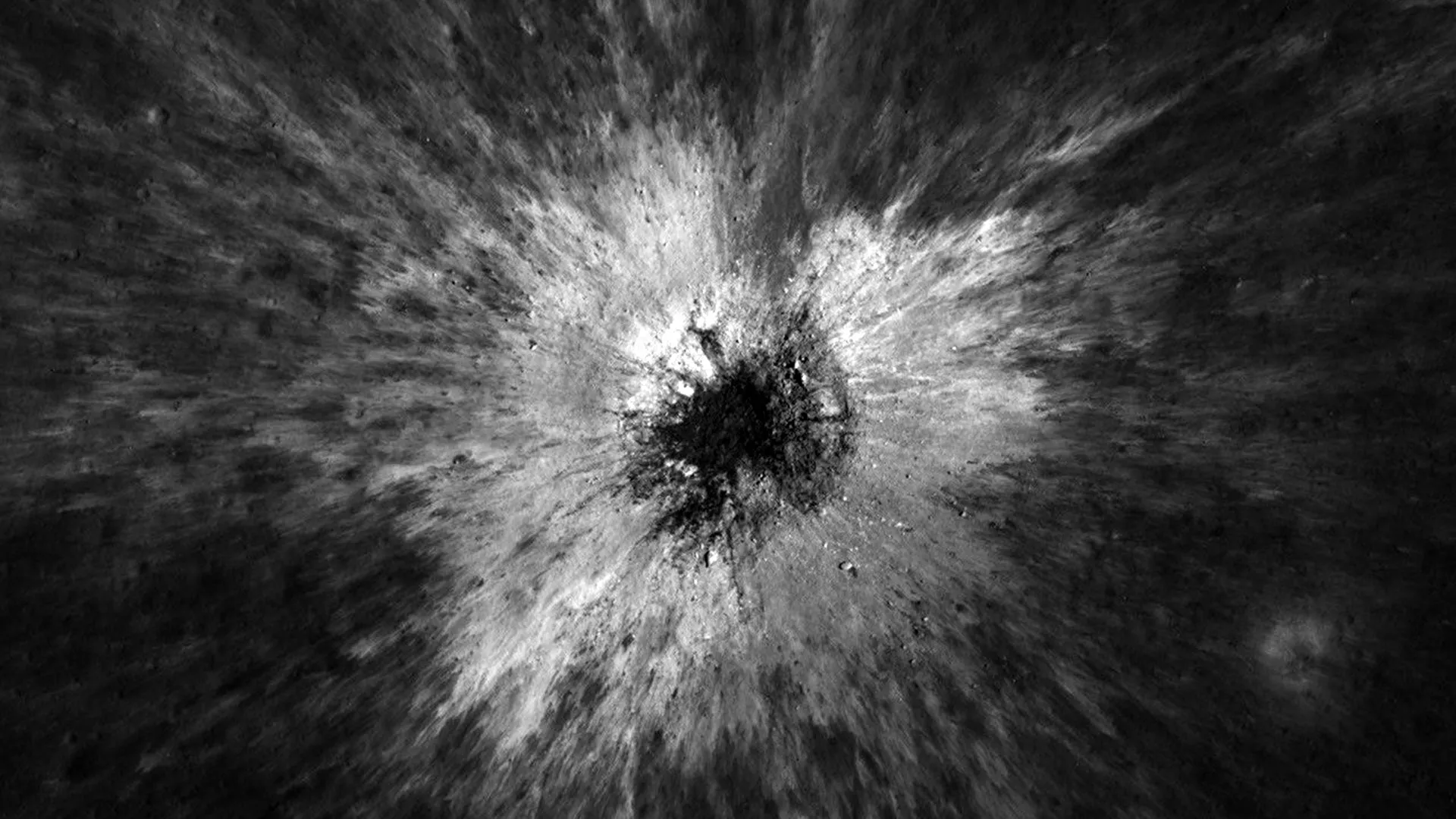
Scientists working with NASA’s Lunar Reconnaissance Orbiter identified a newly formed impact crater on the Moon that represents the largest such feature ever detected in the solar system. The discovery was made by Robert Wagner, an image-processing specialist, who noticed an unusually bright patch with a dark halo while conducting a routine comparison of lunar maps. The crater, officially named McGetchin in honor of pioneering lunar scientist Tom McGetchin, measures 728 feet across and 141 feet deep, roughly equivalent in width to two football fields.
The impact that created McGetchin occurred sometime between April 11 and May 22, 2024, when an asteroid or comet roughly the size of a three- to six-story building struck the lunar surface. Scientists estimate that impacts of this magnitude occur on the Moon approximately once every century or less frequently. The findings were published in Science Advances on September 16, demonstrating the value of NASA’s long-running lunar observation programs as the agency prepares for sustained human presence and expanded scientific and commercial activities on the Moon.
The Lunar Reconnaissance Orbiter, which has been circling the Moon for more than 17 years, has identified at least 1,000 new impact craters during its mission. The spacecraft’s instruments study the lunar landscape, surface composition, temperature, and radiation environment. Unlike Earth, the Moon lacks an atmosphere to slow or burn up incoming space rocks, meaning asteroids and meteoroids strike the surface directly. Researchers estimate that impacts creating craters around 30 feet across occur approximately 140 times annually across the lunar surface.
Following the crater’s discovery, scientists used the LRO’s thermal instrument, Diviner, to examine the surrounding region and uncovered an unexpected finding. An area roughly 4 miles wide around McGetchin registers approximately 16 degrees Fahrenheit colder at night than nearby terrain. Researchers determined that the temperature difference results from changes in the lunar regolith, where the impact loosened and churned up material, reducing its density and heat-retention capacity. This cold spot phenomenon suggests that major impacts alter the lunar surface far beyond the crater itself, potentially affecting future exploration activities through impacts on rover mobility and surface conditions.
Article Attribution | Read More at Article Source
Article summary produced by Claude AI