

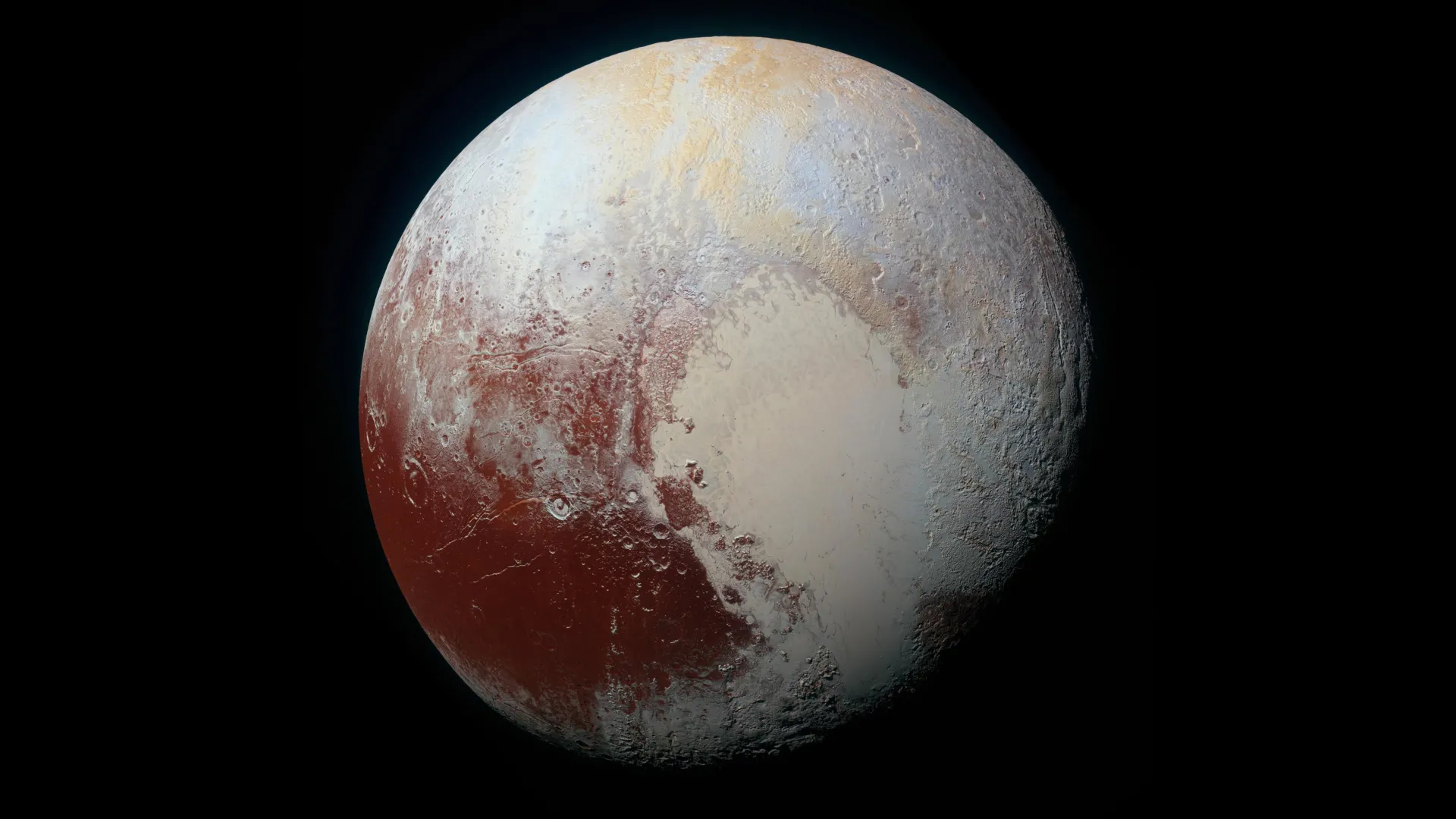
A research team led by Southwest Research Institute has analyzed data from NASA’s New Horizons spacecraft and identified potential evidence of liquid nitrogen movement on Pluto’s surface. The findings focus on Sputnik Planitia, a vast nitrogen glacier larger than Texas and Oklahoma combined, where images from 2015 and 2016 revealed unusual dark markings in the glacier’s northern region.
The dark features on Sputnik Planitia resemble patterns commonly seen on Earth’s glaciers when exposed to liquid water or subsurface fluid flow. To investigate this similarity, researchers compared New Horizons imagery with NASA Landsat 9 satellite data of icy regions on Earth, including Greenland’s ice sheet. Based on these comparisons, scientists propose that liquid nitrogen from beneath Pluto’s surface may be rising through cracks and wetting the frozen nitrogen surface. The surface of Sputnik Planitia is estimated to be less than one million years old, meaning any observed features formed relatively recently in geological terms.
Computer simulations suggest a mechanism by which this process could occur. Models indicate that nitrogen ice at the base of Sputnik Planitia, which extends several kilometers deep, can melt under pressure and temperature conditions, creating liquid nitrogen. This liquid could then rise through narrow channels toward the surface via buoyancy or pressure forces. Once at the surface, the nitrogen could remain liquid long enough to flow downhill and create the dark markings observed in spacecraft images.
While researchers have not yet identified comparable activity elsewhere on Pluto, more than half of the dwarf planet remains unmapped at high resolution. Scientists note that similar mechanisms involving subsurface melting and liquid upwelling may explain geothermal activity observed on other bodies in the solar system, such as Triton, Neptune’s largest moon. The research appears in the peer-reviewed Planetary Science Journal.
Article Attribution | Read More at Article Source
Article summary produced by Claude AI