

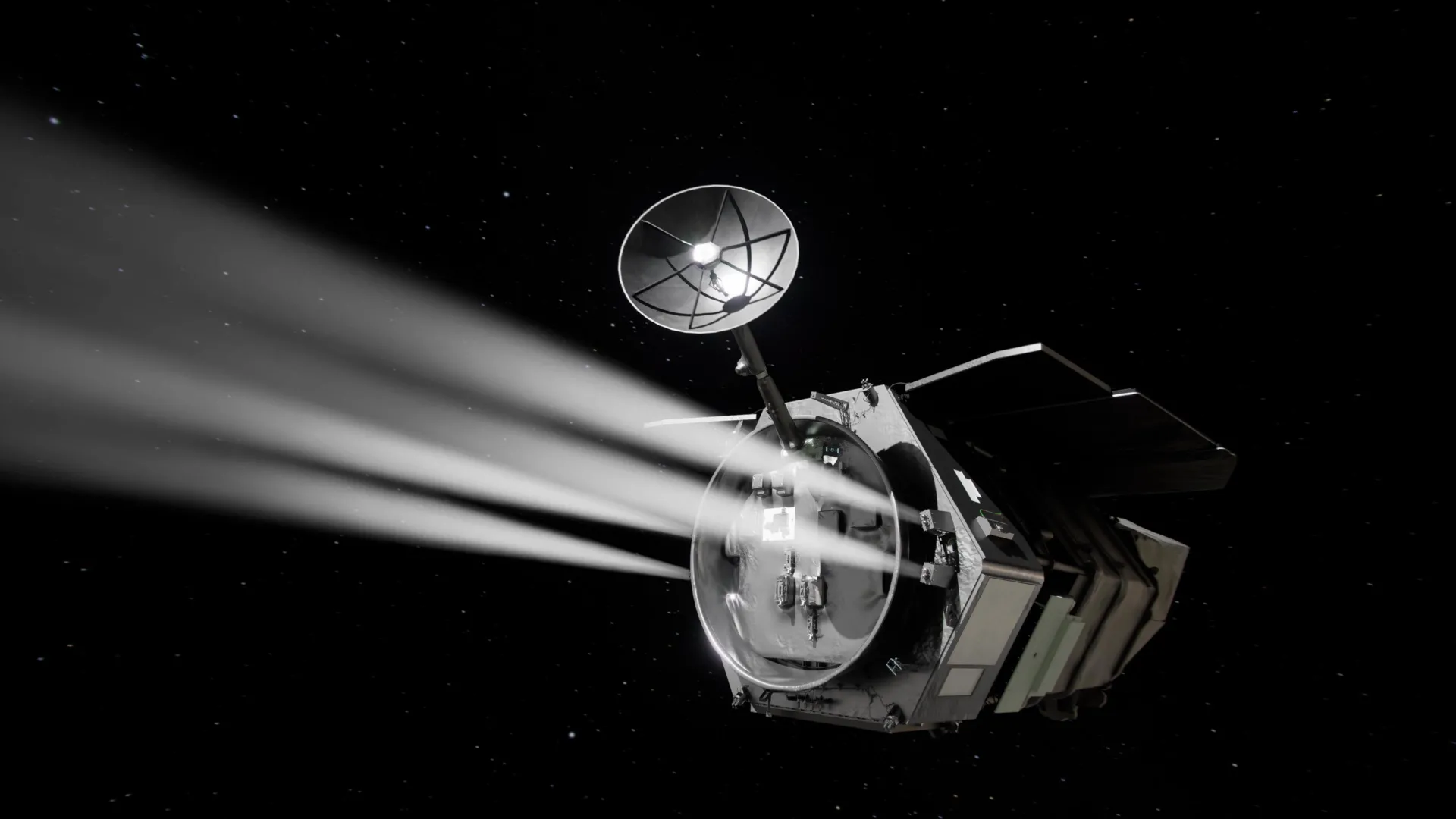
NASA’s Nancy Grace Roman Space Telescope has demonstrated exceptional fuel efficiency during its initial operations, potentially extending its operational lifespan from 10 years to more than 22 years. The extension results from multiple converging factors that have reduced propellant consumption across the mission’s critical early phases.
The spacecraft completed its first mid-course correction on August 31 with remarkable precision, using approximately 40 pounds of fuel compared to the planned allocation of 441 pounds. This maneuver achieved more than 99% accuracy and alone could provide roughly four additional years of scientific operations. According to Jamie Dunn, center director at NASA’s Goddard Space Flight Center, the achievement reflects careful planning by the orbital dynamics team, skilled execution by operations personnel, and a precise launch from SpaceX.
Roman began its journey carrying more propellant than originally anticipated. Engineers had conservatively calculated fuel requirements based on a maximum spacecraft weight of 21,605 pounds, but the actual launch weight was 17,760 pounds. This lighter mass required less fuel for course corrections and allowed engineers to fill the propellant tanks to full capacity rather than only partially filling them. According to Alison Rao, the Roman propulsion lead at NASA Goddard, this additional fuel capacity could support approximately four more years of operations.
Further fuel savings are expected from the spacecraft’s second mid-course correction, scheduled for later this month. Because the first maneuver was highly accurate, the follow-up adjustment will be smaller than originally planned, potentially conserving additional propellant. The second correction and subsequent orbital insertion at the L2 position, expected around early December, are both anticipated to require less fuel than originally budgeted, potentially providing another four years of mission life.
Once Roman reaches its permanent orbit around L2, maintaining its position will require only periodic station-keeping burns approximately once every 28 days, further extending the telescope’s operational duration and preserving fuel for scientific observations.
Article Attribution | Read More at Article Source
Article summary produced by Claude AI