

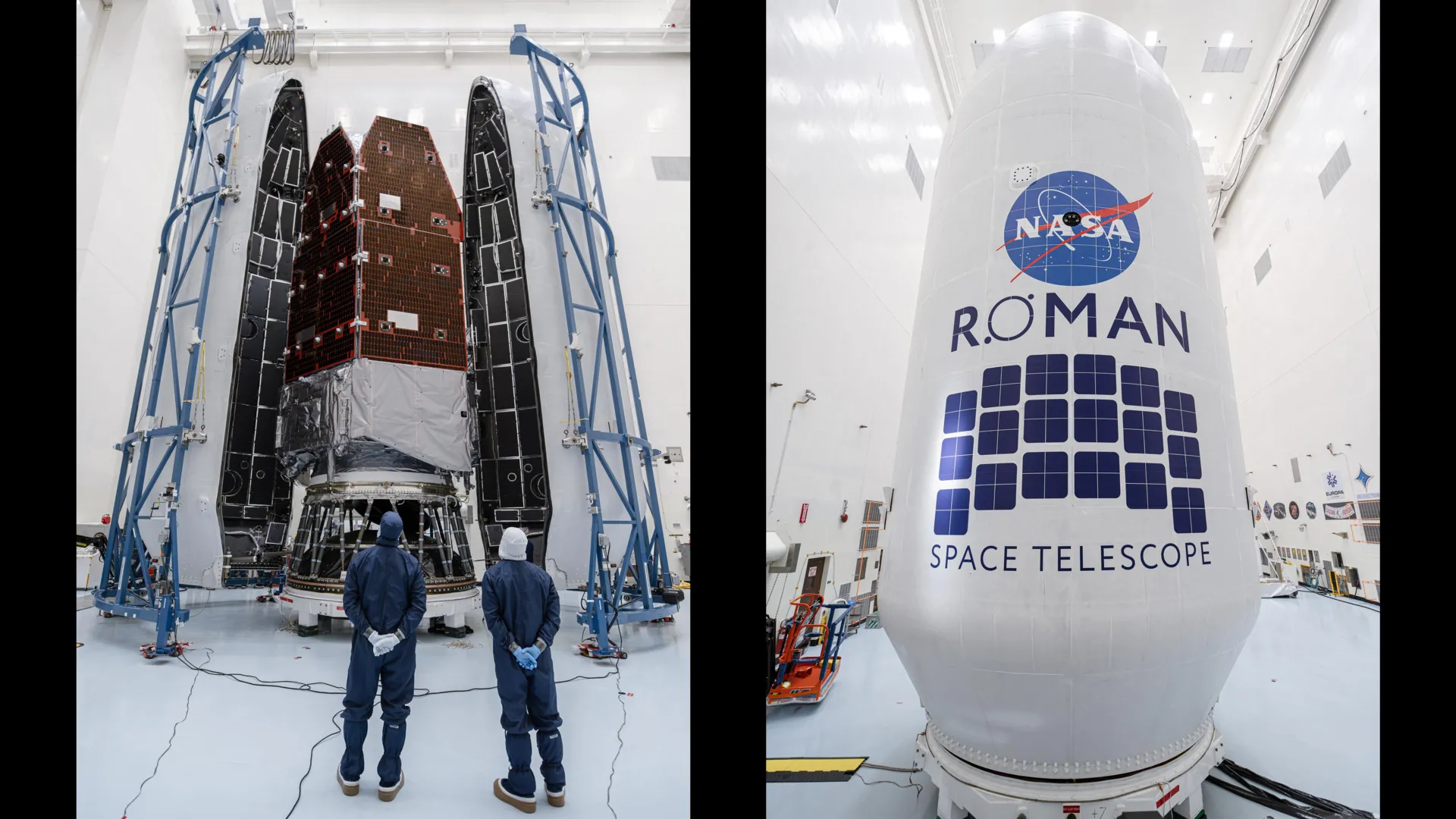
NASA has reached a significant milestone in preparation for the Nancy Grace Roman Space Telescope’s launch. On Aug. 21, teams at Kennedy Space Center in Florida completed the encapsulation of the observatory within the protective fairing of its SpaceX Falcon Heavy rocket at the Payload Hazardous Servicing Facility.
The fairing serves as a critical protective shell that surrounds the spacecraft at the rocket’s tip. Measuring 43 feet in height, it shields Roman from environmental hazards while grounded and during the initial, most turbulent phases of launch. The fairing, along with specialized ground equipment, maintains a controlled environment as teams relocate the telescope between different facilities. During ascent through Earth’s atmosphere, the Falcon Heavy will subject Roman to intense sound waves, aerodynamic pressure, and extreme heat. The fairing is engineered to protect the observatory from these stresses. Several minutes after launch, when the rocket reaches an altitude where atmospheric conditions are no longer a threat, the fairing’s two sections will separate and descend back to Earth, with SpaceX planning to recover both halves.
Following launch, Roman will travel to Sun-Earth Lagrange point 2, a gravitational equilibrium location that provides an ideal environment for space-based observations. Before liftoff, teams will transport the encapsulated observatory to SpaceX’s facility at Launch Pad 39A, where it will be mounted to the Falcon Heavy rocket. NASA and SpaceX are targeting no earlier than 7:26 a.m. EDT Sunday, Aug. 30, for the launch.
Once operational, Roman is expected to identify thousands of exoplanets orbiting distant stars, providing insights into the prevalence and characteristics of various planetary systems throughout the galaxy. Beyond exoplanet discovery, the telescope will focus on two major cosmological puzzles: dark matter and dark energy. Dark matter, which remains invisible to direct observation, appears to influence galactic formation and large-scale cosmic structures through its gravitational effects. Dark energy refers to the unknown force accelerating the universe’s expansion. Through extensive sky surveys and analysis of matter and galaxy distribution across the cosmos, Roman’s observations may reveal new information about both phenomena and enhance scientific understanding of cosmic evolution and expansion dynamics.
Article Attribution | Read More at Article Source
Article summary produced by Claude AI