

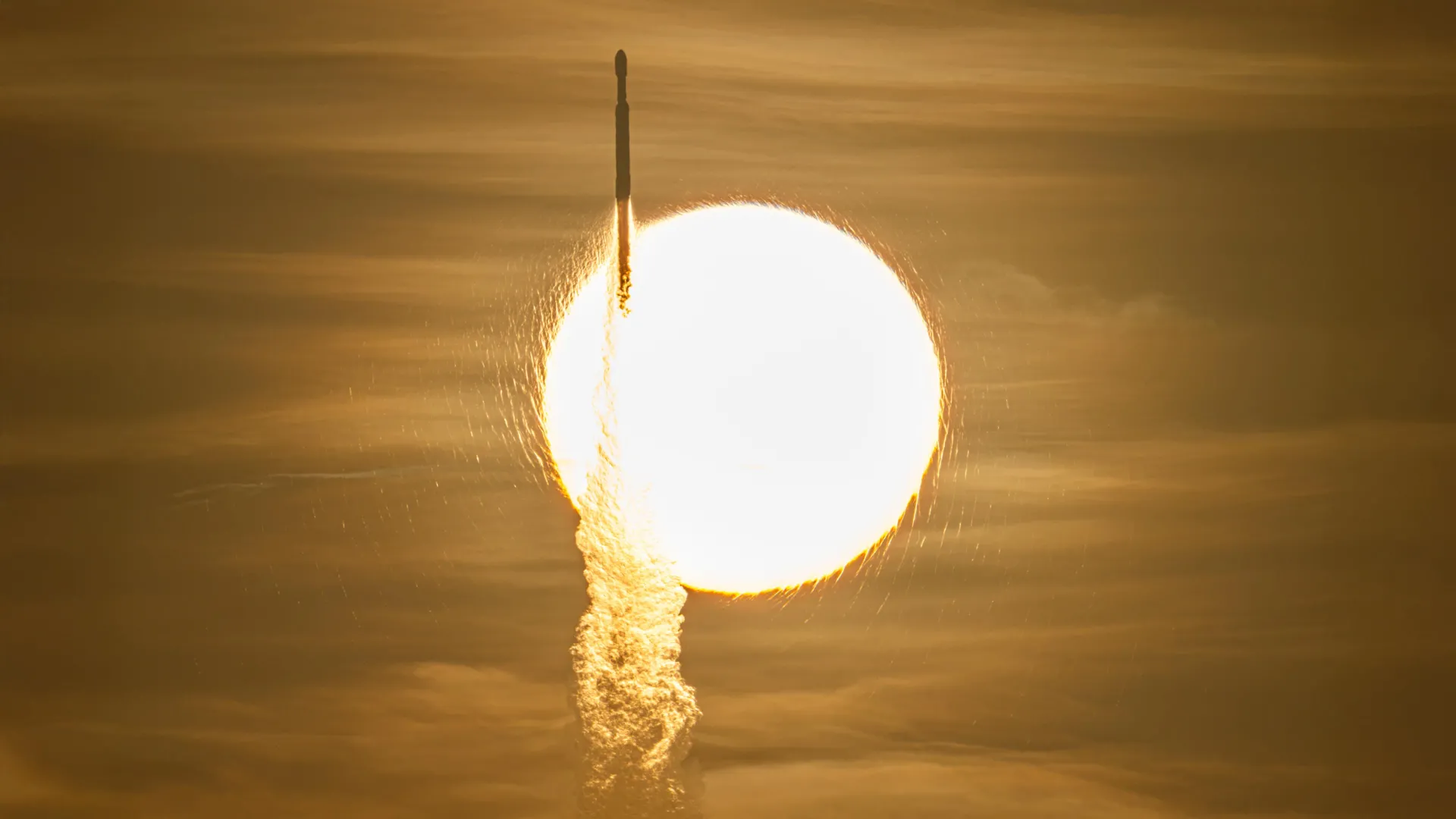
NASA’s Nancy Grace Roman Space Telescope lifted off at 7:26 a.m. EDT on Sunday from Launch Complex 39A at Kennedy Space Center in Florida aboard a SpaceX Falcon Heavy rocket. The observatory is beginning a three-month journey to reach the second Sun-Earth Lagrange point, or L2, located approximately one million miles from Earth. Controllers at NASA’s Goddard Space Flight Center in Greenbelt, Maryland began receiving telemetry from Roman within seven minutes of launch, and the rocket’s boosters successfully returned to the launch site for refurbishment.
Roman’s primary scientific objectives include investigating dark matter, dark energy, and exoplanets. The mission is distinguished by its combination of sharp infrared imaging capabilities with an unusually wide field of view, allowing astronomers to observe large regions of space while examining the distant cosmic past. The observatory is designed to survey the universe approximately 1,000 times faster than the Hubble Space Telescope by maintaining optical stability while rapidly transitioning between observations. NASA Administrator Jared Isaacman noted that Roman was delivered ahead of schedule and on budget, representing over a decade of work by NASA personnel and industry partners.
During the initial phase of the mission, Roman will deploy its solar panels, high-gain antenna, and other critical systems. The Coronagraph Instrument, one of Roman’s key components, will be activated to demonstrate technology for directly imaging planets similar to Jupiter and potentially supporting future missions designed to photograph Earth-like worlds. The Wide Field Instrument, Roman’s main scientific component, will be activated a few weeks into the journey, featuring a 300 megapixel infrared camera equipped with 18 detectors.
Throughout the commissioning period, scientists and engineers will conduct extensive testing and calibration of Roman’s instruments to ensure proper operation before the full science program commences. NASA expects to release Roman’s first images in early 2027. Once operational, the telescope will transmit approximately 1.4 terabytes of data to Earth daily—the highest daily data rate for any NASA astrophysics mission to date. Machine learning, artificial intelligence, and citizen scientists will assist researchers in analyzing the vast quantity of observations Roman will generate.
Article Attribution | Read More at Article Source
Article summary produced by Claude AI