

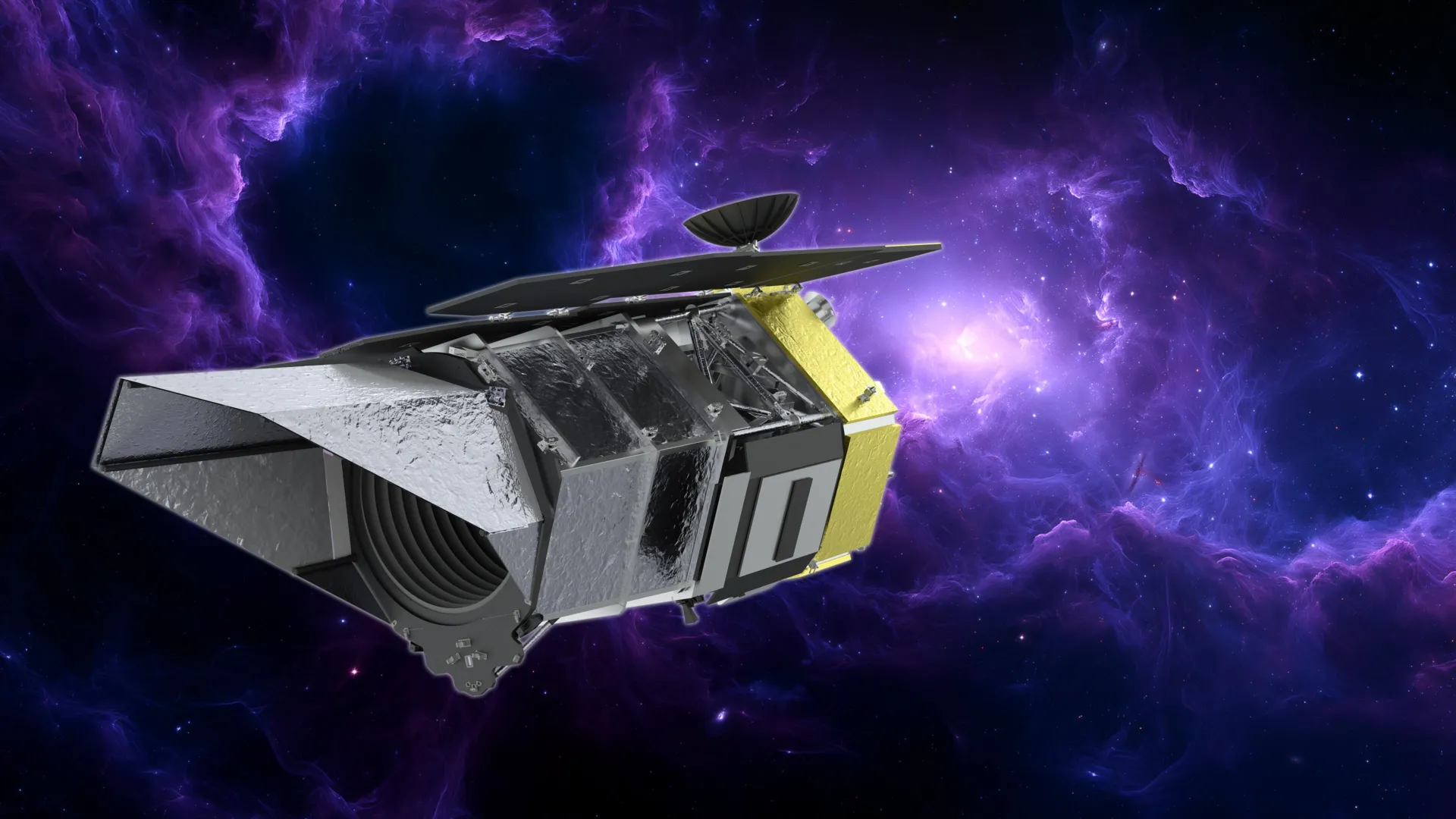
NASA’s Nancy Grace Roman Space Telescope is scheduled to launch in two days, representing the agency’s flagship astrophysics mission following the James Webb Space Telescope. The observatory is expected to begin science operations in January 2027. Unlike Webb, which focuses on detailed study of small cosmic regions, Roman is engineered to rapidly survey extensive areas of the sky.
Roman features a 7.9-foot primary mirror matching Hubble’s diameter but with significantly expanded observational capabilities. Its Wide Field Instrument can image areas 100 times larger than Hubble’s cameras while maintaining equivalent sensitivity. The Coronagraph Instrument is designed to filter starlight, enabling study of exoplanets and surrounding disks. Over three decades, Hubble has observed approximately 0.1% of the night sky, whereas Roman has the potential to survey the entire sky at comparable resolution. Both observatories detect infrared light, allowing astronomers to combine observations for comprehensive analysis of cosmic phenomena.
University of Arizona researchers will contribute to multiple scientific areas. The Arizona Cosmology Lab received funding to support investigations into dark matter and dark energy, two mysterious components comprising nearly all the universe. Professor Elisabeth Krause leads a team developing kinematic lensing techniques to study these phenomena with greater precision. Professor Tim Eifler directs efforts to interpret Roman’s cosmological observations and received funding for computing infrastructure to convert observational catalogs into cosmological analysis.
Roman’s Coronagraph Instrument will demonstrate technologies for suppressing starlight, enabling direct imaging of distant planets and disks. The instrument is expected to detect planets 100 million times fainter than their host stars, representing performance 100 to 1,000 times superior to existing space-based coronagraphs. This capability will serve as a pathfinder for future observatories designed to search for signs of life in other solar systems. University of Arizona astronomers will participate in observation planning and will analyze atmospheric data from planets beyond our solar system using coronagraph observations.
Article Attribution | Read More at Article Source
Article summary produced by Claude AI