

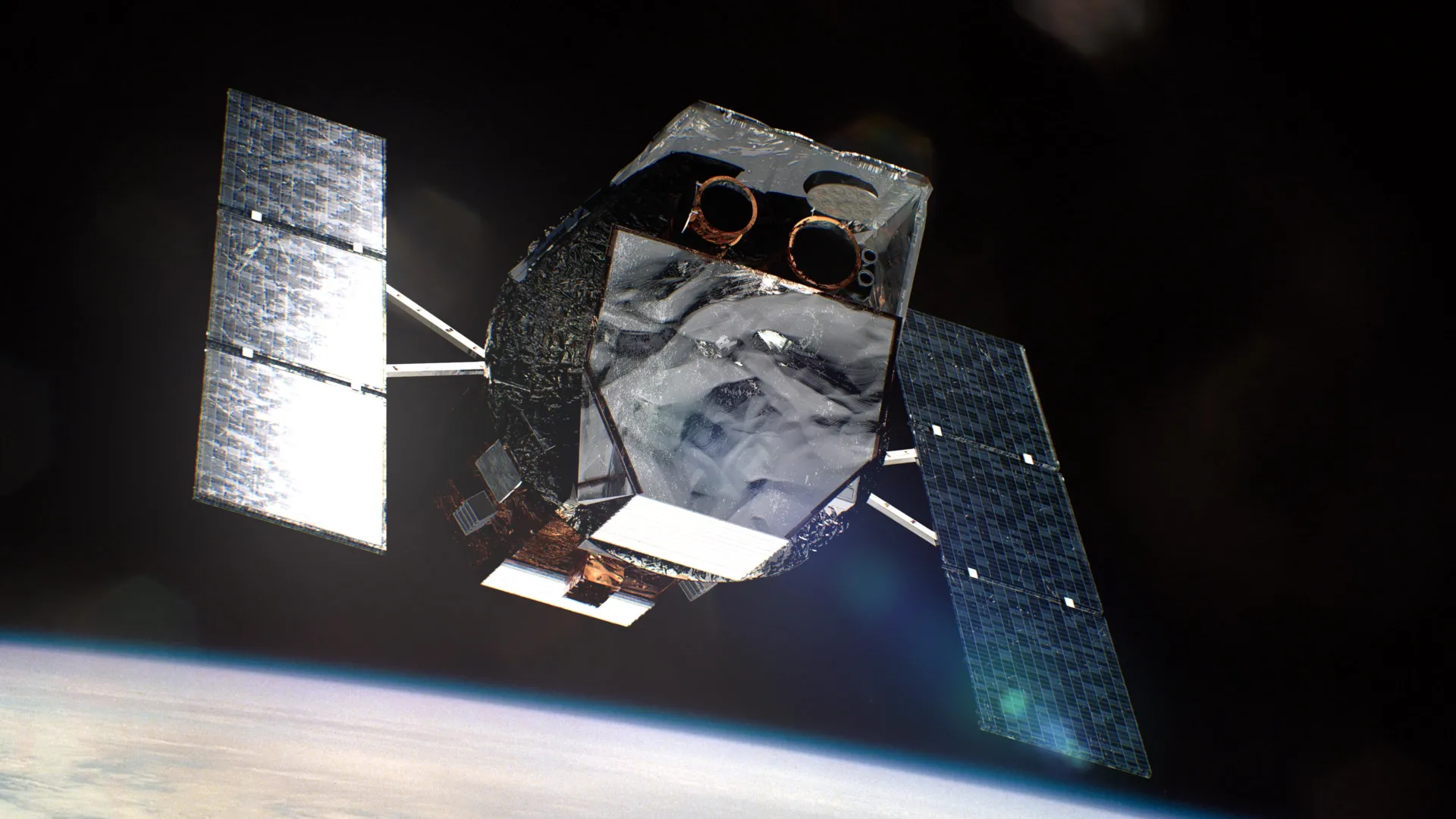
NASA’s Neil Gehrels Swift Observatory has returned to active observations following a period of reduced operations aimed at extending its operational lifetime. Two of the facility’s three instruments—the Ultraviolet/Optical Telescope and X-ray Telescope—were reactivated on Aug. 26, after being powered down in February. The Burst Alert Telescope, which was deactivated in April, is expected to resume data collection within the coming weeks.
Swift has operated as a significant astronomical asset for 21 years, providing observations across multiple wavelengths and playing a crucial role in detecting and responding to transient cosmic events. The observatory’s rapid response capability allows it to redirect toward sudden astronomical phenomena and alert other observatories, enabling coordinated follow-up observations of fleeting occurrences.
The spacecraft faces a fundamental challenge stemming from its location in low Earth orbit. Although positioned hundreds of miles above Earth’s surface, the spacecraft remains subject to atmospheric drag from the upper reaches of the planet’s atmosphere. Increased solar activity in recent years has expanded Earth’s upper atmosphere, intensifying this drag and causing Swift to lose altitude faster than expected. Without onboard propulsion systems, the observatory cannot independently counteract this orbital decay.
In response to accelerating altitude loss, NASA contracted Katalyst Space to conduct an unprecedented orbital boost mission. The company’s LINK spacecraft launched in July but encountered orientation control issues. NASA and Katalyst announced on Aug. 19 that the capture and boost mission would not proceed as planned. Katalyst will instead conduct proximity operations near Swift to test technologies for future satellite servicing applications.
With the boost mission abandoned, Swift’s remaining operational window has contracted significantly. The observatory must maintain altitude above 185 miles to operate effectively. NASA currently projects the spacecraft will fall below this critical threshold within one to two months, after which operations will become increasingly difficult and orbital decay will accelerate further. Until that point, Swift will continue gathering scientific observations as its orbit continues to decline.
Article Attribution | Read More at Article Source
Article summary produced by Claude AI