

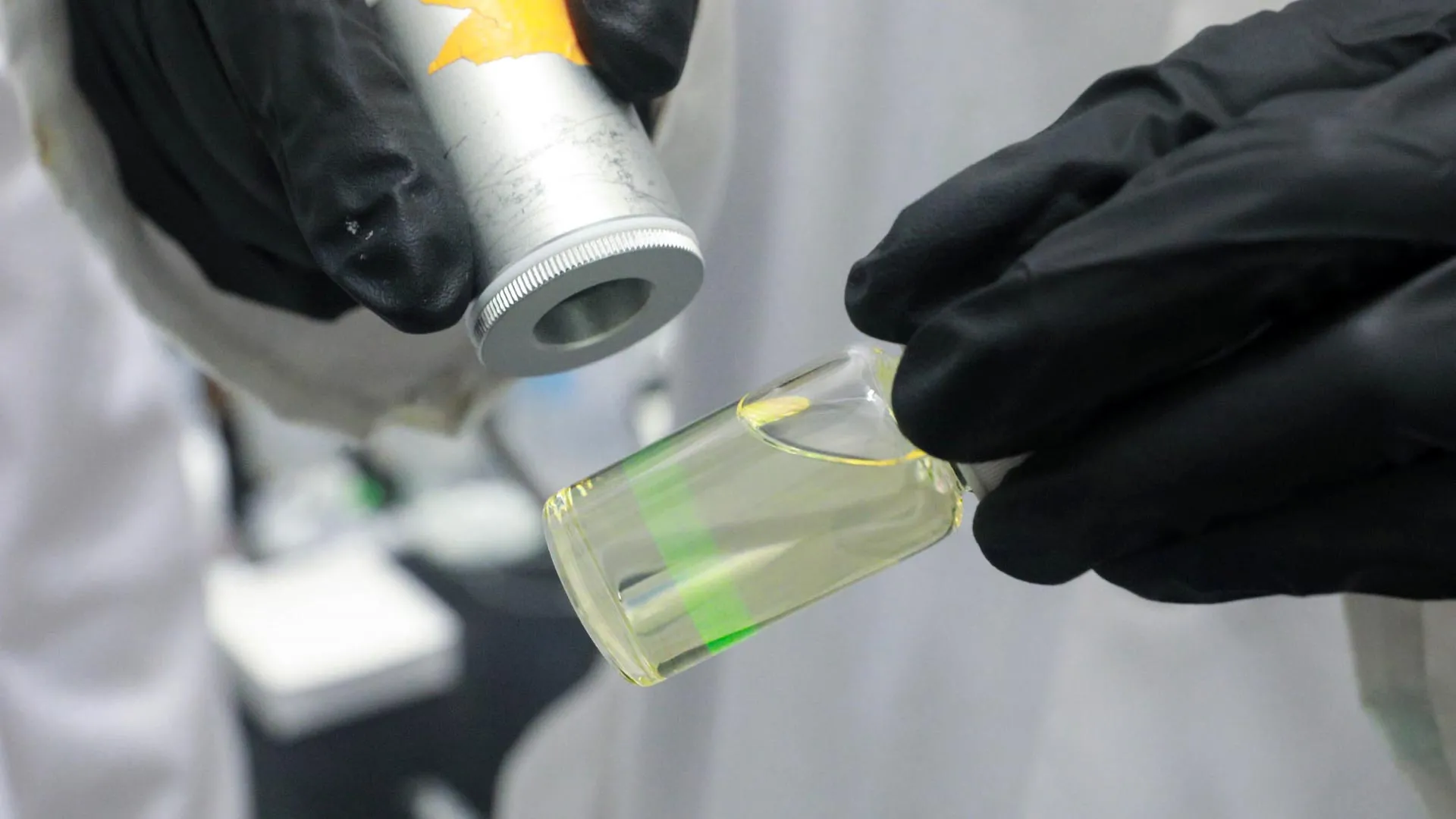
Researchers at the University of Toronto have created a new class of nanoparticles designed to detect trace chemicals while differentiating between molecules with similar structures. The particles function by absorbing low-energy photons and converting them into higher-energy photons that produce measurable light signals. According to the research published in the Journal of the American Chemical Society, these developments could enable pharmaceutical manufacturers to identify impurities in drug production and allow environmental scientists to locate chemical pollutants in groundwater at minimal concentrations.
The nanoparticles utilize a process called upconversion, which represents a significant departure from conventional fluorescent molecules used in detection for decades. Traditional fluorophores can only convert high-energy light into low-energy light, whereas these new particles reverse that process. They can be activated using near-infrared light from inexpensive lasers and respond by emitting bright green light. This approach offers a practical advantage because the different frequencies of input and output light allow researchers to filter out background signals more effectively, similar to how stars become visible when daylight fades.
The particles contain ytterbium and erbium ions from the lanthanide family to execute the upconversion mechanism. The engineering challenge involved preventing unwanted energy loss when packing these ions at high densities. The team redesigned the nanoparticles from flat hexagonal shapes into three-dimensional diamond-shaped structures with distinct core and shell regions, using a matrix composed of lithium, lutetium, and fluorine instead of the previous sodium, yttrium, and fluorine composition. This layered design creates a gradient where ytterbium ion concentration increases toward the center, enabling energy to flow primarily in one direction toward the erbium ions.
Computer modeling played a crucial role in achieving this design. Researchers used Monte Carlo simulations and density functional theory to evaluate dozens of chemical formulations and particle geometries before laboratory synthesis. The resulting nanoparticles demonstrate significantly enhanced brightness, producing light approximately 150 times brighter than previous dye-sensitized versions and roughly 50 times brighter than other highly optimized conventional structures. This increased brightness enables detection of very small quantities of target molecules and allows discrimination between structural isomers—molecules with identical atomic compositions but different spatial arrangements—a capability particularly valuable in pharmaceutical manufacturing where subtle structural differences can have substantial consequences.
Article Attribution | Read More at Article Source
Article summary produced by Claude AI