

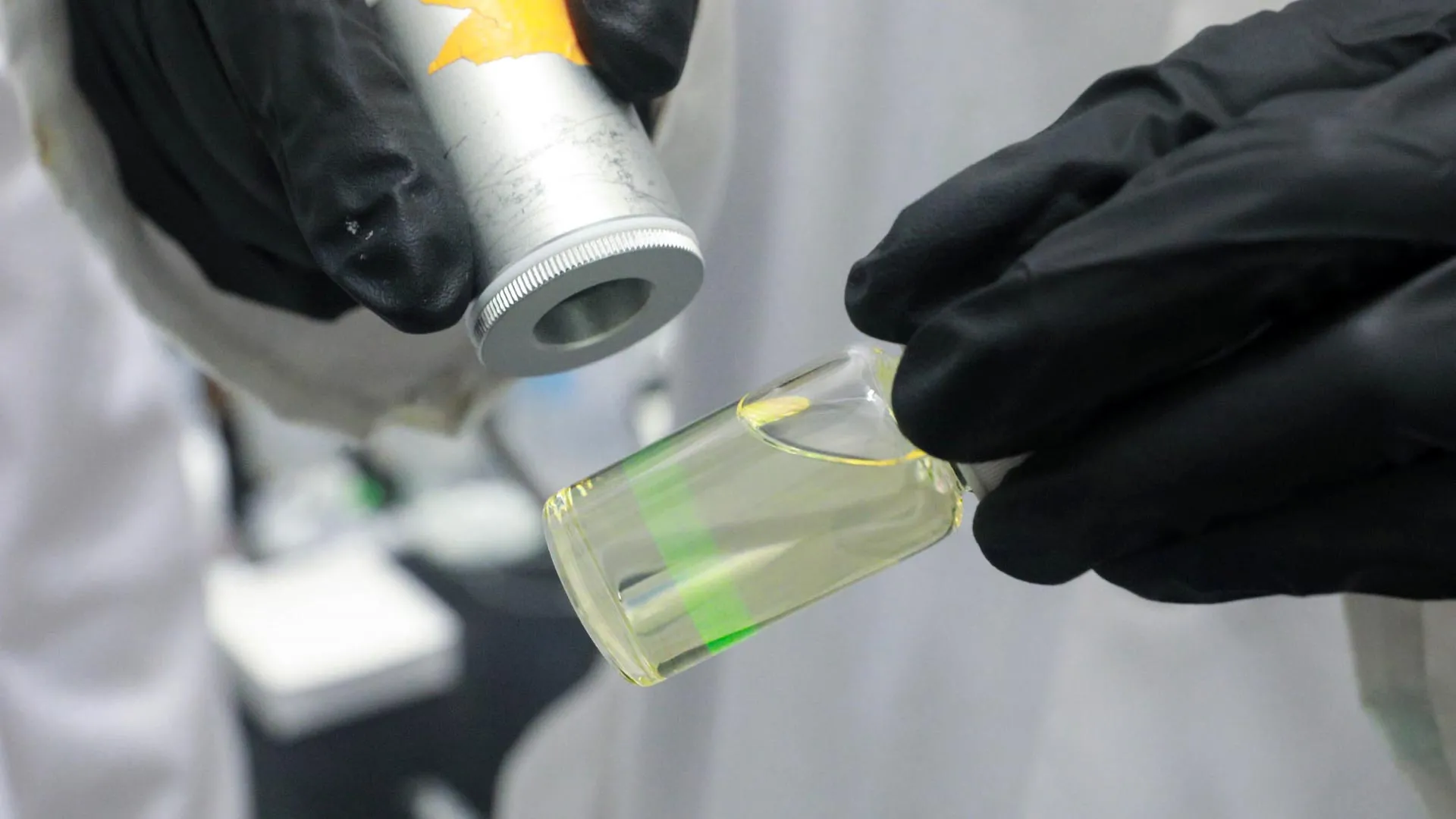
Researchers at the University of Toronto have created a new class of nanoparticles capable of detecting trace chemicals and differentiating between molecules with similar structures. The particles function through a process called upconversion, in which they absorb low-energy infrared light and emit higher-energy visible light in the form of a bright green signal. This capability addresses a significant limitation of traditional fluorescent molecules, which can only convert high-energy photons into lower-energy ones.
The nanoparticles rely on ytterbium and erbium ions from the lanthanide family to execute the upconversion process. When infrared light strikes the particles, organic dye molecules on their surface capture the incoming energy and transfer it to ytterbium ions, which relay it to erbium ions. The erbium ions then emit the energy as green light. A key advantage of this approach is that the difference in frequency between excitation and emission light allows researchers to filter out background noise from the sample itself, improving signal clarity significantly.
Previous versions of these nanoparticles faced a critical limitation: densely packing ytterbium atoms to increase brightness caused back-energy transfer, where outgoing energy would be absorbed by the relay ions instead of reaching the surface. The research team overcame this challenge by redesigning both the chemical composition and physical structure of the particles. They replaced the traditional sodium, yttrium and fluorine matrix with one containing lithium, lutetium and fluorine, and changed the particle shape from flat hexagons to three-dimensional diamond-shaped structures with distinct core and shell regions.
The new design creates a gradient where ytterbium ion density increases toward the core, establishing a one-directional energy pathway that keeps incoming light flowing toward the erbium ions. Computer modeling guided the development process, with researchers using Monte Carlo simulations and density functional theory to test dozens of chemical formulations before laboratory synthesis. The resulting nanoparticles emit light approximately 150 times brighter than previous dye-sensitized versions and roughly 50 times brighter than other highly optimized conventional structures.
The increased brightness enables detection of extremely small numbers of particles, translating to enhanced sensitivity for identifying target chemicals. The sensors can also distinguish between structural isomers—molecules containing identical atoms arranged differently—a capability valuable in pharmaceutical manufacturing where detecting unwanted impurities is critical. Research describing the particles was published in the Journal of the American Chemical Society.
Article Attribution | Read More at Article Source
Article summary produced by Claude AI