

Scientists have long understood that weather deteriorates paint and protective coatings through two primary mechanisms: mechanical stress from repeated water droplet contact and chemical damage from substances like acids or salts. However, researchers led by Hans-Jürgen Butt at the Max Planck Institute for Polymer Research have identified a previously overlooked third mechanism involving the electrical properties of water droplets.
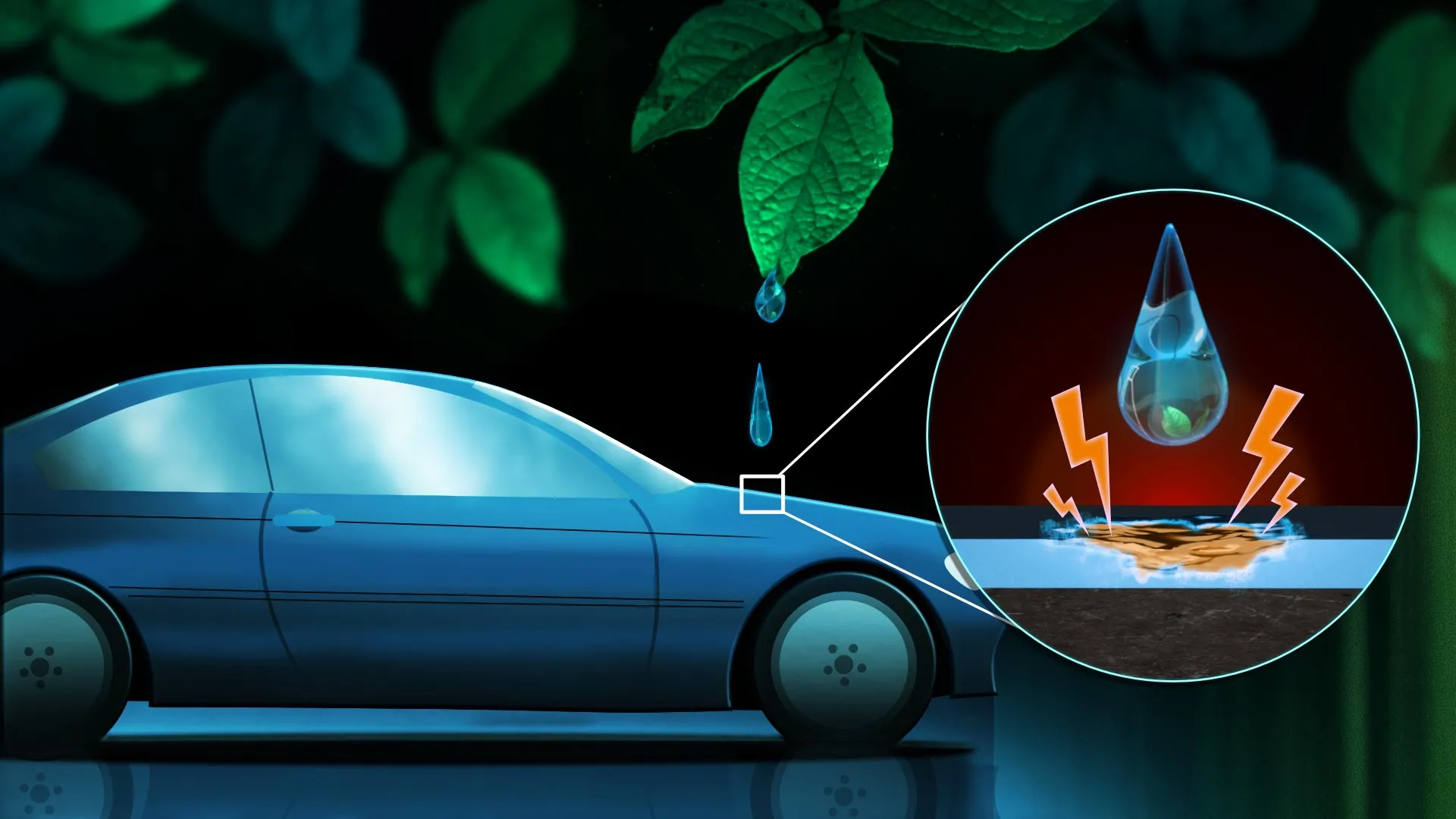
The team, collaborating with institutions including MIT, the University of Bonn, and others, found that water droplets can accumulate electrical charge as they move across surfaces through a process similar to friction electricity. When these charged droplets strike a protective coating, the accumulated charge discharges at the point of impact, potentially puncturing or damaging the material in localized spots resembling miniature lightning strikes.
To investigate this phenomenon, researchers conducted controlled experiments using Teflon as a test surface. When uncharged water droplets struck the coating 3,000 times, no visible damage occurred. However, when droplets were first allowed to roll across common materials such as plant leaves, PVC, or polystyrene before impacting the Teflon, microscopic examination revealed significant changes to both the protective surface and underlying metal.
The amount of electrical charge accumulated by droplets varied considerably depending on the material they contacted, with measured differences reaching up to a factor of ten. Notably, charged droplets produced detectable coating damage in all experiments, regardless of the variation in charge levels. The findings, published in the journal Nature, suggest that electrical discharge from charged water droplets represents an additional factor in the gradual breakdown of protective coatings over time.
The research team believes these discoveries could inform the development of more durable and effective protective coatings. Such advances could extend the lifespan of coatings used on cultural heritage sites, automobiles, major infrastructure projects, and residential structures.
Article Attribution | Read More at Article Source
Article summary produced by Claude AI