

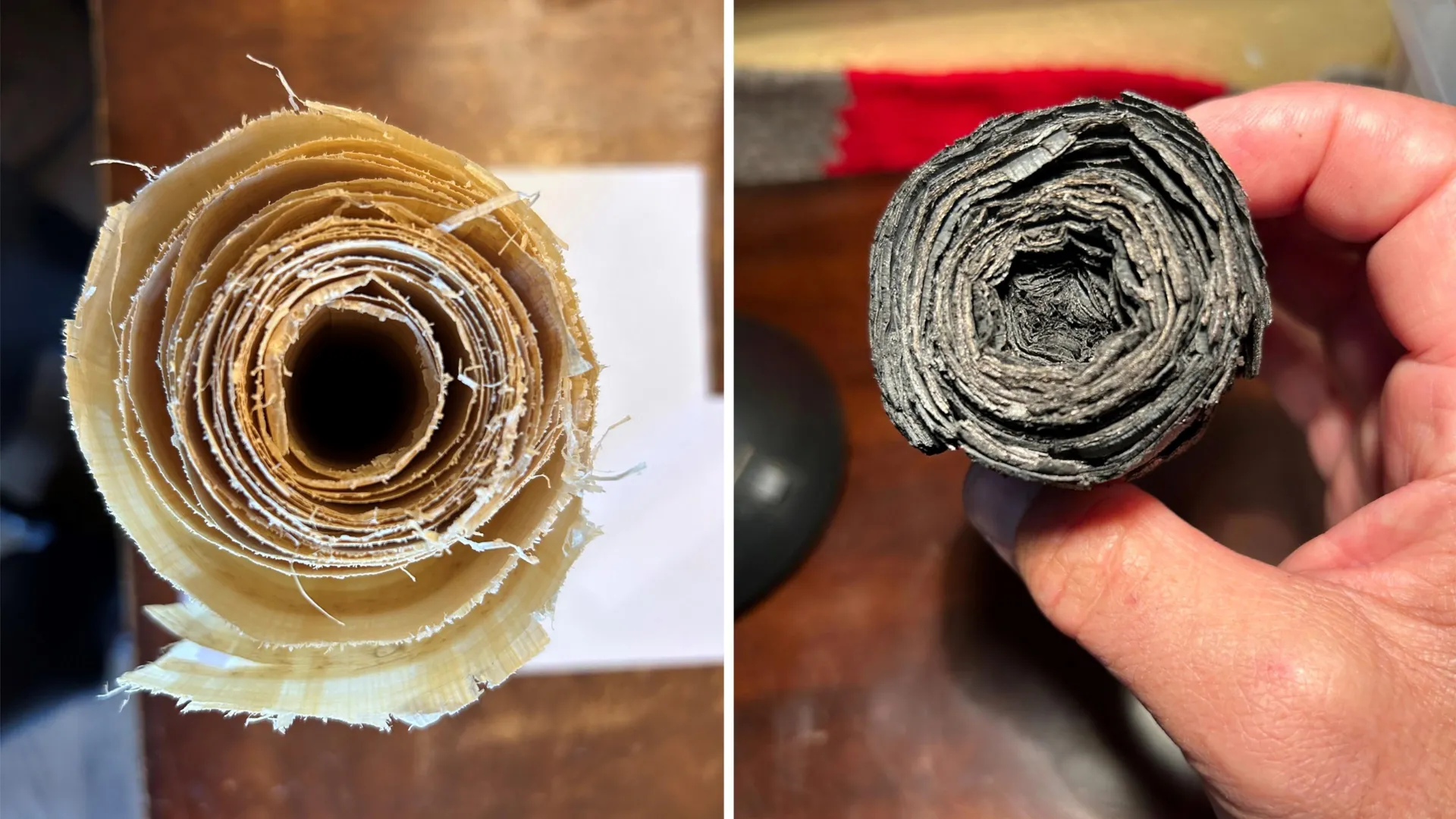
Researchers at UC Berkeley have demonstrated a method to read ancient papyrus scrolls from Herculaneum without physically opening them, using X-ray imaging to detect lead-based ink. The approach addresses a critical challenge in accessing one of antiquity’s most important archaeological discoveries.
The team, led by Douglas Seiler, conducted experiments by creating carbonized papyrus samples with traditional materials and inks, then scanning them with X-ray tomography. The results, published in PLOS ONE, showed that lead in ancient ink absorbs X-rays far more effectively than the surrounding charred papyrus, making text clearly visible in the scans. Lead signatures detected on the scans appeared about 25 times stronger than the surrounding material, providing excellent contrast for digital reconstruction of the writing.
The Herculaneum library, buried when Mount Vesuvius erupted in 79 C.E., represents the only intact library from the ancient world. The eruption preserved over 1,000 papyrus scrolls, though they remain extremely fragile. Physical attempts to open the scrolls since their discovery in 1752 often destroyed them entirely, leading authorities to halt such efforts. Among scrolls that were successfully opened were previously unknown works by ancient philosophers and scholars.
The research team also identified that handheld X-ray fluorescence scanners can quickly detect lead-based ink in scrolls, providing a practical screening method before committing resources to detailed imaging. Currently, approximately 1,800 scrolls and fragments are held in collections across Italy, France, and England, with only a small number successfully deciphered so far. None of those previously read scrolls had been systematically tested for lead content. Researchers believe a comprehensive search for lead-based inks could significantly expand access to these irreplaceable texts from the ancient world.
Article Attribution | Read More at Article Source
Article summary produced by Claude AI