

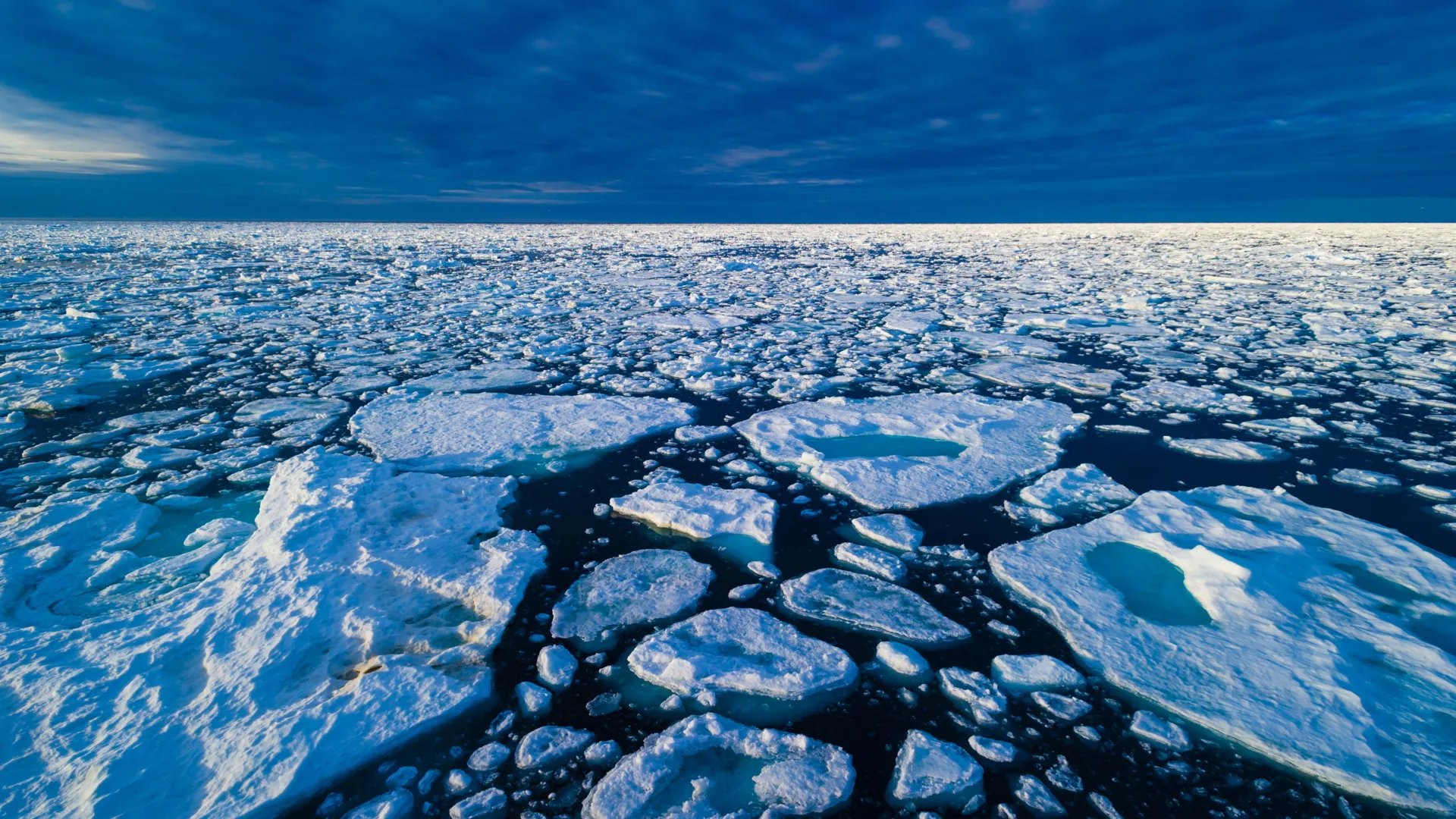
A team of scientists has identified a previously overlooked mechanism affecting how Arctic sea ice moves across the ocean. Rather than responding solely to wind forces as traditional models suggest, the ice’s motion is significantly influenced by repeated collisions between individual ice floes, the floating slabs that make up the Arctic ice pack.
Arctic sea ice exists as separate pieces called floes that range from several meters to several kilometers in width. While wind is recognized as a primary driver of ice motion, observations have consistently shown discrepancies between wind-based predictions and actual ice behavior. The ice often moves at different speeds than models forecast and spreads more slowly than expected, prompting scientists to propose various alternative explanations including unusual wind patterns, ocean eddies, and ice fractures.
The research team, led by Bryan Shaddy of the University of Southern California with collaborators from UC Riverside, developed a computer simulation treating ice floes similarly to grain particles moving through a silo but floating on water under turbulent wind conditions. The model incorporates ocean drag and collisions between floes. When tested against real measurements from the Fram Strait—a passage between Greenland and Svalbard where substantial ice flows toward the Atlantic—the simulation successfully reproduced three previously difficult-to-explain observations: the rate at which sea ice spreads, the range of speeds individual floes achieve, and how ice movement varies over periods from hours to days.
Collisions prove especially significant because Arctic ice can become densely packed. In these crowded conditions, floes collide with neighbors far more frequently than wind alone alters their movement. Each collision dissipates energy supplied by wind, preventing the ice from continuously accelerating and spreading. This finding suggests that small-scale interactions between ice pieces collectively determine large-scale ice field behavior. The research indicates the model could help scientists examine how warming conditions might alter ice distribution and melting rates. Beyond Arctic applications, the principles may apply to other systems involving multiple objects colliding under unpredictable forces, such as avalanches, landslides, and particle-filled inks used in 3D printing.
Article Attribution | Read More at Article Source
Article summary produced by Claude AI