

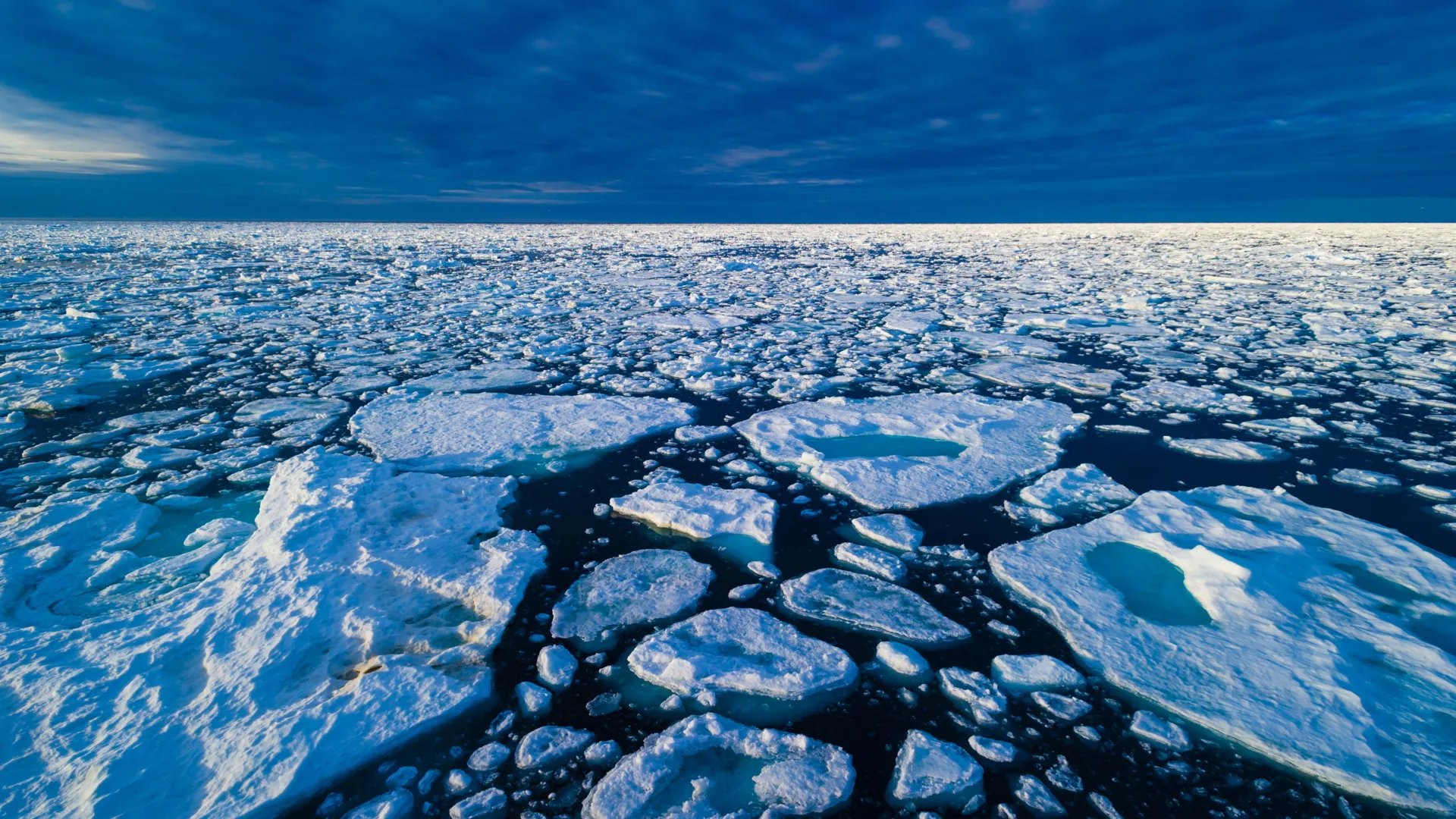
A team of scientists from UC Riverside and the University of Southern California has identified a previously overlooked mechanism affecting Arctic sea ice movement. Rather than responding predictably to wind forces, Arctic sea ice—which consists of separate floating slabs called floes ranging from meters to kilometers in width—exhibits motion patterns that traditional wind-based models cannot fully account for. The new research, led by Bryan Shaddy and involving materials scientist Alex Greaney and mechanical engineer Bhargav Rallabandi, proposes that repeated collisions between neighboring ice pieces explain much of this discrepancy.
To investigate this hypothesis, the research team developed a computer simulation treating ice floes similarly to grains moving through a silo, with the key difference that these floes float on water and are pushed by turbulent winds. The model incorporated ocean drag and collision dynamics between floes. When tested against actual measurements from the Fram Strait—a region between Greenland and Svalbard where substantial Arctic ice moves toward the Atlantic—the simulation successfully reproduced three previously difficult-to-explain observations: the rate at which sea ice spreads, the velocity range of individual floes, and how ice movement changes over timeframes from hours to days.
The researchers determined that collisions carry significant weight in tightly packed Arctic ice fields, where individual floes collide with neighbors more frequently than wind forces change. Each collision dissipates energy supplied by wind and limits how far a floe travels before striking another piece. This repeated interaction prevents the ice from simply accelerating and dispersing in response to wind, as simpler models would suggest.
The findings could eventually refine climate models and forecasts of sea ice transport as Arctic conditions continue evolving. The physics-based framework connecting local interactions between floes with large-scale ice movement patterns may help scientists explore questions about how changing ice conditions might affect the spread and melting of floes. Additionally, the underlying principles appear applicable to other systems involving objects colliding while subject to unpredictable forces, such as avalanches, landslides, and particle-filled materials used in 3D printing.
Article Attribution | Read More at Article Source
Article summary produced by Claude AI