

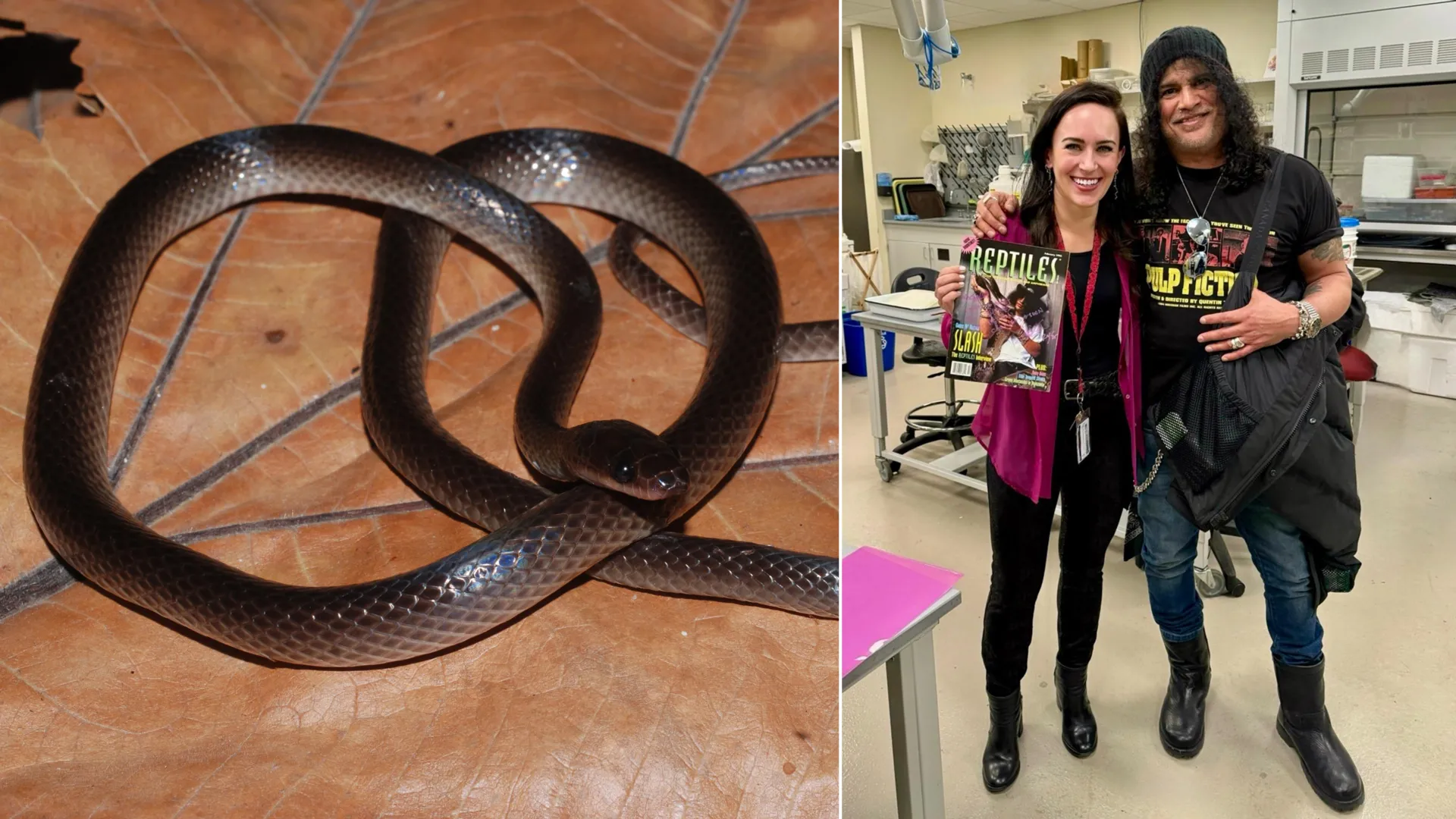
Scientists at the Field Museum have formally identified a previously unknown snake species from New Guinea and designated it Lielaphis slashi, commonly called Slash’s groundsnake, in recognition of the musician’s documented interest in herpetology and wildlife conservation. The reddish-brown snake measures approximately 28 inches in length and was first encountered during fieldwork on the island in 2006 by Chris Austin, a curator at Louisiana State University’s Museum of Natural Science.
The naming decision reflects the professional connection between the research team and Slash’s long-standing advocacy for zoos, museums, and natural history preservation. Sara Ruane, the Field Museum’s Associate Curator of Herpetology and lead author of the study published in Zootaxa, was inspired by Slash’s public support for these institutions and his childhood interest in reptile observation. Ruane noted that Slash’s documented enthusiasm for the natural world aligned with the scientific community’s values regarding species documentation and conservation.
Genetic and morphological analyses confirmed the species’ distinctiveness from related snakes in the same genus. Researchers employed cutting-edge genetic sequencing alongside physical characteristics, including scale count variations, to establish L. slashi as a separate species. Ecological modeling further indicated that this snake occupies a different habitat preference compared to similar species in its genus.
Little is currently known about the behavior and feeding ecology of Slash’s groundsnake. Based on anatomical features, researchers suggest the species may feed on small lizards and reptile eggs using enlarged teeth positioned in the rear of its mouth. The snake presents no venom threat to humans. However, the habitat supporting this species faces pressure from agricultural development and mining operations, making species documentation critical for conservation planning and ecosystem understanding in New Guinea’s biodiverse tropical forests.
Article Attribution | Read More at Article Source
Article summary produced by Claude AI