

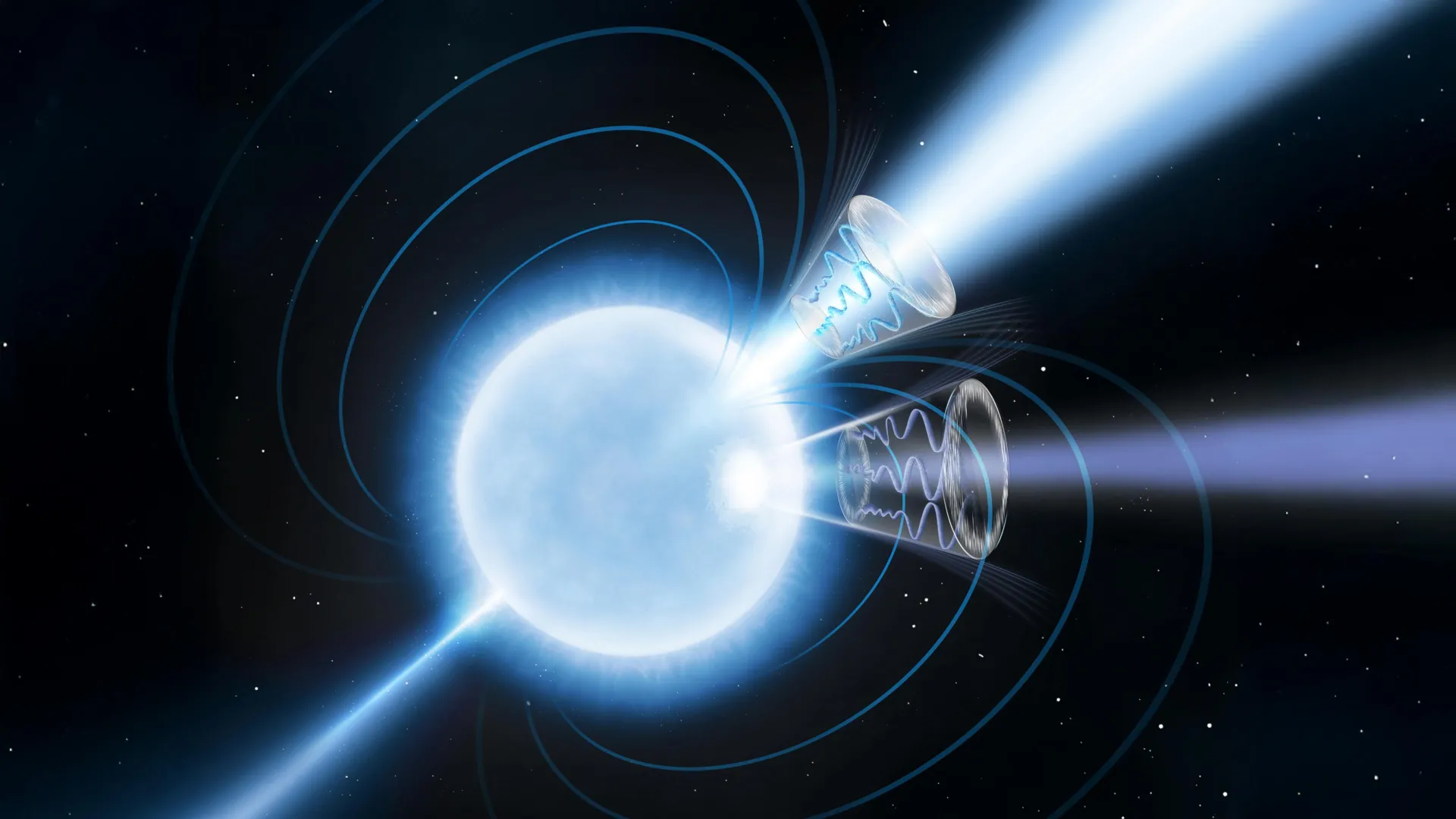
Researchers have potentially identified the first observational evidence of vacuum birefringence, a quantum effect predicted by physicist Werner Heisenberg in the 1930s. The phenomenon describes how seemingly empty space can alter the propagation of light when exposed to extraordinarily strong magnetic fields. According to the theory, a perfect vacuum contains virtual particles that briefly materialize and vanish, enabling them to influence electromagnetic radiation under specific conditions.
The research team, led by Rachael E. Stewart of George Washington University and involving institutions including NASA’s Goddard Space Flight Center, Los Alamos National Laboratory, and Swinburne University of Technology, studied the magnetar designated 1E 1547.0-5408. Magnetars are neutron stars possessing magnetic fields millions of times stronger than anything achievable in terrestrial laboratories. This natural phenomenon provides an ideal environment for testing quantum predictions that cannot be replicated on Earth.
The investigation utilized multiple observational tools, including the Parkes radio telescope operated by Australia’s CSIRO, NASA’s Imaging X-ray Polarimetry Explorer, and the NICER X-ray telescope stationed aboard the International Space Station. Researchers tracked how the orientation of radio and X-ray waves shifted as the magnetar rotated. The analysis revealed that both emission types maintained polarization aligned with the magnetar’s magnetic field, a signature consistent with vacuum birefringence occurring in the extreme environment.
The geometric configuration of the target magnetar proved particularly advantageous for the analysis. The alignment between the object’s magnetic axis and rotational axis, combined with the nearly pole-on viewing angle from Earth, created optimal conditions for detecting the predicted quantum effect. However, researchers emphasize that confirmation requires further observations and refined computational models to exclude alternative physical mechanisms that might produce similar signals.
If validated through additional study, this discovery would provide unprecedented insight into quantum physics under extreme conditions and establish a novel methodology for testing fundamental physical theories in cosmic laboratories.
Article Attribution | Read More at Article Source
Article summary produced by Claude AI