

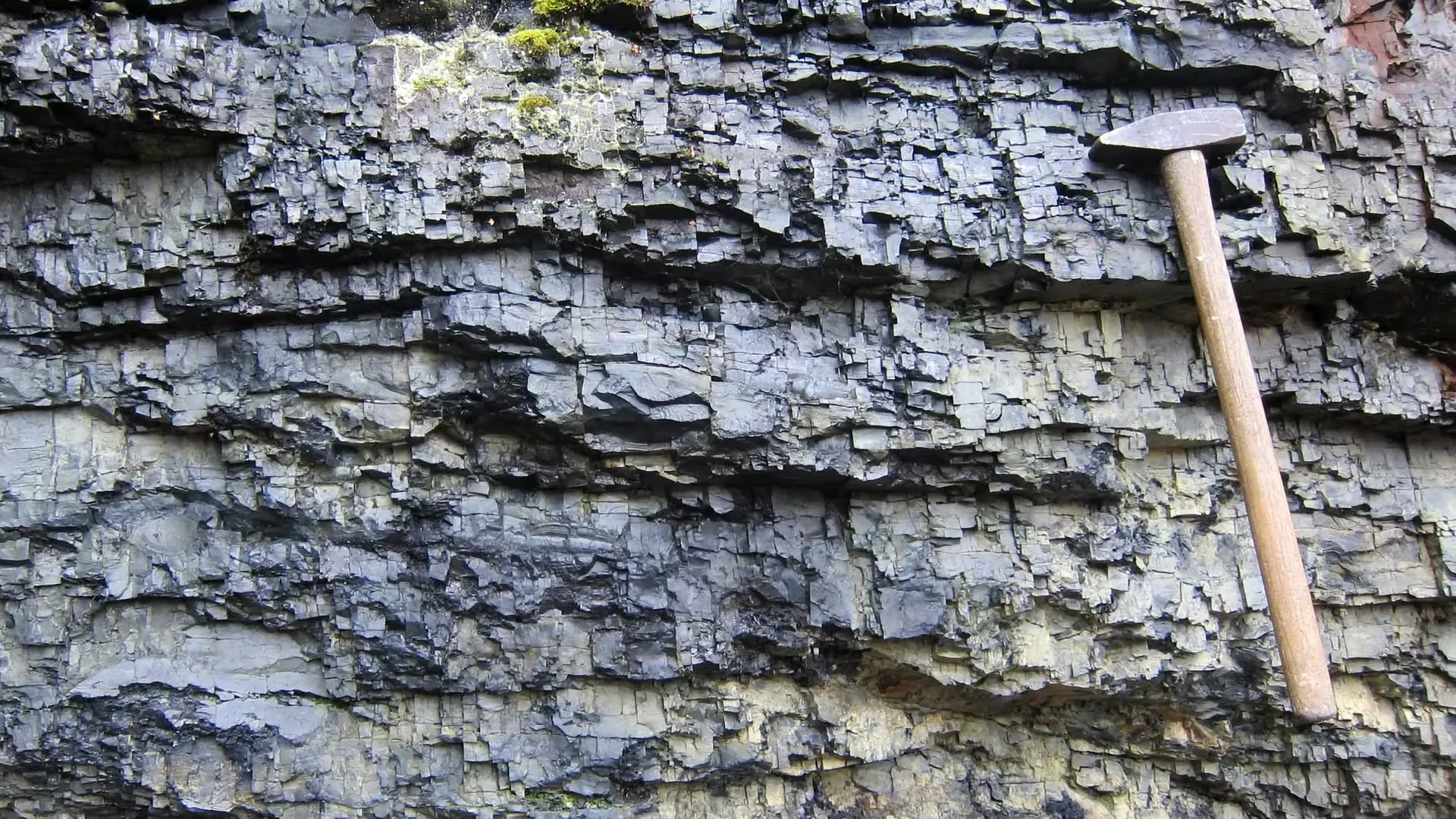
Researchers at Caltech and collaborating institutions are questioning the long-held interpretation of an unusual carbon-isotope signal preserved in ancient rocks from Russia and Gabon. The signature, known as the Shunga-Francevillian event, has been widely cited as evidence that Earth’s carbon cycle experienced a dramatic global imbalance around 2 billion years ago, during the period when atmospheric oxygen first began accumulating significantly.
A new study led by Caltech researchers examined drill core samples from the Zaonega Formation in Karelia, Russia, one of the world’s oldest known fossil oil fields. Rather than interpreting the carbon-isotope signal as a planetary-scale phenomenon, the team analyzed gases trapped within microscopic pockets in the rocks and developed an alternative explanation. Their analysis suggests that the unusual isotopic signature can be explained by localized geological and biological processes occurring within a sedimentary basin spanning several hundred square kilometers, rather than reflecting changes across the entire globe.
The researchers proposed that magma intruded through marine sediment layers, generating heat that warmed organic-rich materials and produced hydrocarbons including methane and propane. These gases migrated upward through the sediment where methane-consuming microbes near the seafloor processed the gases and generated organic material with a distinctive light carbon-isotope signature. This chain of processes, the team argues, could account for the anomalous carbon signal without requiring a global environmental disruption.
The findings do not completely rule out contributions from other processes, but they indicate that the Zaonega carbon-isotope anomaly was driven primarily by local events rather than worldwide disturbances. Because Zaonega serves as a reference site for the Shunga-Francevillian event, these results raise questions about whether the phenomenon should be considered a global occurrence.
Researchers plan to test whether similar local processes can explain the comparable isotope signal found in Gabon, analyzing samples from the GOE-DEEP drilling project to determine if geological and biological mechanisms identified in Russia also account for the Gabonese rock record.
Article Attribution | Read More at Article Source
Article summary produced by Claude AI