

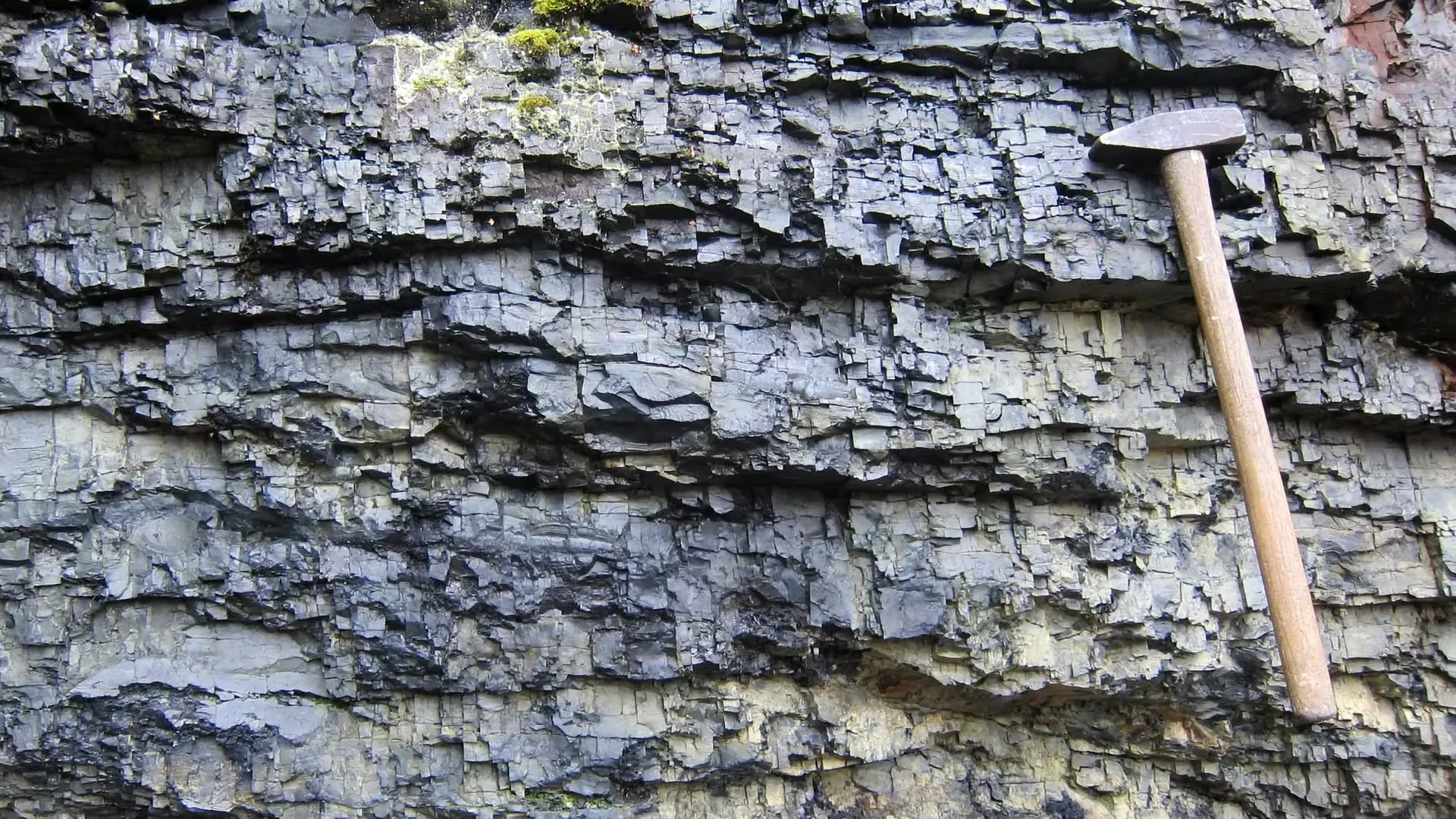
During the period roughly 2.5 to 2 billion years ago, Earth experienced its most significant chemical transformation when oxygen began accumulating in the atmosphere. This oxygenation event set conditions that eventually enabled the emergence of complex organisms. As oxygen levels rose, vast quantities of microbial material became buried beneath the seafloor, trapping carbon in rocks and producing an unusual isotopic signature that scientists have long interpreted as evidence of a dramatic global disruption to Earth’s carbon cycle.
Researchers from Caltech have challenged this interpretation by examining drill core samples from the Zaonega Formation in Karelia, Russia, one of the world’s oldest known fossil oil fields. The team analyzed gases trapped in microscopic pockets within these ancient rocks and concluded that the carbon-isotope signal at this key site can be explained by localized phenomena occurring within a several-hundred-square-kilometer sedimentary basin rather than across the entire planet. The unusual signal, known as the Shunga-Francevillian event, has been cited by many scientists as evidence of a worldwide environmental disturbance around 2 billion years ago.
The researchers propose that magma intruded through layers of marine sediment at the Zaonega Formation, generating heat that warmed surrounding organic-rich materials. This thermal activity produced hydrocarbons including methane and propane, which migrated upward through the sediment. Microbes living near the ancient seafloor then consumed this methane, producing biomass with a light carbon isotope signature that matches the unusual signal preserved in the rocks. Temperature measurements from the site support this scenario, with readings near the magma intrusion reaching approximately 350 degrees Celsius and declining with distance from the heat source.
The findings suggest that the carbon isotope anomaly at Zaonega was primarily driven by local geological and biological processes rather than by a global disturbance. Because Zaonega has served as a reference site for the Shunga-Francevillian event, these results raise questions about whether the event should be classified as a worldwide phenomenon. The research team plans to test whether the same local mechanisms can account for similar isotope signals observed in rock samples from Gabon.
Article Attribution | Read More at Article Source
Article summary produced by Claude AI