

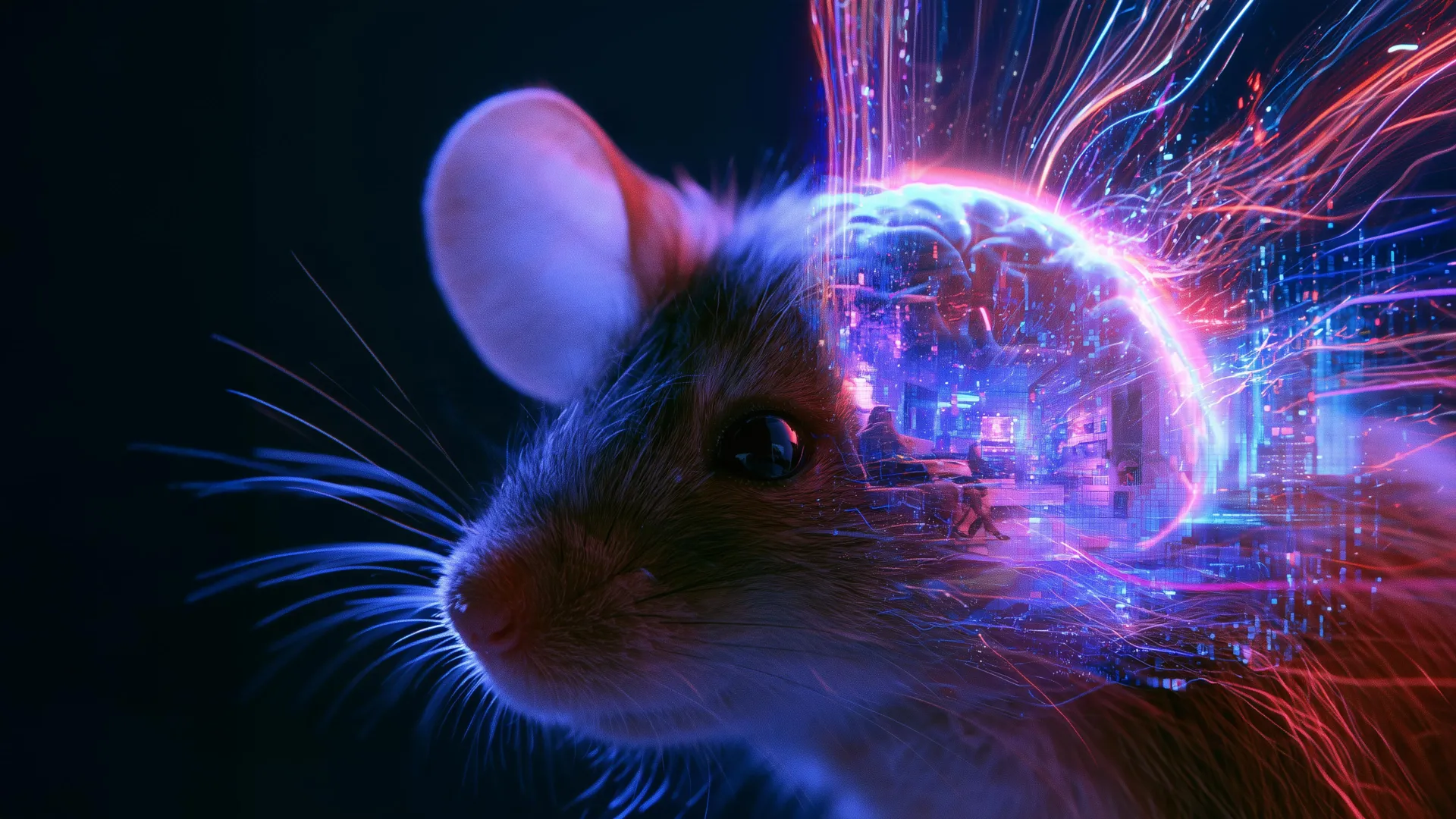
Researchers at University College London have successfully reconstructed video clips using only neural activity recorded from the brains of mice, a development that advances understanding of how the brain processes visual information. The study, published in eLife, demonstrates a methodology that differs from previous approaches by utilizing recordings from individual brain cells rather than broader imaging signals, allowing for more detailed analysis of visual representation in the brain.
The research team employed a dynamic neural encoding model to predict how individual neurons respond while mice watch movies, accounting for factors such as the animals’ movements and pupil diameter changes. Researchers recorded neural activity using a microscopic imaging technique that detects which brain cells are active by identifying localized calcium level increases. The team developed an algorithm that gradually adjusted pixels of a blank video frame until the reconstruction matched the actual movie shown to the mouse, based on the differences between predicted and measured neural activity.
To test the effectiveness of their approach, the scientists trained their model and then challenged it with brain activity recordings from mice watching videos not included in the training data. Using only this neural activity from an unseen video, the system successfully reconstructed 10-second movie clips. The accuracy of these reconstructions improved when data from more individual neurons were incorporated, indicating the method was identifying patterns in neural activity rather than simply memorizing previously observed videos.
The researchers evaluated their results using pixel correlation analysis, which compared individual pixels in original and reconstructed movies, finding only small timing differences. While current capabilities show promise, the team acknowledges significant room for improvement in image resolution and expanding the portion of the visual scene that can be reconstructed. Future research will focus on collecting data to support sharper reconstructions and broader visual coverage.
The longer-term goal of the research is to investigate how the brain’s internal representation of the world differs from external reality. Researchers note that vision involves continuous interpretation, filtering, and modification of sensory information rather than simple recording, and understanding where these changes occur could reveal fundamental principles about perception.
Article Attribution | Read More at Article Source
Article summary produced by Claude AI