

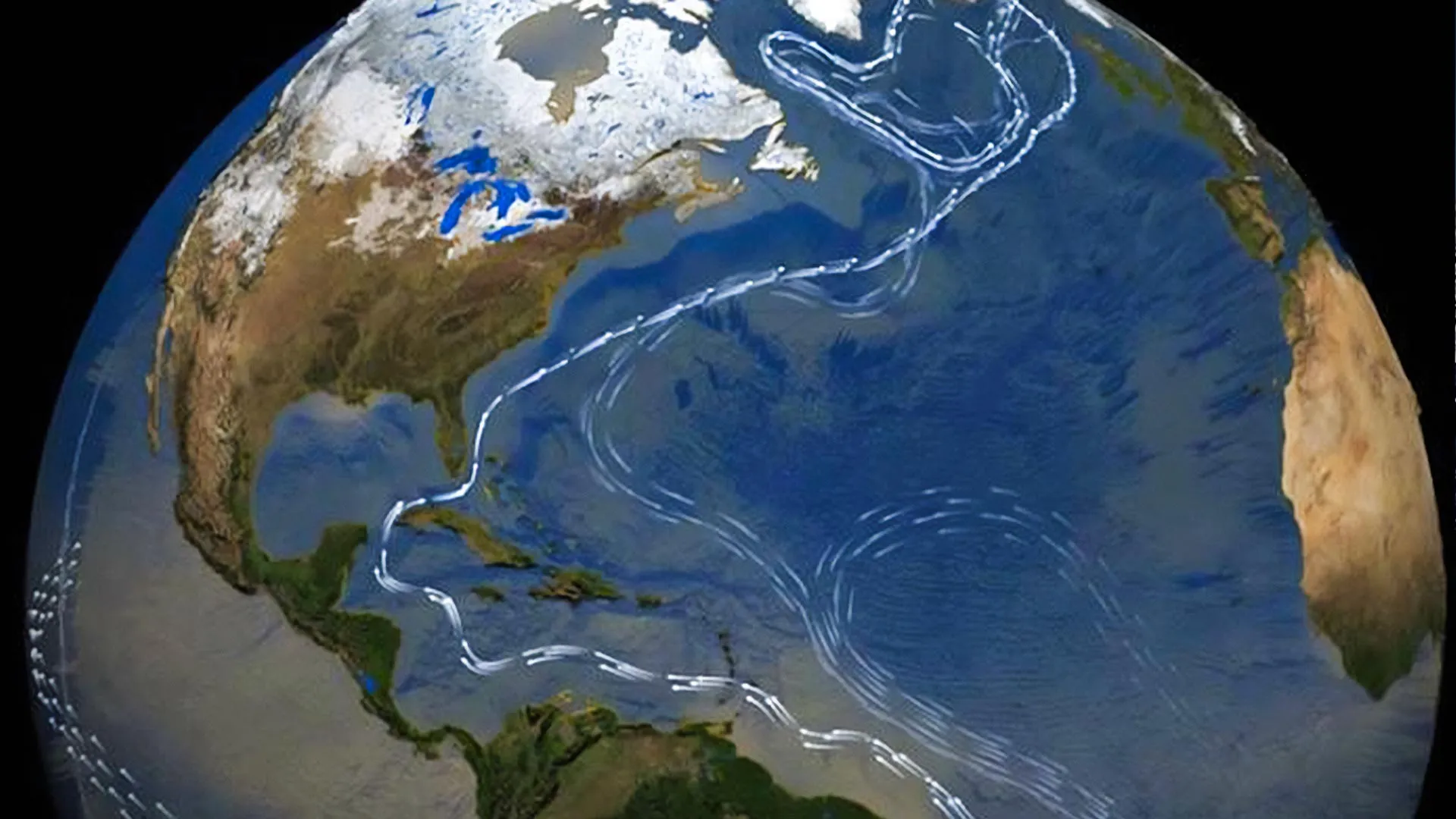
Researchers at the University of Miami Rosenstiel School of Marine, Atmospheric and Earth Science have documented a sustained decline in the Atlantic Meridional Overturning Circulation (AMOC), a vast system of ocean currents responsible for redistributing heat throughout the Atlantic basin. The new research provides direct observational evidence that this weakening pattern has persisted across a broad geographic region spanning multiple decades.
The AMOC operates by moving warm water northward at the ocean surface while transporting colder, denser water southward at greater depths. This heat redistribution mechanism plays a central role in regulating temperatures, rainfall patterns, sea levels, and weather conditions across regions bordering the Atlantic and beyond. According to Shane Elipot, a senior author of the study, a weaker AMOC could shift weather patterns, produce more extreme storms, alter precipitation, influence seasonal temperatures in certain areas, and affect coastal sea-level rise.
To conduct their analysis, the research team examined long-term observational data from four ocean monitoring arrays positioned along the western boundary of the North Atlantic, extending from tropical waters to higher latitudes. These anchored monitoring systems continuously measure pressure, temperature, density, and ocean currents at depths greater than 1,000 meters. By applying consistent analytical methods across all four locations and comparing measurements over time, the researchers identified a consistent pattern of decline in a key AMOC component spanning from approximately 16.5 degrees North to 42.5 degrees North latitude.
The geographic consistency of this weakening pattern across such a large area indicates a broad shift in Atlantic circulation rather than a temporary regional fluctuation. Scientists emphasize that such changes in AMOC strength can influence climate conditions far beyond the locations where the currents are measured. The findings suggest that monitoring the western boundary of the Atlantic could serve as an efficient early warning signal for broader shifts in this climate-regulating circulation system, comparable to a canary in a coal mine.
The study, published in Science Advances on April 8, was supported by grants from the U.S. National Science Foundation and the UK Natural Environment Research Council. Researchers indicate that long-term ocean observations remain essential for distinguishing temporary natural variability in ocean currents from persistent underlying changes, providing information that governments, businesses, and communities can use to prepare for future environmental conditions.
Article Attribution | Read More at Article Source
Article summary produced by Claude AI