

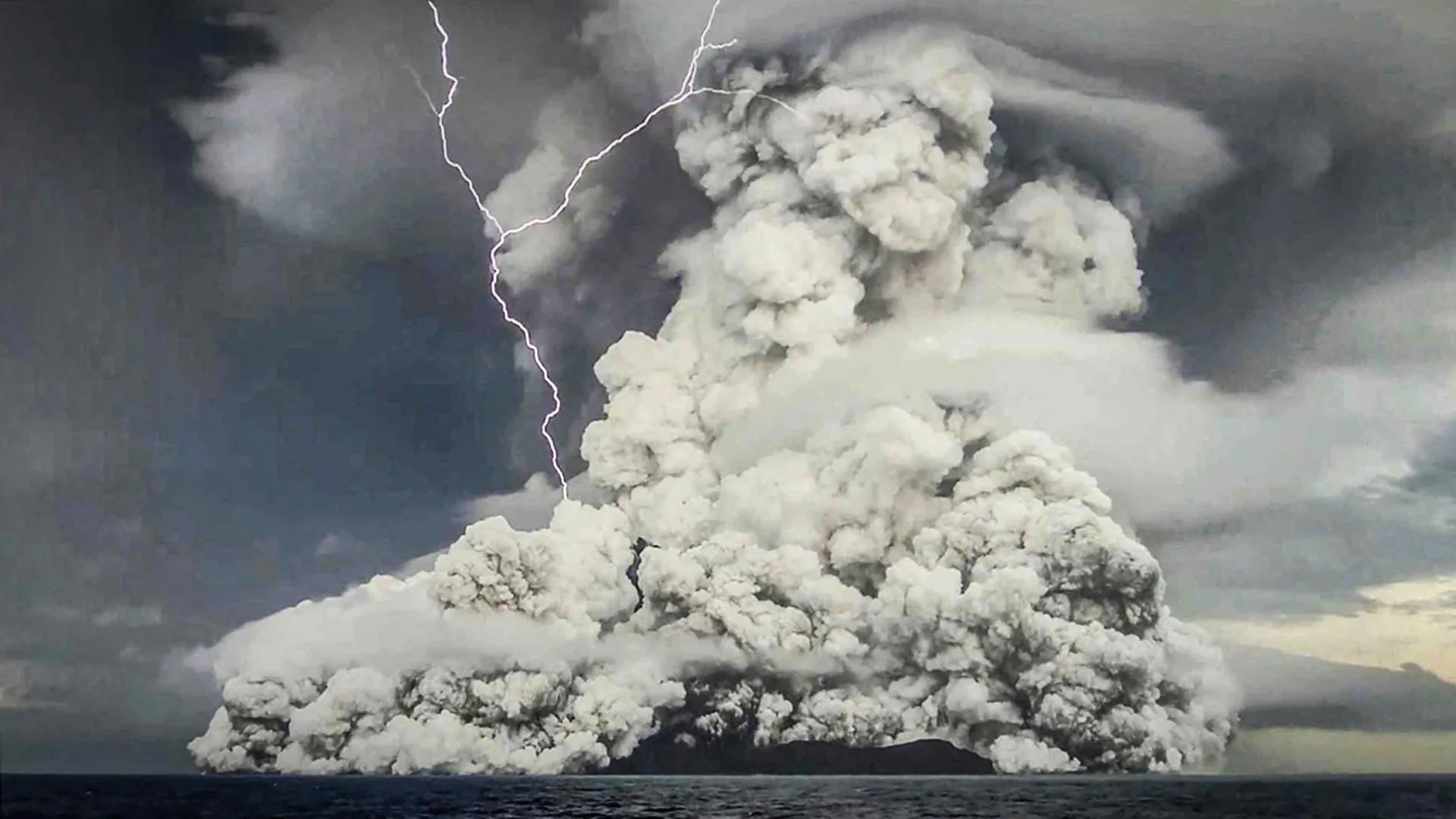
Researchers analyzing satellite data from the Hunga Tonga-Hunga Ha’apai volcanic eruption in January 2022 have identified an unexpected atmospheric benefit from the catastrophic event. The study, published in Nature Communications, found that the volcano’s enormous plume actively destroyed methane—one of the most potent greenhouse gases—while dispersing across the South Pacific toward South America over a 10-day period.
The discovery emerged through detection of unusually high formaldehyde concentrations in the volcanic cloud. Formaldehyde serves as a chemical indicator of methane breakdown, as it is produced briefly during atmospheric reactions that decompose methane. The sustained presence of formaldehyde suggested continuous methane destruction occurring within the plume. Scientists estimated the volcano released approximately 300 gigagrams of methane during the eruption, equivalent to annual emissions from over two million cattle. Simultaneously, the plume removed roughly 900 megagrams of methane daily—a quantity comparable to daily emissions from the same number of animals.
Researchers attribute the methane destruction to an unusual combination of volcanic ash, ocean salt, and sunlight. The mechanism involves volcanic ash mixing with seawater that was lifted into the atmosphere, creating iron salt aerosols. When sunlight strikes these particles, chemical reactions release highly reactive chlorine atoms that break apart methane molecules. This chemical process was previously documented in different atmospheric conditions involving Saharan dust and sea salt over the Atlantic Ocean, but its occurrence in a volcanic plume in the stratosphere proved surprising.
The findings carry significance beyond this single eruption, as methane accounts for approximately one-third of current global warming. Despite being far less abundant than carbon dioxide, methane traps heat approximately 80 times more efficiently than CO2 over a 20-year period. Methane’s relatively short atmospheric lifetime of about 10 years, compared to carbon dioxide’s longer persistence, makes it an attractive target for rapid climate interventions. Scientists describe methane reduction as an “emergency brake” on climate change, as lowering atmospheric methane levels today could produce measurable climate benefits within a decade.
The research may inspire development of technologies designed to artificially accelerate methane destruction in the atmosphere. However, challenges remain in verifying that such interventions actually remove methane from the wide atmospheric areas where it disperses. The satellite observation method employed in this study demonstrates one approach to measuring atmospheric methane reduction, potentially offering a model for evaluating future technologies.
Article Attribution | Read More at Article Source
Article summary produced by Claude AI