

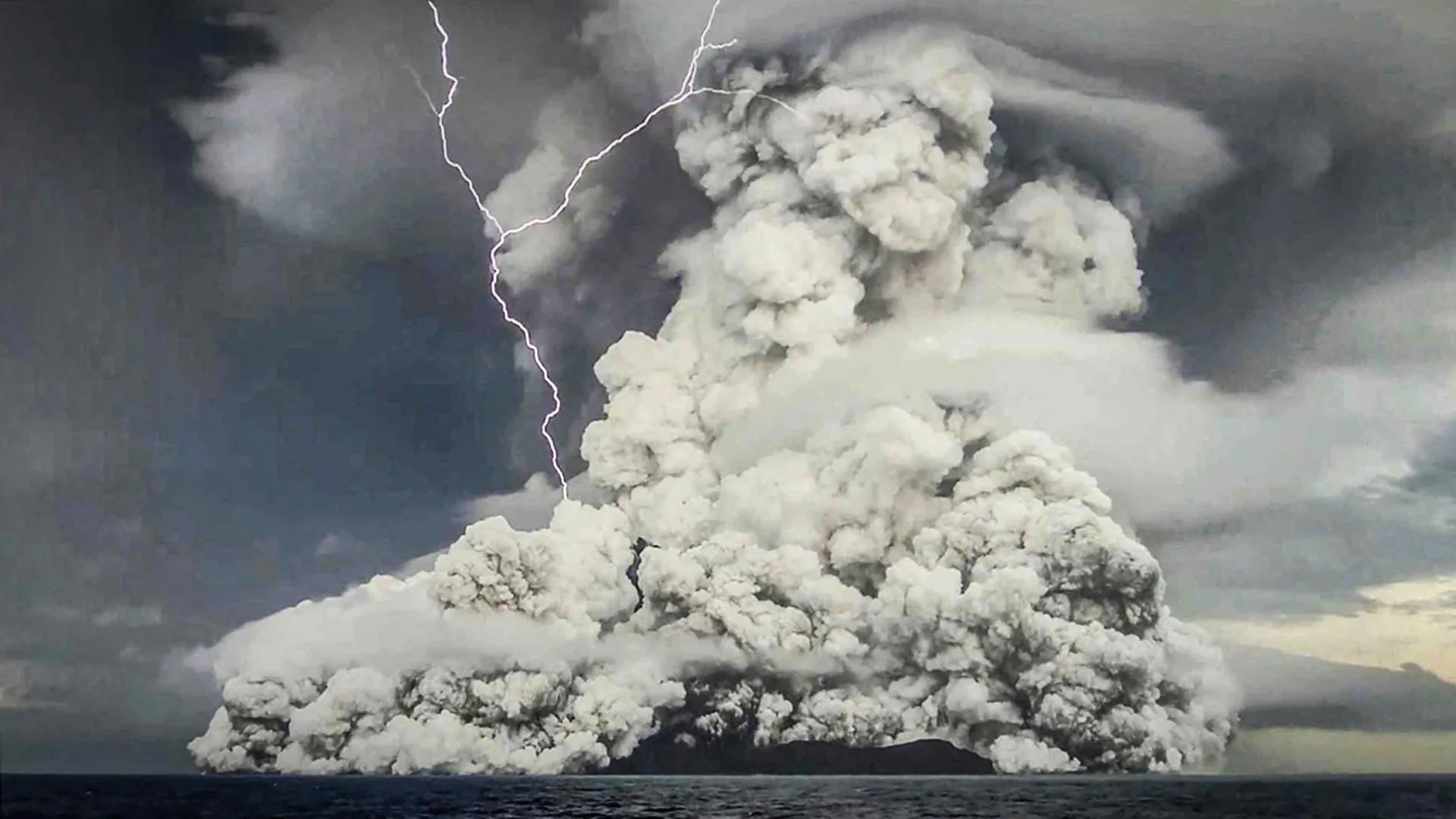
Researchers have identified an unexpected consequence of the Hunga Tonga-Hunga Ha’apai eruption in January 2022, a powerful volcanic event in the South Pacific. Analysis of satellite observations revealed that the enormous volcanic plume generated by the eruption appears to have facilitated the destruction of methane released during the event itself. This finding has drawn attention from the scientific community due to growing interest in reducing atmospheric methane, a potent greenhouse gas that dissipates more rapidly than carbon dioxide.
The discovery emerged through detection of exceptionally high formaldehyde concentrations in the volcanic cloud. Formaldehyde serves as a chemical marker indicating active methane breakdown, as it is produced briefly during reactions that decompose methane but persists for only a few hours. Researchers were able to track the cloud across a 10-day period extending to South America, with the sustained formaldehyde signal indicating continuous methane destruction for more than a week. The volcano released approximately 300 gigagrams of methane during the eruption—equivalent to annual emissions from more than two million cows—while the plume removed roughly 900 megagrams daily.
Scientists attribute the methane destruction to a combination of volcanic ash, seawater, and sunlight. The mechanism builds on research from 2023 showing that Saharan dust mixing with sea salt can form iron salt aerosols that release reactive chlorine atoms when exposed to sunlight. The Hunga Tonga eruption created unusually favorable conditions for this process. Because the volcano erupted underwater, it propelled large quantities of salt water and ash into the atmosphere, with some material reaching the stratosphere where sunlight-driven chemical reactions produced reactive chlorine that attacked methane molecules.
Methane currently accounts for roughly one-third of global warming and traps heat approximately 80 times more efficiently than carbon dioxide over a 20-year period. Unlike CO2, methane typically persists in the atmosphere for about 10 years before being chemically removed, making it an attractive target for near-term climate action. Researchers describe rapid methane reduction as an “emergency brake” on climate change, as lowering methane levels could produce measurable climate benefits within roughly a decade. The volcanic discovery could inspire research into deliberately accelerating atmospheric methane destruction, though significant challenges remain in measuring whether such methods actually function as intended.
Article Attribution | Read More at Article Source
Article summary produced by Claude AI