

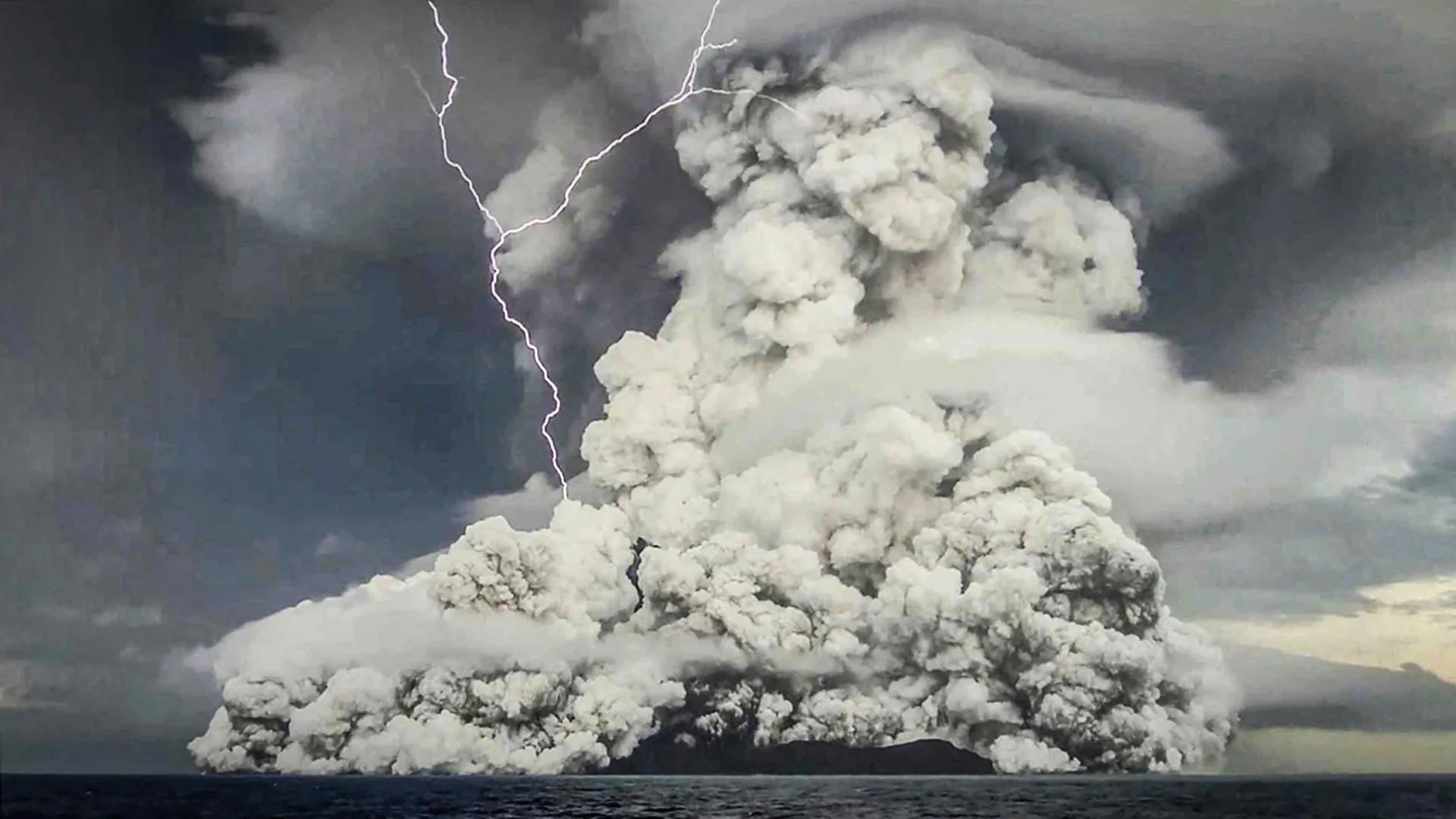
Researchers analyzing the January 2022 eruption of Hunga Tonga-Hunga Ha’apai in the South Pacific have identified an unexpected environmental consequence: the volcanic plume actively destroyed methane in the atmosphere. Using satellite observations, scientists detected unusually high concentrations of formaldehyde in the volcanic cloud, a chemical that signals methane breakdown is occurring. Because formaldehyde persists for only hours, the sustained high levels indicated methane destruction continued for over a week as the plume traveled across the Pacific toward South America.
The volcano released approximately 300 gigagrams of methane during its eruption, roughly equivalent to annual emissions from more than two million cows. Simultaneously, the plume removed around 900 megagrams of methane daily. Scientists propose the methane destruction resulted from an unusual combination of volcanic ash, seawater, and sunlight. When sunlight struck particles containing both volcanic material and sea salt in the stratosphere, chemical reactions released highly reactive chlorine atoms capable of breaking down methane molecules.
This mechanism parallels chemistry previously observed in Saharan dust crossing the Atlantic, where dust and sea salt aerosols similarly produce reactive chlorine. However, researchers expressed surprise that identical chemistry operates in the stratosphere under entirely different physical conditions than in the lower atmosphere. The underwater eruption’s unique characteristics—blasting enormous quantities of salty seawater and volcanic ash skyward into the upper atmosphere—created ideal conditions for this process.
The findings carry significant implications for climate research. Methane currently contributes approximately one-third of global warming and breaks down in the atmosphere roughly twice as fast as carbon dioxide. This relatively shorter atmospheric lifespan makes methane reduction attractive for near-term climate action. The discovery could inspire development of new technologies designed to deliberately accelerate methane destruction in the atmosphere, offering what researchers term an “emergency brake” on climate change. Scientists note that demonstrating effective atmospheric methane removal remains technically challenging, though the volcanic plume observations provide satellite-based evidence that such processes are measurable and verifiable.
Article Attribution | Read More at Article Source
Article summary produced by Claude AI