

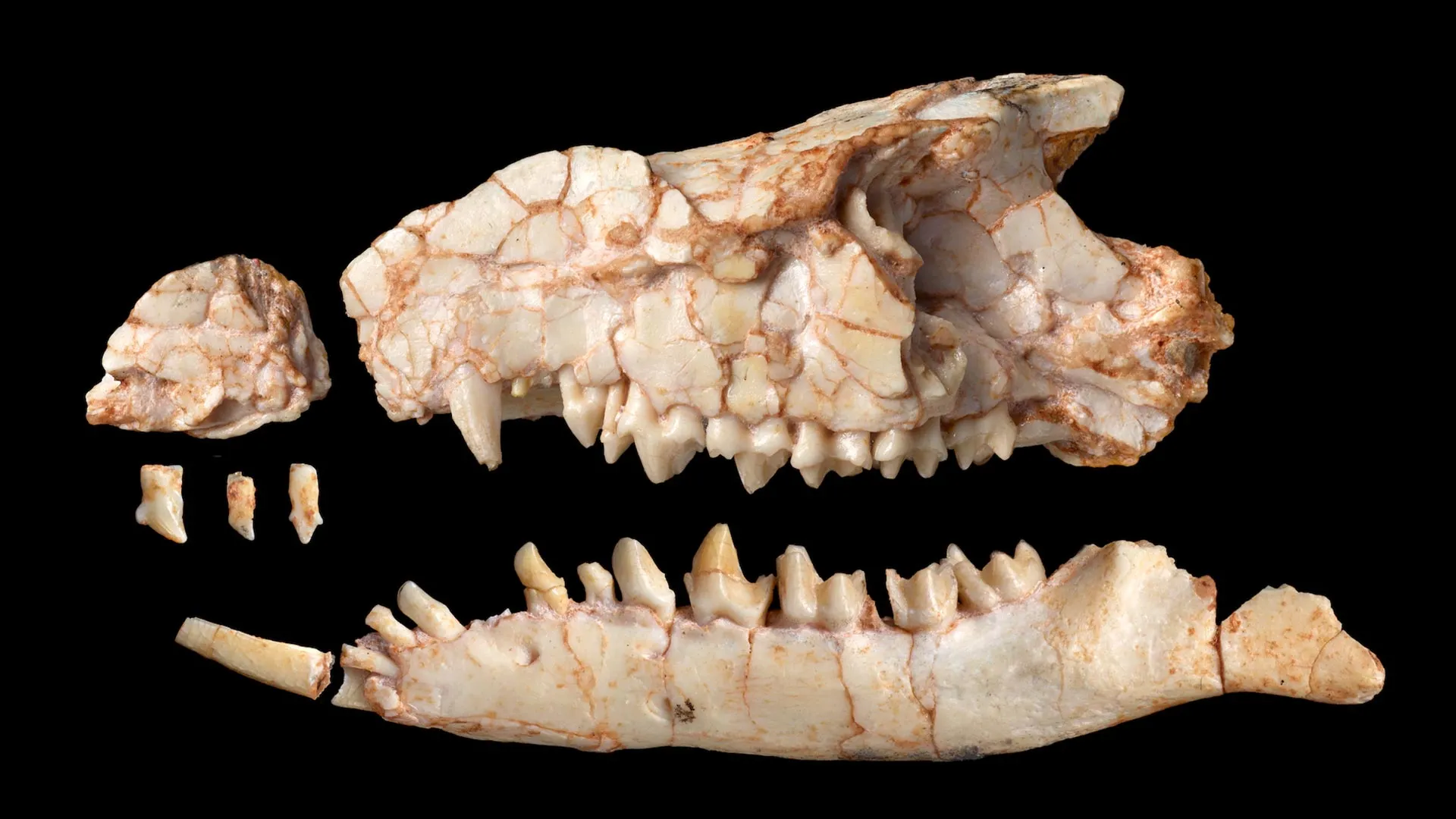
Paleontologists have revised their understanding of an extinct mammal group based on a remarkably well-preserved fossil discovered in Mongolia’s Gobi Desert. The specimen, identified as a new species called Tamirkhan balcarceli, was found during an expedition in 2004 and represents the most complete zhelestid ever recovered. The discovery challenges decades of scientific interpretation that had classified zhelestids as closely related to modern placental mammals.
For nearly 40 years, scientists based their classification of zhelestids primarily on isolated teeth and incomplete skeletal remains. The animals possessed low, rounded teeth specialized for plant-eating, which led researchers to propose various theories about their evolutionary relationships. Some scientists believed they represented an unknown group of hoofed mammals, while others debated whether they were early placental mammals or members of a separate evolutionary lineage that independently developed similar characteristics. Molecular studies had suggested that placental mammals may have originated before the end of the Cretaceous period, supporting the possibility that zhelestids belonged to this group.
The new fossil evidence points to a different conclusion. Researchers from multiple institutions examined the specimen and found that while Tamirkhan possessed the characteristic rounded teeth of zhelestids, it also exhibited other anatomical features that definitively linked it to zalambdalestoids, a group of small, shrew-like insectivorous mammals. Key identifying features included continuously growing incisors, distinctive skull characteristics, and notably slender hind legs with unique ankle structures typical of zalambdalestoids. These combined traits indicated that zhelestids were not closely related to placental mammals at all.
The discovery underscores the limitations of relying solely on dental remains for paleontological classification. The rounded teeth associated with zhelestids likely represent an example of convergent evolution, where unrelated animals independently developed similar traits while adapting to comparable ecological niches. Tamirkhan, which measured between 6-7 inches from head to tail with elongated hind limbs resembling those of modern rabbits, demonstrates how incomplete fossil records can lead to misinterpretation. The research employed MorphoBank, a comprehensive database of mammalian evolutionary relationships, to properly situate the species within the early mammal family tree, illustrating how advancing scientific tools combined with complete fossil specimens continue to refine understanding of mammalian evolution during the age of dinosaurs.
Article Attribution | Read More at Article Source
Article summary produced by Claude AI