

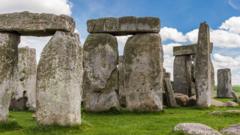
A team of archaeologists has identified what they believe to be a predecessor to the famous Stonehenge monument, located approximately 3 miles from the well-known prehistoric site. The structure, discovered in the village of Bulford, dates to approximately 5,000 years ago, predating Stonehenge by roughly 500 years. The site consisted of two wooden posts positioned 120 meters apart, estimated to stand between 2 and 4 meters in height. Both structures share a significant astronomical feature: their alignment with the Sun during the summer and winter solstices, the longest and shortest days of the year.
The initial discovery of the post holes occurred a decade ago when land was being cleared for military housing in Bulford. However, detailed analysis of the site’s celestial alignment has only recently been completed. Using advanced archaeoastronomical techniques, researchers reconstructed the position of the Sun as it would have appeared 5,000 years ago, confirming that the wooden posts were precisely aligned with sunrise on the summer solstice and sunset on the winter solstice.
Excavations surrounding the two main post pits revealed numerous artifacts that provide insight into the lives of the prehistoric inhabitants. Radiocarbon dating analysis, which measures the decay of a particular carbon isotope over time, established the site’s age. Among the discovered objects were pottery fragments, flint tools, animal bones used for digging, and a notably crafted disc-shaped Neolithic knife that may have held symbolic significance. The collection of artifacts suggests that organized gatherings took place at the location, indicating its importance to the community.
Experts suggest the Bulford site may represent the earliest phase of activity in the broader Stonehenge region. According to researchers, the people who built the initial stages of Stonehenge were likely based at or seasonally gathering near Bulford, possibly to coordinate construction efforts. The occupants were early agricultural communities whose survival and prosperity depended on the seasons and the Sun’s cycles. While modern visitors flock to Stonehenge primarily during the summer solstice, evidence suggests that the winter solstice held greater ceremonial significance for ancient peoples, potentially marking a critical period when communities sought to ensure the return of spring and the flourishing of crops and livestock.
Article Attribution | Read More at Article Source
Article summary produced by Claude AI