

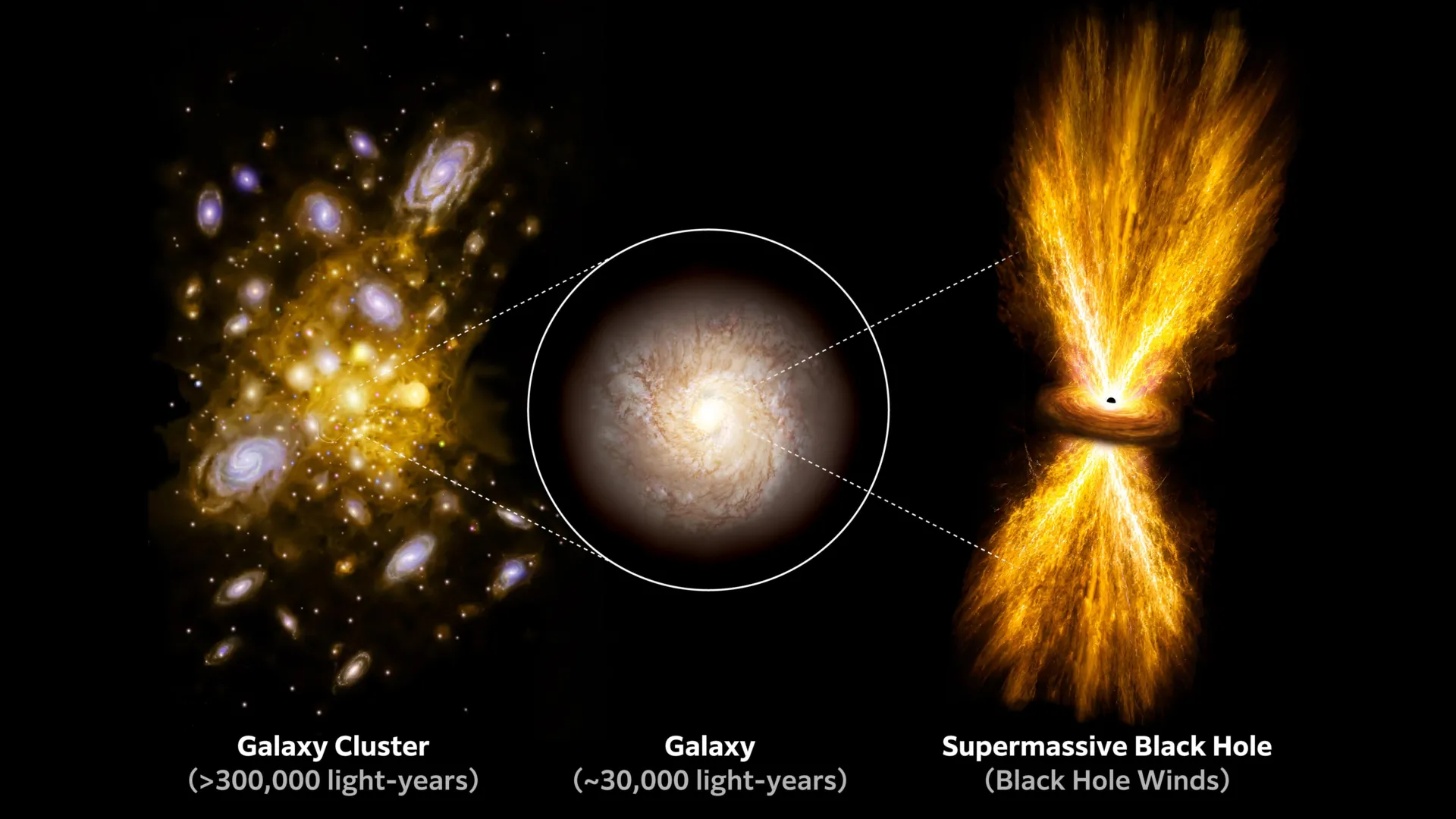
Researchers studying supermassive black holes have discovered that winds generated by these cosmic objects wield substantially greater influence over their surroundings than previously documented. Using the XRISM X-ray astronomy satellite, scientists analyzed the quasar H1821+643, located approximately 3.4 billion light-years from Earth in the constellation Draco. The investigation revealed that energy associated with black hole-driven winds measures about 100 times greater than earlier calculations had indicated.
While supermassive black holes are commonly understood to consume matter through gravitational pull, they simultaneously eject gas in powerful outflows. These winds were traditionally thought to remain confined within individual galaxies. However, the new findings demonstrate that the force extends far beyond such boundaries, reaching distances of approximately 300,000 light-years into surrounding space. The turbulent gas flow around the black hole at the center of H1821+643 creates measurable disturbances that propagate across a broad cosmic region.
The research team, led by Satoshi Yamada of Tohoku University’s Frontier Institute for Interdisciplinary Sciences and including collaborators from Kanazawa University and Tokyo Metropolitan University, analyzed X-ray emission produced by hot gas surrounding the black hole. By examining iron ion emission lines, researchers measured the motion of extremely hot gas in the vicinity of the supermassive black hole. The energy contained within this turbulent motion proved comparable to the output of several billion supernova explosions combined.
These findings suggest that supermassive black holes play a more expansive role in shaping the cosmos than previously understood. Rather than functioning solely as matter-consuming objects, they actively transport vast quantities of energy and gas throughout surrounding regions of space, potentially influencing the broader environments of galaxies and galaxy clusters. The research was published in the journal Nature Astronomy, with scientists indicating that future observations will continue clarifying how black holes affect their cosmic surroundings and facilitate the movement of matter and elements throughout space.
Article Attribution | Read More at Article Source
Article summary produced by Claude AI