

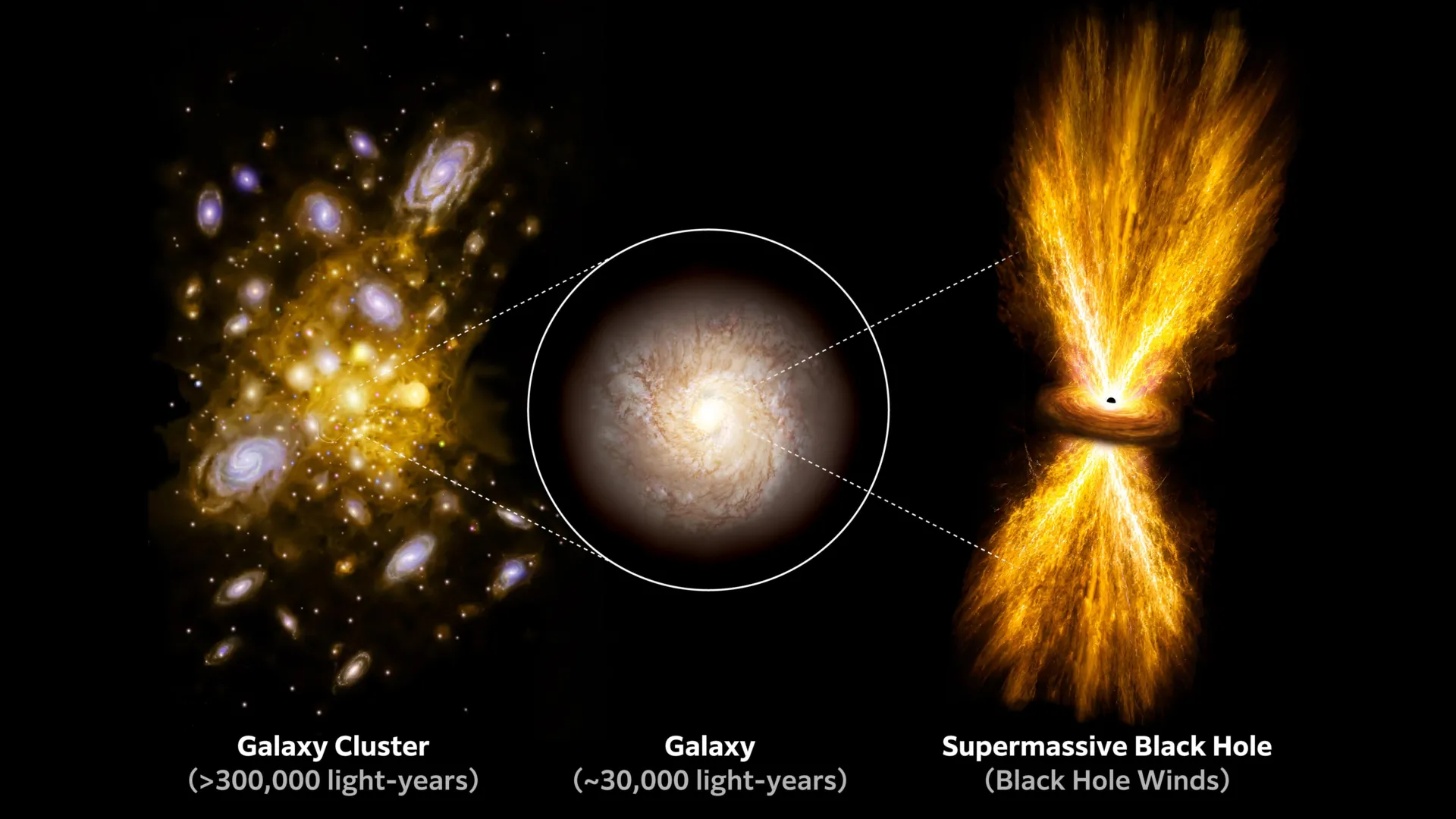
Research using the X-ray astronomy satellite XRISM has revealed that supermassive black holes exert significantly greater influence on their cosmic surroundings than previously understood. Scientists studying the quasar H1821+643, located approximately 3.4 billion light-years away in the constellation Draco, found that winds driven by these massive objects transport energy across distances of about 300,000 light-years, far exceeding the boundaries of their host galaxies.
The investigation, conducted by researchers from Tohoku University, Kanazawa University, Tokyo Metropolitan University, and other institutions, focused on analyzing the movement of extremely hot gas surrounding the black hole at the quasar’s center. By examining emission lines produced by iron ions, the team measured turbulence patterns in the gas located within a galaxy cluster. The high-precision measurements from XRISM demonstrated that rather than remaining stationary, the gas exhibits violent, widespread motion driven by the black hole’s influence.
The most significant finding was that the energy contained within this turbulent gas flow is approximately 100 times greater than earlier estimates. This energy level is comparable to the combined output of several billion supernovae, representing an extraordinary cosmic phenomenon. The gas flow extends well beyond the black hole’s original galaxy, indicating a scale of influence previously underestimated by the scientific community.
These findings suggest that supermassive black holes play a far more substantial role in shaping their cosmic environments than previously believed. Rather than simply consuming nearby matter, these objects actively distribute energy and gas throughout surrounding space, potentially influencing the development and characteristics of galaxies and galaxy clusters across vast distances. The research was published in the journal Nature Astronomy, with scientists indicating that future observations will provide additional insights into black hole dynamics and their effects on cosmic matter distribution.
Article Attribution | Read More at Article Source
Article summary produced by Claude AI