

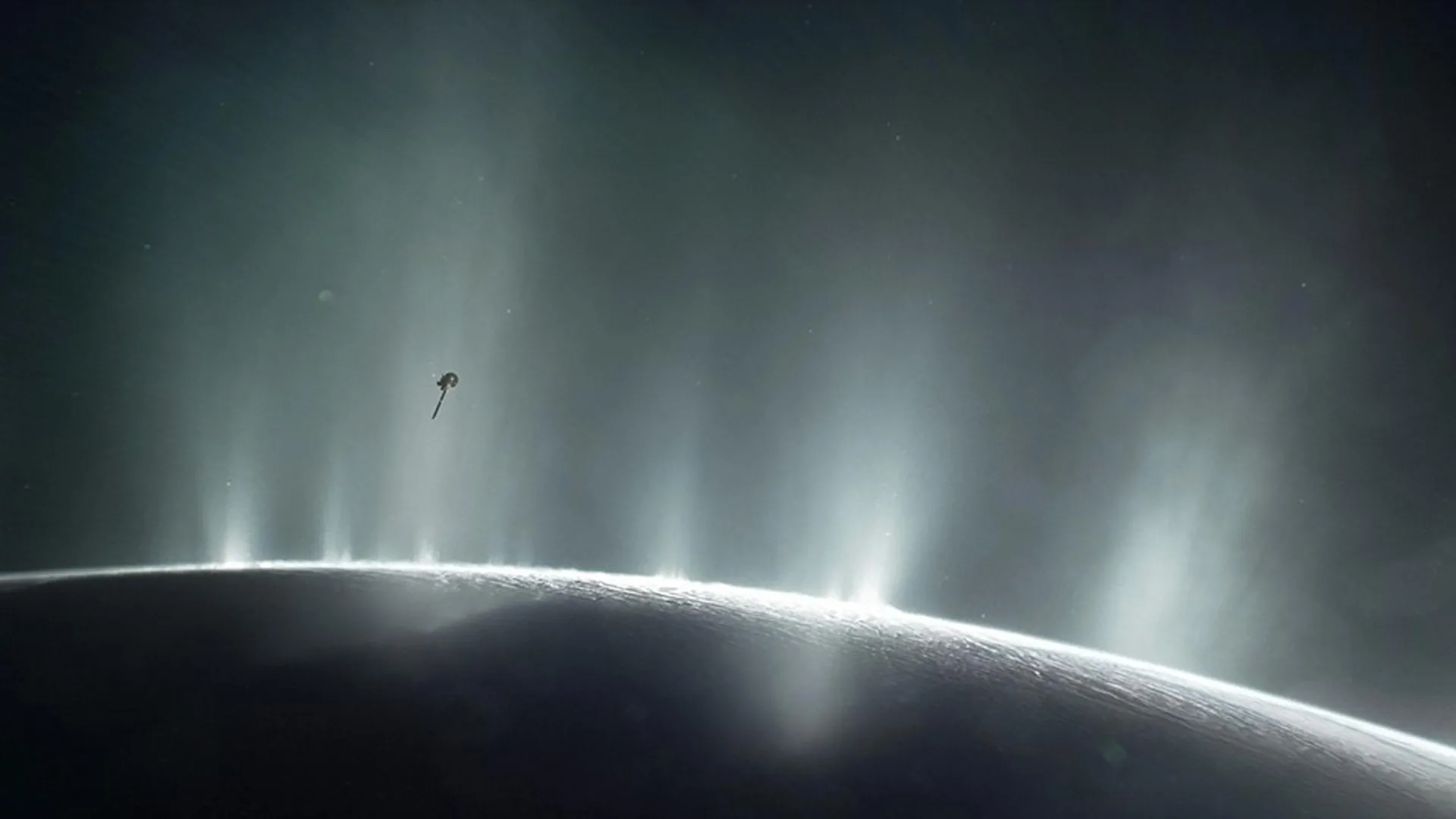
Researchers studying data from NASA’s Cassini spacecraft have identified an unexpected pattern in ice particles ejected from Saturn’s moon Enceladus. Between 2004 and 2017, the Cosmic Dust Analyzer measured individual particles in Saturn’s E-ring, which is continuously replenished by material from Enceladus’ south polar geysers. An analysis of 961 salt-rich particles showed dramatic variation in composition, with some enriched in sodium chloride while others contained higher amounts of carbonates, phosphates, or potassium chloride. Notably, chloride and carbonate rarely appeared together in the same particle, raising questions about how such diversity could arise from a single ocean.
To investigate this puzzle, researchers at the Earth-Life Science Institute conducted laboratory experiments freezing droplets containing the major salts believed to exist in Enceladus’ ocean. They discovered that the speed of freezing was critical. When droplets approximately 200 micrometers across froze slowly, at roughly 10 K per minute or less, different salts separated into distinct regions. Rapid freezing, by contrast, kept chemical ingredients evenly mixed. This finding suggested that the chemical diversity observed by Cassini could originate from a uniform ocean if droplets underwent slow freezing before breaking apart into smaller grains.
The results point to a more complex journey for ocean material than previously assumed. Rather than freezing quickly after ejection, droplets likely move slowly through underground vent systems, traveling complicated pathways through ice fractures while gradually freezing. As droplets move closer to the surface, conditions change and gases accelerate, causing frozen droplets to collide with icy channel walls at high speeds. These collisions fragment the droplets into much smaller pieces, each potentially derived from different salt-rich regions of the original frozen droplet.
Beyond explaining Cassini’s observations, these findings carry implications for future missions and the search for life. As droplets freeze and separate, compounds become concentrated in particular grains, potentially making detection easier than in bulk ocean samples. Brine pockets trapped between growing ice crystals can concentrate salts and organic compounds, conditions relevant to prebiotic chemistry. Since material ejected from Enceladus eventually falls back onto the moon, this freezing and concentration cycle may repeat multiple times, creating an environment potentially conducive to chemical processes that precede life.
Article Attribution | Read More at Article Source
Article summary produced by Claude AI