

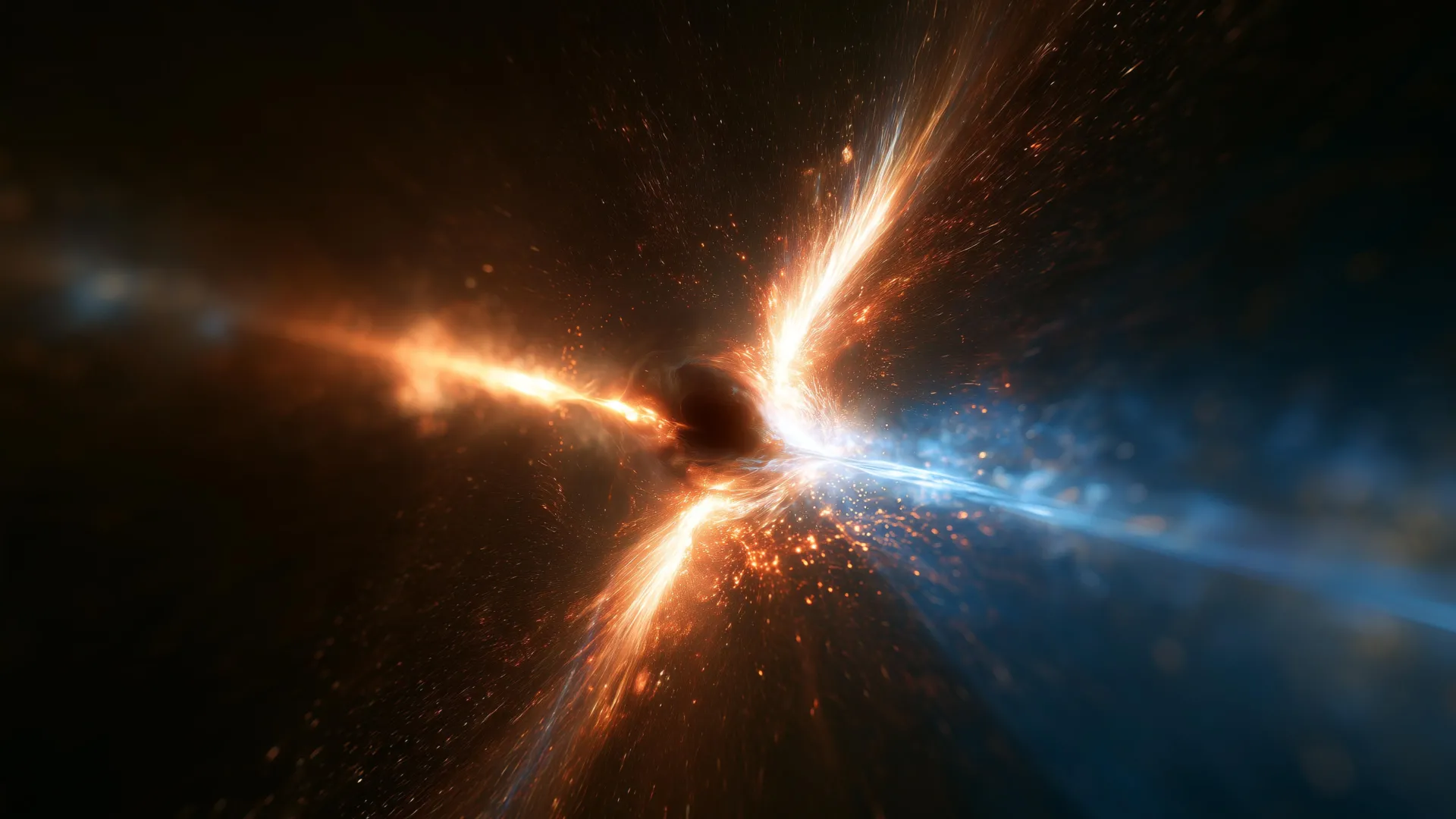
Physicists at UC Santa Barbara conducting research at the Large Hadron Collider have completed a search for microscopic black holes that would be extraordinarily small and short-lived. The investigation represented an effort to test whether such objects could be produced through particle collisions and potentially provide insights into quantum gravity and the unification of fundamental forces.
The search did not yield any evidence of quantum black holes. However, researchers emphasized that null results in particle physics carry scientific value by establishing exclusion limits. The findings indicate that if quantum black holes with specific properties existed, they would have been detected under the experimental conditions. This information contributes to narrowing the range of viable theoretical possibilities, with each negative result directing future research efforts toward unexplored areas.
The theoretical concept of producing quantum black holes at the LHC emerged roughly two decades ago. Physicists proposed that if extra spatial dimensions exist, as suggested in string theory, extremely high-energy collisions might create these objects. Unlike the massive astrophysical black holes found in space, quantum black holes would disintegrate almost instantaneously. The possibility has generated substantial interest because it could help explain the hierarchy problem—why gravity appears dramatically weaker than other fundamental forces—and might provide experimental access to quantum gravity effects.
Creating such black holes would require concentrating enormous energy into an exceptionally small region. The LHC accelerates protons to tremendous energies and collides them, allowing physicists to probe scales as small as 10-20 meters. Researchers theorized that if gravity were sufficiently strong at these tiny distance scales due to extra dimensions, the collisions could produce quantum black holes. Safety concerns about this possibility were addressed through comparisons with ultra-high-energy cosmic rays that naturally strike Earth without producing harmful effects. The results have been published in the journal Progress in High Energy Physics.
Article Attribution | Read More at Article Source
Article summary produced by Claude AI