

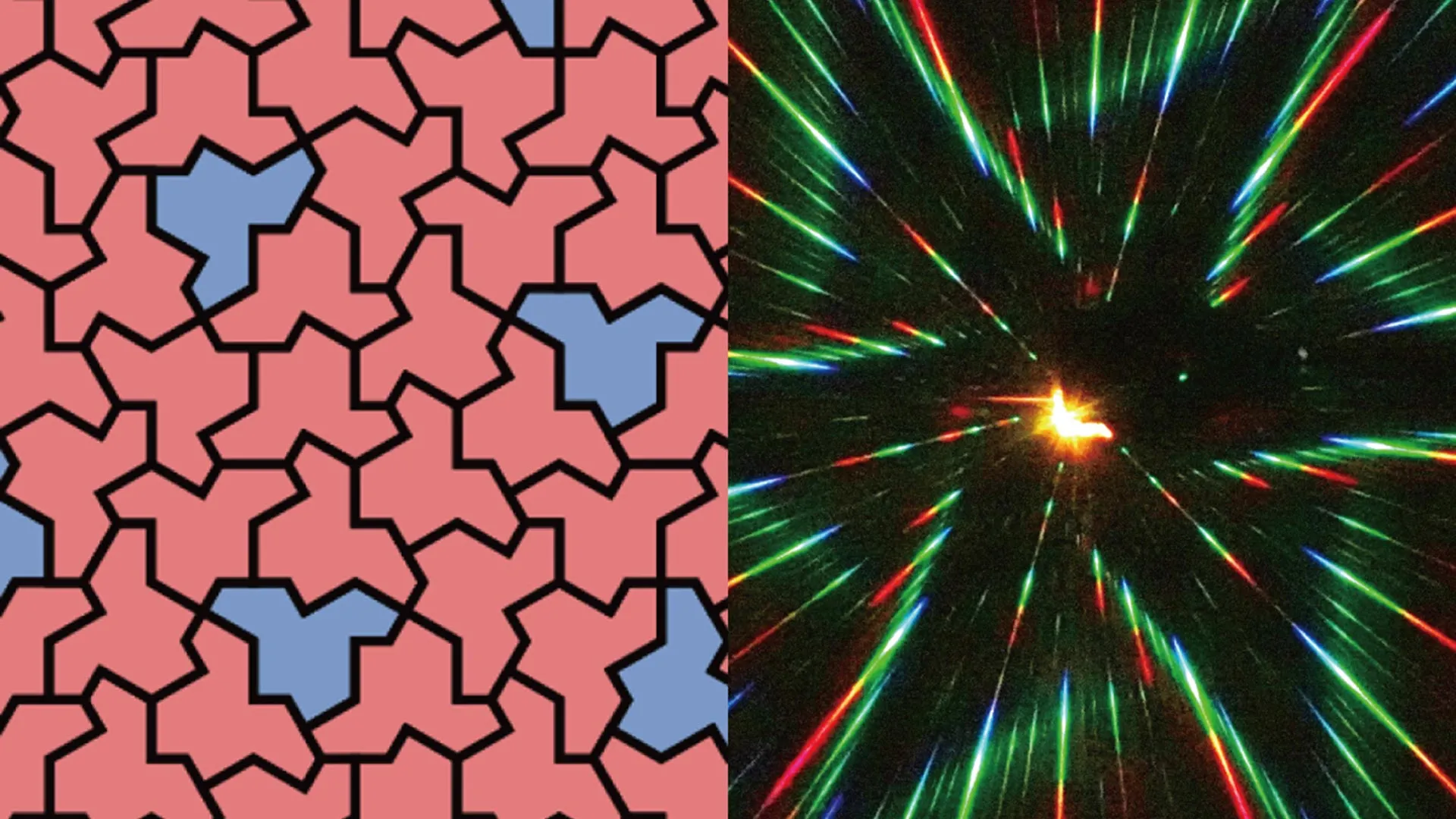
Scientists have demonstrated that nanoscale structures patterned after the Smith hat, a mathematical shape that solved the decades-old Einstein problem, can produce unique optical effects when illuminated with laser light. The work, published in Nature Communications by researchers from the Institute of Industrial Science at The University of Tokyo and collaborating institutions, shows that these structures exhibit diffraction patterns with previously unobserved chiral characteristics.
The Einstein problem, a long-standing mathematical puzzle, asked whether a single tile shape could cover an entire surface without creating a repeating pattern. In 2023, researchers identified the Smith hat as the first monotile capable of achieving this aperiodic tiling. The current study extends this discovery by exploring whether the shape’s geometric properties could generate unexpected physical phenomena when applied to optical systems.
The research team created nanoscale versions of the Smith hat pattern on silicon nitride films using electron beam lithography. Upon directing laser light at these structures, they observed distinctive diffraction patterns that displayed pinwheel-like formations and revealed chiral properties not typically seen in conventional quasicrystals. The optical response proved dependent on both the direction and polarization of incoming light, and when the physical structures were mirrored, their optical behavior reversed accordingly.
The findings demonstrate a direct connection between the geometric symmetries of the aperiodic pattern and how light behaves when interacting with it. This represents a new category of symmetry-controlled optical behavior emerging from the unique properties of monotile arrangements. Researchers suggest that structures inspired by monotile patterns could eventually support technologies for manipulating light and controlling polarization in advanced optical devices, illustrating how abstract mathematical solutions can lead to practical applications in physics and engineering.
Article Attribution | Read More at Article Source
Article summary produced by Claude AI