

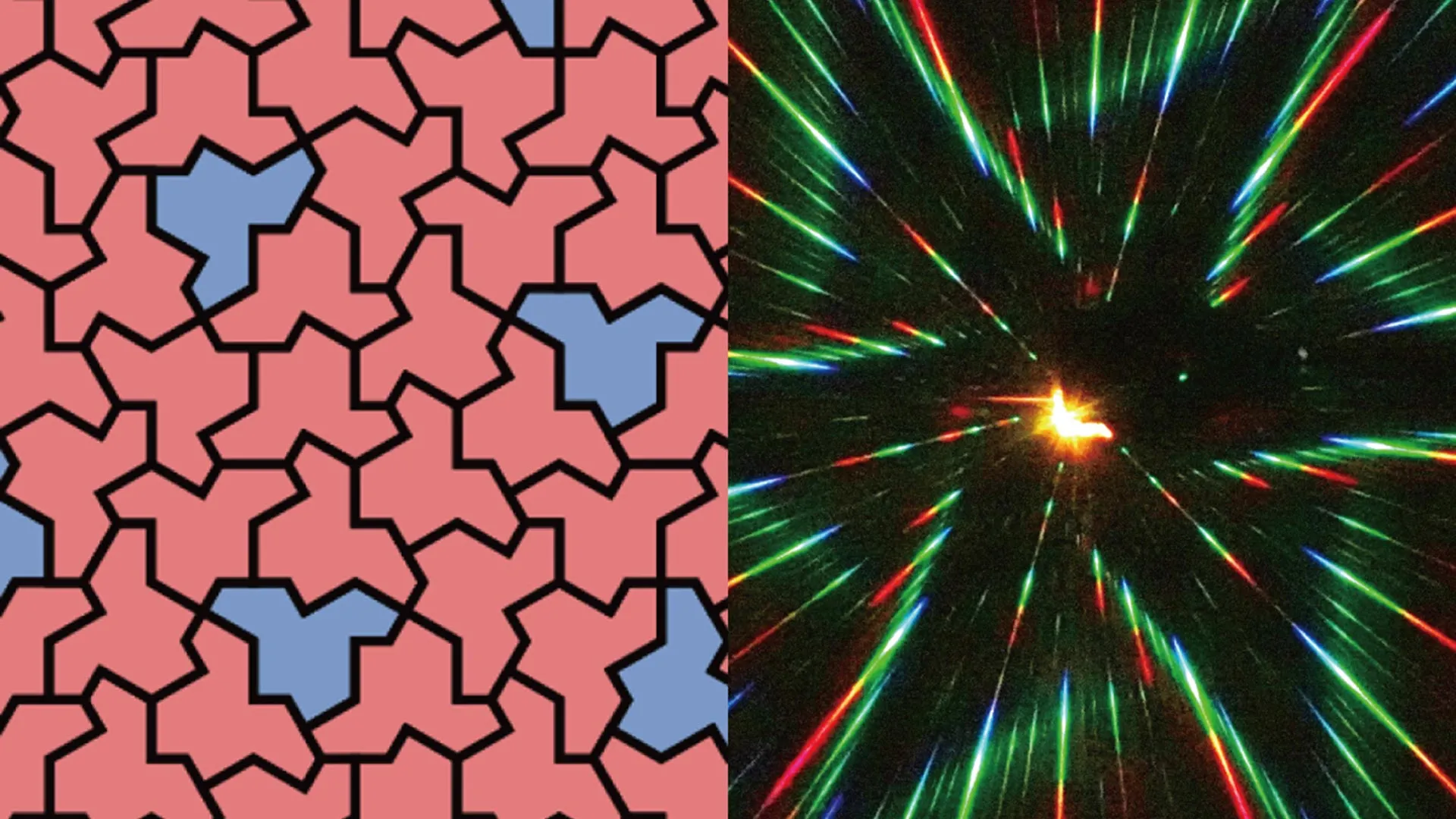
Scientists from the Institute of Industrial Science at The University of Tokyo and collaborating institutions have identified surprising optical properties in structures derived from the Smith hat, a mathematical shape that gained recognition for solving the Einstein problem. Their findings, published in Nature Communications, demonstrate that when laser light interacts with nanoscale versions of these patterns, it produces diffraction effects distinct from those observed in conventional quasicrystals.
The Smith hat represents a significant mathematical achievement as the first known monotile capable of covering a surface without creating a repeating pattern. Unlike familiar tilings such as checkerboards or honeycombs, which establish regular arrangements, aperiodic monotiles can fill space indefinitely while maintaining irregularity. Researchers created the optical structures using electron beam lithography on silicon nitride films and observed that illuminating them with laser light produced distinctive pinwheel-shaped diffraction patterns that revealed the chiral character of the aperiodic structure.
Chirality, referring to the handedness property where a structure and its mirror image cannot be perfectly matched, emerged unexpectedly in the optical response. The aperiodic arrangement of the monotile pattern caused light itself to display chiral behavior. The team also found that diffraction patterns varied depending on the direction and polarization of incoming light, and when the physical structures were mirrored, their optical responses reversed correspondingly. This demonstrated a direct connection between the underlying pattern’s symmetry and the light’s behavior.
The researchers suggest that structures inspired by monotile patterns could eventually support technologies designed to manipulate light, control polarization, and develop advanced optical devices. The findings illustrate how a discovery originating from abstract mathematical inquiry can produce unexpected practical applications in physics and optics research.
Article Attribution | Read More at Article Source
Article summary produced by Claude AI